Where's our doctor, dentist, new school? The sprawling Glasgow suburb lacking basic amenities

 BBC
BBCWhen Alana Muir was a child growing up in the Glendale estate of Glasgow's Robroyston area, she could look out the windows of her house and see green space everywhere.
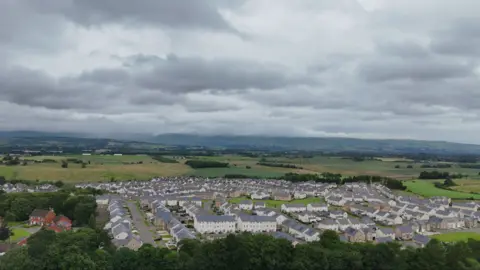
Forty or so years later, Alana still lives in the area. Her view, however, is of houses - lots and lots of them.
Since the 1990s Robroyston has exploded in terms of housing, with more and more families coming to live there. The problem for locals old and new, however, is that nothing else has accompanied them.
"It's just houses and houses", sighs Alana. "We have no doctors, no dentists, hardly any sports facilities - and there's hundreds more houses on the way."
For many years Robroyston was mostly farming land, and best known as the location where William Wallace was betrayed and handed over to English soldiers in 1305.
It later was home to Robroyston hospital but after it shut in the 1970s, housing developments started to appear on the land - slowly at first, with Glendale in the 1980s, and then rapidly from the late 1990s onward.
In 2009 the city council identified Robroyston and nearby Millerston as a community growth area, complete with a masterplan to bump up housing and infrastructure accompanying this.
About 1,600 homes were listed, although the city council now estimate the final number will end up at about 2,000, due to extra homes outside the masterplan also being built on land there.
Several residents contacted BBC Scotland's Your Voice to express frustration over the housing expansion not being accompanied by anything else.
Betrayal on the scale of what happened to Wallace would be an exaggeration, but there is evident disappointment among people living there over what they see as broken promises from housing developers who have built there.
"This area is bursting at the seams, but none of the benefits from so many people moving in has resulted in anything going back into the actual community," says Eamonn McCloskey, who has lived there for several years.
"They sold houses on the basis of schools, shops and amenities coming in. Essentially we have the opposite problem to nimbyism in that we are desperate for anything in our backyard."
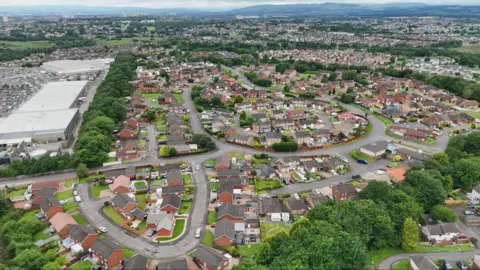
Eamonn and Alana are among a group of residents sitting in a coffee shop in the area's retail park - built about 30 years ago and one of the few additions to Robroyston that is not just housing.
The surge in housing, many of which are bought by expanding families with young children at a time when Glasgow is facing a housing emergency, has led to practical problems.
Alana's son Ethan still does not have a secondary school to attend after the summer holidays end.
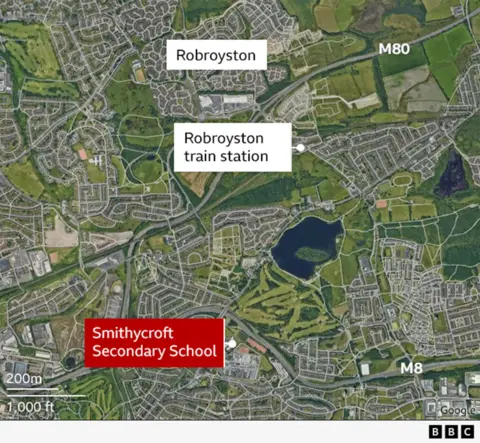
Robroyston's only non-denominational secondary school is Smithycroft, and Glasgow City Council have previously stated the area does not need another.
However the school is about three miles away from Alana's home, and her job as a nurse - and its shift patterns - means she cannot always drive her son to school.
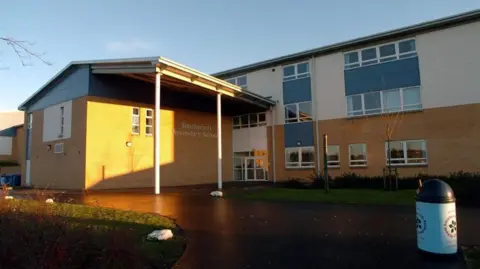 Smithycroft Secondary School
Without a car, options are limited - there are no cycle lanes going towards the school and there is only one bus that goes near there, making numerous stops.
Alana and other parents have been told their children should walk there instead, which she estimates as a 90 minute trip that goes past a graveyard - where warning signs say kids should not be unsupervised going through it for safety reasons.
"A walk like that will affect his education. There needs to be better transport to actually get children to Smithycroft - it isn't safe at all to get there without it.
"Where are all the new children going to go that are moving in here?"
All Saints Secondary in the neighbouring Barmulloch area is much closer to Alana's home, but she has been unable to secure a place for Ethan there with demand high.
Glasgow City Council estimate the walk to Smithycroft as being about 45 minutes, and suggested the No 8 bus service as an alternative.
It is hourly in the afternoons and the council said it had asked operators SPT if more frequents services were possible, but were told there was not enough demand to justify it.
One particular irritation for many people who spoke to BBC Scotland News is how Glasgow City Council uses section 75 money - a scheme where the local authority receives around £15,000 per new home from developers.
The money then goes towards surrounding infrastructure and facilities, but much of that money went into building Robroyston train station, which opened in 2019, with the idea it would help connect the region to other parts of the city.
However the project cost considerably more than expected and locals say there is no transport options to actually get people from their homes to the train station.
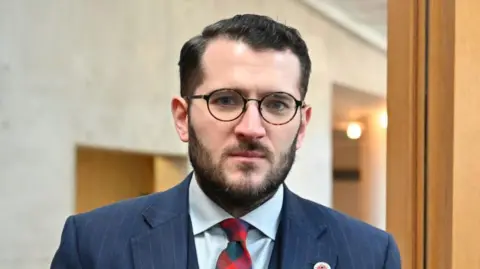
Glasgow list MSP Paul Sweeney wearily agrees with this take.
"The train station has really soaked up the community growth fund money," he says.
A total of £5.4m of funding remains though, which will increase as more homes are sold.
 Getty Images
Sweeney says the issues with the development of Robroyston can be traced back to the 1990s and the break-up of Strathclyde Regional Council.
This saw Robroyston fall under Glasgow City Council and the likes of nearby Bishopbriggs come under East Dunbartonshire Council.
"Someone in the 1990s drew a line down Auchnairn Road and now there is an arbitrary split.
"If you look at somewhere like Sighthill in Glasgow there is a masterplan where things like shops and a GP surgery are all baked in.
"Here, it's been incoherent for 30-odd years and been left to the developers."
BBC Scotland News contacted many of the developers working across the area.
Taylor Wimpey West is involved with about 400 homes in total, across different developments. It said it worked "closely and constructively with Glasgow City Council and key stakeholders" to fit within the planning framework.
Amenities will include a tennis court and an "enhanced central community space".
Avant Homes is currently constructing 109 homes as part of a development called Darroch Fields. It has planning permission secured for a further 470 homes, ranging from two bedrooms up to five.
It said it paid money into the council's Section 75 and ENV2 funds to be used on projects like the train station.
Park Lane and Beltway Homes are working on a development of 256 homes, from three bedrooms up to five.
Beltway said the project brought benefits like improvements to the M80 motorway, and the wider development would include local amenities - once again citing Section 75 money.
A spokesperson for Glasgow City Council said discussions over the area's infrastructure remain ongoing as the various housing developments are built.
He added there was a recognition community facilities were needed in the new housing plans, but adding the likes of doctors, dentists or shops were dependent on private businesses or the NHS.
'Robroyston is just a monster now, it's too big'
However there is an obvious solution that some people in Robroyston have started to take while waiting - leaving the area entirely.
"People are choosing to leave", says Jillian Davis, who moved to Robroyston in 1998 and feels she has been raising the same issues with the city council for years.
"My daughter was born here, brought up here and likes the area but has moved to Moodiesburn, and that's because she can get far more there in terms of facilities than here.
"We are more remote than the Highlands."
Local councillor Thomas Rannachan believes adding infrastructure would help, at least in the short-term.
"Whether that's buses to make it easy to reach the train station or cycle lanes," there needs to be something beyond houses.
"Robroyston is just a monster now, it's too big. People here aren't asking for much - they just want basic things you would expect pretty much anywhere in the country."

