Farmers struggling to plan for extreme weather

 BBC
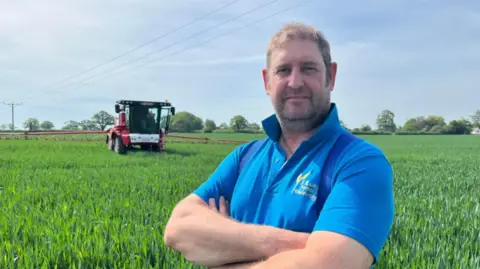
BBCA farmer from Shropshire has said he believes it is becoming impossible to plan for increasingly extreme weather.
Rory Lay, who farms beef, sheep and arable fields near Wem, said the current hot weather was likely to cost him up to 20% of some crops and he is having to take extra measures to keep his animals cool.
He said it was "really difficult to know what to do", because increasingly he was seeing "very wet seasons in the summer and the hot spells earlier on in the year".
Last month, the National Farmers Union produced a report on the impact of climate change, which said farmers needed more help to adapt their businesses.
Lay has about 200 sheep and the same number of cows.
He said his cattle were feeling the effects of the extreme heat the most and because they could not sweat to cool themselves down, "they look absolutely fed up", particularly in the middle of the day.
Cows pant when they get hot, to cool themselves down, and he said they were "moping around", looking like "grumpy teenagers".
The solution, Lay said, was fans in the cow sheds, shelter in the fields and "plenty of water".
Some of his crops have already been lost.
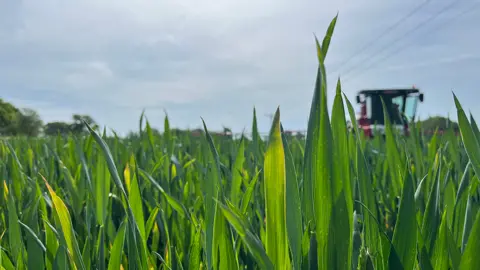
The hot weather this week, combined with the heatwave last month meant his cereal crops were "literally just burning up".
"It is really, really difficult to try and plan to change our crops or varieties to suit a weather we can't predict," Lay said.
He is hoping for some cooler, wetter weather soon and added: "We need a bit more really to take us through to harvest."
The NFU's report on the impact of climate change made a number of recommendations.
It suggested removing regulation that hindered farmers from adapting their businesses and giving them incentives to seek training.
The report said farmers were already taking measures, like planting different crops and installing solar panels, but extreme weather was expected to become more common.
NFU Deputy President Paul Tompkins said: "While farmers and growers are making real improvements in this area, they cannot work on this alone."
Learning to cope
We are going to have to get used to coping with higher temperatures as a result of climate change, according to BBC West Midlands environment correspondent David Gregory-Kumar.
He said when he had started in his role, heatwaves were the sort of thing we could expect with climate change, but we could not be sure it was the definite cause.
"Twenty-five years later, the science is very different," he added. "Not only can we say climate change is making this heatwave worse, scientists can say by how much."
He said studies from scientists at Climameter, a consortium of researchers that puts weather events in a climate change context, found it was making current weather patterns 2C to 4C warmer than what was typical in the 20th Century.
Gregory-Kumar said they found this out by searching records for previous similar weather events and comparing them with what was happening now.
"One worry is heat events like this week seem to be happening more often than models predicted," he added.
"It raises the prospect of the impact of climate change on us when it comes to intense heat being worse than we thought."
Follow BBC Shropshire on BBC Sounds, Facebook, X and Instagram.
