More than half of England in drought, Environment Agency declares

 Finnbarr Webster/Getty Images
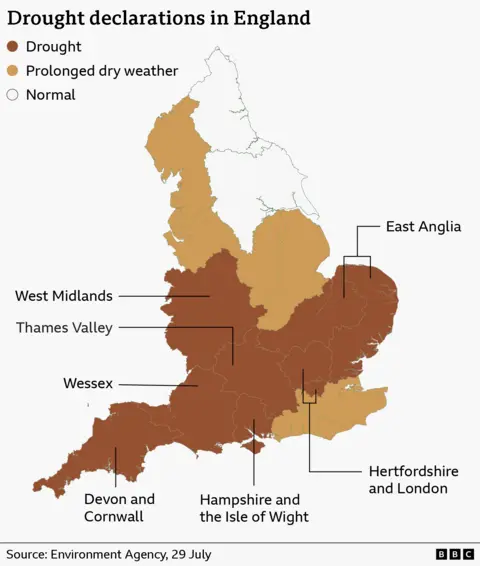
Drought has been declared across more than half of England as hot, dry weather takes its toll on the country's water supplies.
The Environment Agency (EA) announcement covers much of central, eastern and southern England, and is a public sign that further restrictions on water use might follow.
It added that the impacts are already being felt, including low river flows, early harvests and high risk of wildfires. More than 20 million people are already under hosepipe bans.
North Wales and the Upper Severn river basin entered drought conditions last week, Natural Resources Wales said.
Scotland does not declare drought but monitors "water scarcity". Some parts of eastern Scotland are in the most extreme category of "significant scarcity", according to the Scottish Environment Protection Agency.
Northern Ireland is not currently in drought.
The full list of English regions in drought conditions are:
- East Anglia
- Hertfordshire and the whole of London
- Thames Valley
- Hampshire and the Isle of Wight
- Devon and Cornwall
- the West Midlands
- Wessex, covering Dorset, Somerset, Wiltshire, and South Gloucestershire
There is no single definition of drought, but it usually refers to a period of prolonged unusually dry weather that can have impacts on people, nature and the environment.
The EA considers all of these factors before deciding whether to declare a drought in England.
The declaration is a public sign that the EA is stepping up its response to the dry conditions, including increased monitoring and controls on how much water can be taken from rivers and groundwater.
It can mean hosepipe bans being introduced if they are not already in place.
"The hot and dry weather means we are currently using water faster than nature can replenish it," said Helen Wakeham, director of water at the Environment Agency and chair of the National Drought Group.
'Flash drought'
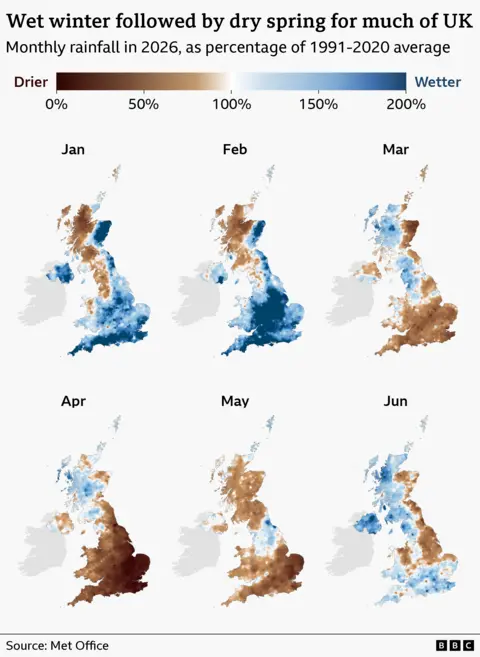
This year's drought is somewhat unusual because January and February were very wet for much of the UK, helping to replenish reservoirs and groundwater.
But late spring and summer have been exceptionally hot and dry. The quick switch between wet and dry conditions is sometimes called "climate whiplash".
In particular, July has seen 7% of the average levels of rainfall in England so far, with just 1% across southern England. Some parts of Devon and Hampshire have gone more than a month without rain.
"The warm and exceptionally dry conditions experienced across much of England over recent months are continuing to have a significant impact," said Will Lang, chief meteorologist at the Met Office.
Early August could bring some rain to parts of the country, but the Met Office has said there is no sign of sustained rainfall that would make a significant difference to the dry conditions.
The combination of low rainfall and prolonged high temperatures - meaning greater evaporation of moisture - has quickly depleted water reserves in soils, vegetation and rivers.
These conditions have led to a "flash drought", the EA has said. This is where drought begins suddenly rather than over many months or years.
Today's announcement means there have been three droughts in the past five years – 2022, 2025 and now 2026.
While droughts happen naturally, scientists say that climate change is raising the risks, with higher summer temperatures drying out soils more quickly. This can lead to more severe and longer-lasting droughts.
Some researchers have also highlighted underinvestment in water infrastructure as an issue.
The EA has previously warned that England's public water supplies could face a shortfall of 5 billion litres per day by the middle of the century without urgent action.
"This drought isn't just about a lack of rain," said Prof Hayley Fowler of Newcastle University. "It's the result of hotter temperatures from a warming climate, rising water demand, ageing infrastructure and too much water being lost through leaks."
The government has committed to improving the water industry and water companies have announced plans for investment, but bills are rising as a result.
Food production 'riskier and more costly'
The dry conditions have consequences for nature, with Atlantic salmon unable to move upstream where river flows are low. Agriculture has also taken a hit.
Paul Tompkins, deputy president of the National Farmers' Union of England and Wales (NFU), said: "Farmers and growers have always had to contend with the weather, but what they are experiencing now is climate change in action. More extreme conditions [are] making it harder, riskier and more costly to produce the nation's food."
He added the issue of drought is something that "should matter to everyone" as it affects the country's food security.
Some areas of the country have now entered their fourth heatwave of the year.
Amber and yellow heat health alerts have come into force for parts of the UK, with temperatures potentially peaking at 35C in parts of south-east England on Wednesday.
The hot, dry weather has created ideal conditions for wildfires to spread. The National Fire Chiefs Council has warned that wildfire risk "remains elevated across the UK".
More than 200 wildfire incidents have been reported in England and Wales over the past two weeks, it said.
The Met Office has separately announced that the new June temperature record set last month was even higher than previously thought, following verification processes.
The previously-reported figure of 37.7C in Lingwood, Norfolk, on 26 June 2026 has been updated to 38.0C – smashing the UK's previous June high of 35.6C.
Additional reporting by Jess Carr


Sign up for our Future Earth newsletter to keep up with the latest climate and environment stories with the BBC's Justin Rowlatt. Outside the UK? Sign up to our international newsletter here.
