How helping European eels complete epic journey could save species

 Getty Images
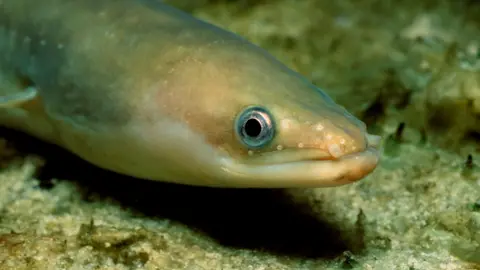
European eels begin life in the Sargasso Sea near Bermuda and drift 5,000km (3,106 miles) to Britain in an "epic" journey marvelled at by experts. But due to changes to their habitat and migration routes, the species is now classed as critically endangered, with about 90% fewer compared to the 1980s.
Campaigners say the eels have been suffocated by water engineering, while the Environment Agency said it was working with partners to improve fish passage at more than 100 migration barriers.
Activists say for the eels, it is crucial more action is taken to improve their journey routes to save them from extinction.
One group, based in the West of England, is also hoping to boost people's knowledge of the creature in a bid to reverse its decline.
Somerset Eel Recovery Project (SERG) travelled to Westminster this week to urge MPs to introduce teaching packs for local children and put "epic eels" on the national curriculum, as part of the proposed Natural History GCSE.
Andrew Kerr, one of the directors of SERG, said he wanted children "to learn about rivers, wetlands and eels and the challenges they face".
The Department for Education said the current curriculum content would help students "build a strong understanding of British habitats and wildlife".
Where do European eels come from?

European eels begin life in the Sargasso Sea and drift 5,000km (3,106 miles) to Britain, where some travel along waterways in Somerset, Gloucestershire, Bristol and Wiltshire.
No one has ever witnessed the eels being spawned in the Sargasso Sea, but the creatures then travel across the Atlantic Ocean as tiny larvae before they turn into small glass eels to continue their journey inland towards the Severn Estuary, where they before they leave again for the return journey.
To survive, the eels, which have been swimming the Earth's waters since the time of the dinosaurs, need to swim freely up and downstream along waterways like the River Parrett and the River Severn to find food and places to hide.
Why are eels endangered?

There were so many eels in medieval England, the creatures were used as a form of money.
But their numbers have drastically reduced, with the SERG estimating that since the 1980s, the number of young eels reaching Europe had declined by 90%.
Overfishing, pesticides and parasites are also believed to contribute to their demise, while experts from the wetlands and wildlife charity WWT suggested climate change may shift the track of the Gulf Stream so fewer glass eels travel across the Atlantic.
Man-made structures likedams, hydropower and water-pumping stations in waterways can also block the creatures' migration pathways from the sea into freshwater catchments where they grow and mature, the charity said.
SERG has called for fish-friendly pumps to be installed at Gold Corner Pumping Station on the Huntspill River.
"Eels have been suffocated by water engineering and it will take many, many decades to moderate the extremes of that action," Kerr said.
A spokesperson for the Environment Agency said: "The passage of these species through the Somerset landscape is crucial, which is why we have worked with partners to improve fish passage at over 100 migration barriers this year, including the Bridgwater Barrier eel mitigation scheme for the Tone and Parrett catchments.
"Better fish passage is also part of our long-term plans for Gold Corner Pumping Station."
What is being done to save the eel?
 The Ruby Cube
SERG introduced eels in 59 classrooms in 2024 to help children in Gloucestershire and Somerset learn about the creatures.
The organisation said it wanted children to have a better understanding of the eel and the problems it faced, with greater emphasis placed on the creatures in the curriculum.
Kerr added that the creatures were "a great vehicle" to explain rivers, wetlands, migratory fish and how they all link to birds and food chains.
The Department for Education said: "We have worked closely with experts to develop proposed content for a new natural history GCSE, which will help students build a strong understanding of British habitats and wildlife, alongside the knowledge, skills and hands-on experience to access careers in some of the UK's fastest growing sectors."
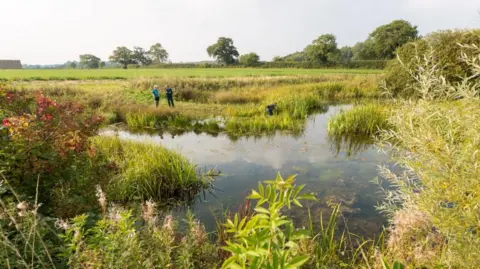
The Eelscapes project in Gloucestershire is also trying to help by restoring a wildlife haven along a stretch of the River Severn, while Gloucestershire Wildlife Trust (GWT) is working with 22 landowners along the waterway to improve wetlands and accessibility for eels.
Emma Hutchins, director for nature's recovery at GWT, said the work was likely to take 20 or 30 years to "really reap the rewards".
She said the project would also work with the local community.
"They're not lovely, fluffy and cute, and we need people to understand that all of wildlife is important and that eels do a really critical job for us."
"They're very important to the ecology of our estuary and the river that runs through," Hutchins added.
Follow BBC Somerset on Facebook and X. Send your story ideas to us on email or via WhatsApp on 0800 313 4630.
