Is the South West better or worse off 10 years after Brexit?

 BBC
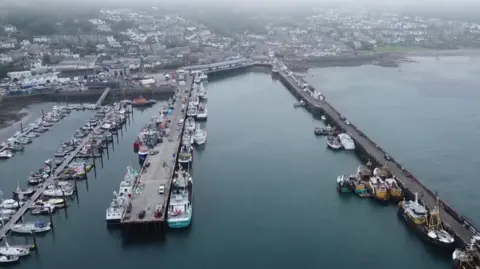
BBCTen years on from the UK's vote in favour of Brexit in 2016, there are concerns some industries are worse off than before the referendum.
In the South West, the European Union (EU) played a major role in fishing and farming. Cornwall also received millions of pounds in EU funding because of its classification as a deprived area.
So what is the ongoing impact of Britain's departure from the EU for Devon and Cornwall?
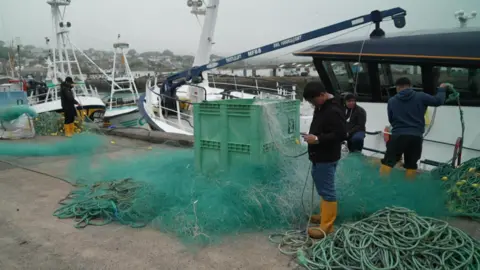
The fishing industry makes only a small contribution to the UK economy, but it has an emotional pull which probably far outweighs its modest contribution to gross domestic product (GPD) – something almost certainly not lost on our politicians.
As the Cornish Fish Producer's Organisation later reminded the leaders of the Leave campaign, fishing became something of a poster child for Brexit.
Pro-Brexit politicians talked up taking back control of UK waters and securing a fairer share of fishing quotas.
While the UK does now control its own fishing waters, the choices post-Brexit governments have made continue to dismay many in the industry.
A particular grievance is the continued access for EU boats to Britain's inshore waters.
This was initially agreed until 2026 by Boris Johnson's government when it negotiated the Trade and Co-operation Agreement with the bloc at the end of 2020, and then it was extended for another 12 years when the present government re-negotiated the deal last year.
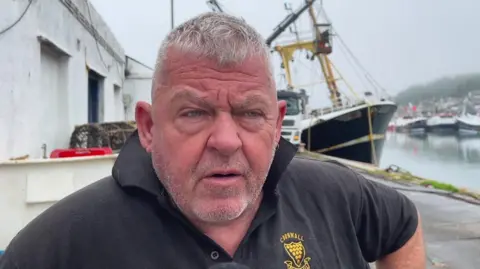
Newlyn-based fisherman Phil Mitchell said the fishing community in 2016 was "all in favour" of Brexit "because of what we were being promised".
"We're probably worse of now than when we started," is his verdict 10 years on.
He said: "The main point of having the Brexit is that we would get our territorial waters back for UK boats.
"Foreign boats are still fishing inside the 12-mile limit, big foreign boats competing with our smaller local trawlers.
"Another thing that we were promised is that we would get back some of the quota allocation, that it would be realigned more to match our waters - that didn't happen either.
"Unfortunately, to go with the things we didn't get, we've also got extra controls for the exports, so we're worse off than we were before because it's now much more difficult to export the fish we do catch."
Mitchell said he had to sell his own boat and now skippered for a firm instead.
If the EU ruled the waves through the rules and regulations of the Commons Fisheries Policy, the Common Agriculture Policy did the same thing on land for farmers.
It also paid them substantial subsidies based on the amount of land they farmed, which many small family farms in the South West were heavily dependent on.
'Bit of a mess'
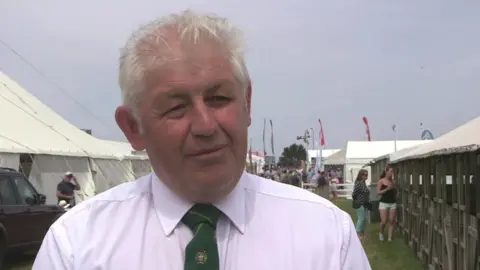
EU membership divided opinion among farmers as among the population generally. But Martin Howlett, who farms near Callington in Cornwall, was one of those who believed the UK should remain in the bloc.
Concerns about what would happen to agricultural subsidies if they were in the gift of Westminster was one of the reasons he gave for his decision at the time.
"Clearly, when we look at the British economy and the demands of where that money might want to go, whether that be the National Health Service, whether it's education, whether it's a whole raft of other places; clearly we aren't going to be at the top of the agenda in terms of receiving support from the British government", he said in June 2016.
Speaking today, he said he had been "a reluctant remainer".
"The fact that we are now out of Europe in the last 10 years, probably it's been a bit of a mess how it's all happened. But, from a farming point of view and my own livestock's point of view, we have seen some very good prices, probably doubling in price of both our beef and sheep products which as been very, very welcome," he said.
"Inevitably, of course, we do have big costs now, so it's all been sucked back up again. But the bottom line is we've tried to make it work".
Although control of both these industries is now emphatically back in UK hands, the government is planning to return to EU regulatory orbit in one crucial area which would affect both farming and fishing.
Leaving the bloc brought a slew of costly and complex paperwork for those exporting food and fish to the rest of Europe – a process previously as simple as sending it for sale elsewhere else in the UK.
So-called "dynamic alignment" would remove the complications by accepting EU rules for food safety and following suit whenever the EU changes or updates them.
Critics said this would make the UK a rule-taker rather than a rule-maker, but the plans have been welcomed by many exporters – especially smaller business which have found it more difficult to absorb the additional costs.
The changes cannot start soon enough for Charles Baughan, who owns Newton Abbot-based sausage-maker Westaways in Devon.
"It would solve every single issue - we'd crack on and away we'd go", he said.
"Will it be completed by 2027? I don't know, I really don't know."
With both fishing and farming now firmly in the hands of domestic politicians, the Department for the Environment, Food and Rural Affairs said: "Food security is national security and the government is determined to give our farmers, fishers and food exporters the support they need to enable them to thrive.
"This includes our renewed Sustainable Farming Incentive deal, investing around £800m in our farmers and food producers, alongside £360m invested through our Fishing and Coastal Growth Fund."
One more area in which the EU loomed large for the region was money for economic development.
So-called "structural funds" provided financial support for much of Devon while Cornwall - deemed to be among the poorest regions in Europe - qualified for the highest level of funding, Objective One.
From the turn of the century until the UK parted company with the EU, Cornwall received more than one billion euros.
Among the things it helped fund were broadband rollout, the Eden Project, Newquay Airport, a university for Cornwall and the dualling of the A30.
'Dwindled down to nothing'
Post-Brexit, the Conservative government replaced EU structural funds with something called the UK Shared Prosperity Fund, which continued to support Cornwall but at half the previous level of funding – a reduced rate of about £48m a year.
This was extended for the first year of the Labour government but, again, at a further reduced rate.
"That was far less than we'd ever received under the EU and that now has dwindled down to nothing", said Leigh Frost, Liberal Democrat and leader of Cornwall Council.
"We've had the Kernow Industrial Growth Fund, which is very targeted, but is actually only £30m, so, from Cornwall's point of view, there is no benefit from us being out of the EU."
The Kernow Industrial Growth Fund - a funding pot worth £30m spread over five years – was announced in last autumn's Budget.
At the same, the UK Shared Prosperity Fund was replaced by the Local Growth Fund and the Pride in Place Programme, neither of which have allocated any money to Cornwall.
Perran Moon, Labour MP for Camborne and Redruth, said the four Cornish Labour MPs "fought really hard" for the Kernow Industrial Growth Fund but "there is no question that from a purely financial perspective Cornwall is far worse off as a result of Brexit than before it".
The Ministry of Housing, Communities and Local Government said: "We're supporting Cornish communities and fixing regional inequalities by providing long-term, targeted funding to areas that need it most".
