Could my rare muscle condition be traced back to my Orkney roots?

 Stuart Flett
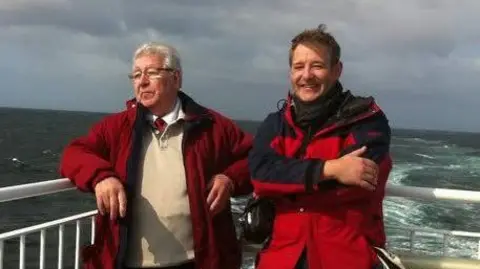
Since childhood, Stuart Flett has been effortlessly muscular - but he has also endured severe cramps and spasms in his muscles.
Now aged 60, the former police officer from Barrow-in-Furness in Cumbria has spent a lifetime trying to pinpoint what was wrong with him.
And researchers believe the answers may lie with his roots in Orkney - his father's birthplace.
They suspect the family may harbour a unique genetic trait which gives them an unusually strong physique as well as a predisposition to the rare genetic condition of neuromyotonia.
In 2024, the Viking Genes project began studying members of the Flett family from the Orkney island of Flotta, to focus on a suspected inherited muscle-and-nerve condition.
Neuromyotonia can cause severe cramps, muscles that are slow to relax after movement, and enlarged muscles.
Both of Stuart's paternal grandparents are Orcadian. His grandmother's family were from Westray and his grandfather's family were from Flotta.
His father was born in Orkney, but moved to England. That was where he met Stuart's mother.
"So that makes me 50% Orcadian," Stuart said.
He said he was first aware of unusual symptoms when he was about seven years old, and as his muscles started to develop he became aware of more issues.
 Stuart Flett
"I kind of got a hint once I'd reached early adulthood, when my muscles started to grow," he told BBC Radio Orkney.
"My father has always been immensely strong, not a big bloke but a strong guy. Folk would say 'you take after your dad then'. I just thought folk take after their father, that's how genetics work."
He explained: "In my younger days I had that kind of chiselled physique, but without gong to the gym or doing any work.
"I was accused of taking steroids. Folk said 'you can't possibly have a physique like that without training'. I didn't think I was anything unusual until folk started pointing it out to me."
Stuart added jokingly: "Not so much now I'm getting old and flabby.
But his enviable physique came with some difficult symptoms.
"When I activate a muscle, it's not like a cramp, the muscles just remain activated," he said. "Then a rippling sensation. I've lived with it all my life.
"The most difficult symptom to deal with is if I get knocked, that elicits whole body spasms, so I have to be very careful."
 Getty Images
He said at one stage he went to see an expert in inherited conditions.
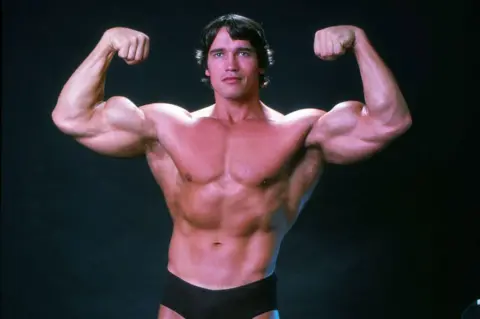
"He called his counterpart and said 'I have a very interesting gentleman sitting in front of me who has the appearance of Arnold Schwarzenegger'."
Stuart described the Arnie comparison as "a bit of an exaggeration".
But eventually getting the genetic neuromyotonia diagnosis was a "game changer".
It was vindication, he said, and not an imaginary condition.
 Flett family
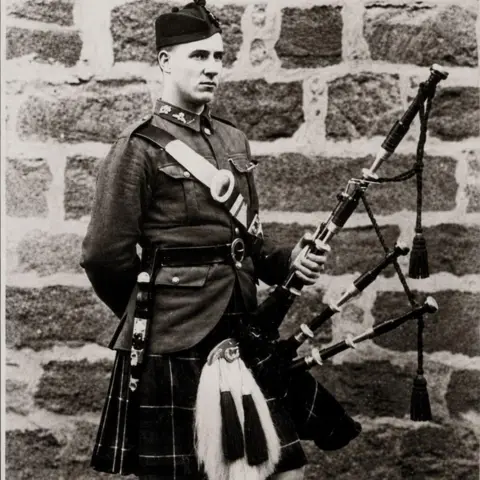
Going back through the family generations, the pipe tune "Flett fae Flotta" (Flett from Flotta) was named after Flotta piper William Arnot Flett.
He was well known for his physical strength and distinctive gait, both symptoms of the condition. The rhythm of the tune is said to mimic his walk.
Stuart knows a number of his father's relatives in Flotta had muscle-related issues as well as a relatively high incidence of MND and Parkinson's.
And now his daughter Dr Chloe Flett - a medical biochemist with a focus on rare disorders - has also diagnosed with neuromyotonia.
She said further research could help understand why the condition can encourage the development of big muscles.
The knowledge may help future gene therapies to prevent muscle wasting or weakening in a range of other conditions.
"That's why finding the gene is so important," she said.
Stuart hopes the research can also offer "clarity" to future generations of the Flett family.
 Flett family
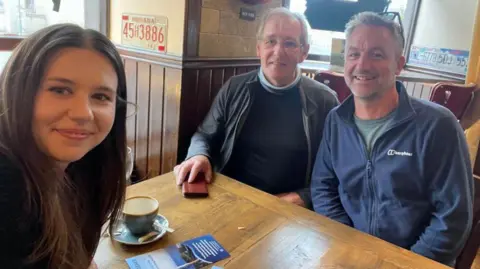
Prof Jim Flett Wilson leads the Viking Genes studies, and said having the Flett family to focus on could be key.
"It's so so rare, it's one of the rarest conditions I've ever worked on, so it's in a whole different ballpark," he said.
"It's quite possible that whatever's causing it in Stuart Flett's family will be unique in the whole world, we simply don't know yet."
They are using Orcadian volunteers, as well as recruiting members of Stuart's extended family.
"We can use all these people and compare their DNA to try to find the gene that's causing this condition," he explained.
"We are pretty certain it's genetic, it's been four or five generations of his family have had these kind of symptoms.
"We're really still at the first stage of this."
Stuart said his family was "firmly behind" the project and "extremely grateful for the tireless work" from Prof Wilson and his team.
