Call for statue of England's 'forgotten' captain

 Hulton Archive/Getty Images
Campaigners are calling for a statue to celebrate the life of a Victorian footballer who became one of England's first ever captains.
John Hunter was born in Sheffield in 1851 and went on to make seven appearances for England between 1878 and 1882, including leading the team out against Wales in 1881.
According to the Football Association, Hunter, who was more commonly known as Jack, was the tenth man to captain England, and is regarded by some as England's "first working class captain".
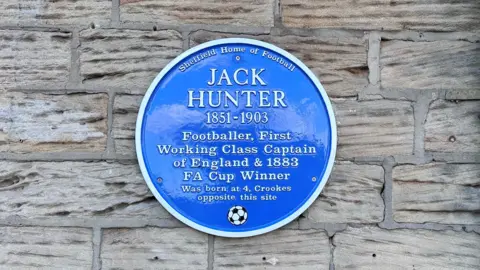
Now, Sheffield Home of Football - who recently installed a plaque in the city in honour of Hunter - say they would like a statue to commemorate his role in the game.
At the time Hunter broke into the England set-up the team was almost entirely made up of players from the upper classes and public schools.
Hunter, who worked as a cutler and a butcher during his footballing career, was among the first working class players and
Football historian Graham Curry, who has a PhD in the early development of association football, said: "Jack Hunter was the first working class captain of the England football team.
"To be captain of people with the real social power, from Eton, from Harrow, the southern amateurs, it was just incredible.
"The only thing that can I think is, he must have been a great player."
 BBC / Mia Fitzpatrick
Hunter made his England debut against Scotland in 1878, losing 7-2 in Glasgow.
He went on to play six more matches for England, winning just once, and captained the side in a 1-0 loss to Wales on 26 February 1881 at Alexandra Meadows in Blackburn.
"If you look at the results against England, some of them are quite embarrassing, so Hunter was surviving on an international stage when England were not brilliant," said Steve Wood, historian and trustee of Sheffield Home of Football.
Despite his lack of international success, Wood still thinks Hunter should be celebrated.
"We put on the plaque, he's the first working class captain of England," he said.
"When you consider the game, the international side was dominated by players from the upper class. It was a fantastic achievement for a working class player to break through into the England side."
While Hunter's international achievements were limited to a handful of games, he enjoyed success at a domestic level, winning the FA Cup in 1883 with Blackburn Olympic, where he was both a player and a coach.
Olympic's victory marked the first time the competition had been won by a working class side.
"[Hunter] took a group of basically working class mill workers from the North down to London to beat the highly fancied Old Etonians," Wood said.
"Hunter was a real breakthrough, because after 1883 it was all the Northern clubs who won the FA cup from then on.
"Before 1883 football was watched by the upper class and played by the upper class."
It is this achievement, alongside Hunter's role with England, that has prompted Wood to call for a statue in Sheffield.
"Somebody who creates, or is part of the spark that creates, something followed by six billion people needs a statue," said Wood.
"When you see those photographs of people chucking beer around because England have scored, and when you see those scenes of people celebrating in the streets because their team has won, think Hunter - Hunter did that."
Listen to highlights from South Yorkshire on BBC Sounds, catch up with the latest episode of Look North.
