'We need funding to fix Bristol's housing crisis,' says council leader

 BBC
BBCA city council leader says the authority needs allocated funding from the government to help combat his region's ongoing housing crisis.
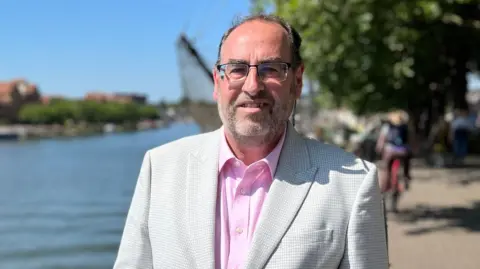
Councillor Tony Dyer, leader of Bristol City Council, appeared on BBC Radio Bristol's Hot Seat segment to answer questions from listeners earlier.
Along with housing issues, he discussed the city's controversial liveable neighbourhood scheme and special educational needs and disabilities (SEND) backlogs.
Read our takeaways from John Darvall's show below or listen to the full interview here.

'We face a housing crisis'
Dyer discussed the lack of housing provision in the city, as well as the the lack of meanwhile sites for people living in vehicles.
Since July 2025, the council has had an injunction in place to prohibit van dwellers from living on the grassed areas of Clifton Down, Durham Down and Ladies Mile.
Most of the van dwellers left the beauty spot in May and pitched their vehicles at one of the meanwhile sites on offer, like one in Lockleaze.
However, the sites are only temporary and the council said it had fallen short of its target to provide 250 pitches by April 2026.
Dyer said the council was still looking for additional meanwhile sites, including one in Whitchurch.
"There's an underlying issue here as well.
"Quite a few people who are living in vans can't afford to rent or buy a home in Bristol, so there is a bigger societal problem here," he told BBC Radio Bristol.
He also discussed the waitlist for permanent accommodation.
According to council figures, there are 20,000 households on the list, while 2,000 are living in temporary accommodation.
Dyer said the authority needed "specific" funding for council and social housing.
"In the past when we've faced a housing crisis, the only way we've ever solved that is by having public investment into delivering council homes.
"We need allocated funding so we can provide the housing people need," he said.

Liveable neighbourhoods 'evolving'
The city's liveable neighbourhood schemes aim to reduce through-traffic and encourage more walking, cycling and public transport use.
The project - which was recently approved as a permanent measure in east Bristol - has sparked controversy among residents, with some claiming the changes have made journeys harder and longer.
Dyer said the council voted to approve it with amendments, following "balanced feedback" from residents.
He added that people had raised "very valid concerns" about the road traffic management scheme and acknowledged his responsibility as the council leader and a ward councillor to respond and provide reassurance.
"We've looked at a couple of the bus gates and made sure we monitor them to make sure that they are doing the job that they're supposed to do, and if not, if there is still a case for them to remain, so it is an evolving process," said Dyer.
"It's our choice as a council through the committee system to deliver what we see as an attempt to reduce congestion, but also to improve the quality of life, particularly improving air quality," he added.
SEND support is a 'key issue'
The demand for SEND support has significantly increased nationwide in recent years.
In Bristol, Dyer said there were 5,770 children with Education, Health and Care Plans (EHCPs), an increase of 195% in the last decade.
The statutory wait time for an EHCP - the legal documents setting out the support a child is entitled to - is 20 weeks, but in Bristol, families wait for an average of 47 weeks, according to council figures. Only 65 EHCPs were completed within the 20-week official deadline last year.
Dyer said the statistics were "extraordinary" and "illustrated the problem of bringing in new duties for local authorities, but not providing the resources including the funding but also the skills that are needed to deliver on them".
Dyer said he hoped the new prime minister Andy Burnham could implement change.
"This is a nationwide issue. It's a key issue and I think if the new prime minister can light a fire under this and get it resolved, it will be the defining moment of his prime ministerial career," he added.
