Housing or data centre? London's land-use dilemma

 Getty Images
A growing debate is playing out across London: As demand for artificial intelligence (AI) and digital infrastructure grows, what should happen when data centres compete with housing and regeneration ambitions for the same land?
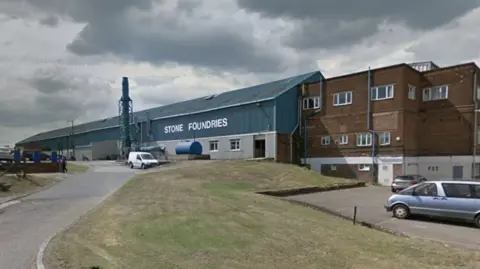
In south-east London, a site designated for redevelopment at Charlton Riverside has become the latest flashpoint in the debate about London's digital future.
The proposed 100,000 sq m (1 million sq ft) data development on industrial land at Charlton Riverside has been dubbed "concerning", with Greenwich Council opposing the idea before the centre's planning application has been submitted.
Supporters say data centres are critical infrastructure that power technology many people rely on.
But critics question whether they belong in areas earmarked for new homes and have raised concerns about their energy use, water consumption and environmental impacts.
Data centres are not new. Telehouse's Tower Hamlets site was built in 1989 under different ownership.
Managing director Mark Pestridge said demand was accelerating rapidly due to London's position as a global technology and finance hub.

"If you think about everything you do on a daily basis, whether you want to look at your bank account online, you want to look at your medical records or book a GP appointment, or stream a video, that will all run through a place like this," he said.
"I think London needs to be at the forefront of this moving forward, I think we have an exciting opportunity that we need to develop to make it quicker for us to stand up buildings like this.
"There's a huge opportunity for London."
And as artificial intelligence (AI) tools are increasingly used, there is a rising demand for large-scale computing infrastructure.
Data centre developers are particularly attracted to London because of the capital's dense concentration of businesses, financial services and internet connections.
Operators often want facilities close to the customers using their services, such as the controversial data centre approved for Brick Lane in Tower Hamlets in July, which is intended to provide faster internet connections for financial traders in the nearby City of London.
 Google
In Charlton, Greenwich Council said the proposal for a data centre was at odds with its plans for the area.
Tom Creswell, the council's cabinet member for planning and development, said they had plans to build about 8,000 homes, improve public transport, and create 1,000 new jobs in the Charlton Riverside area.
"Our priorities as a council will always be focused on serving local people and bringing meaningful opportunities to the beautiful borough we call home," he said.
At the moment the draft local plan is being formulated and so a particular use has not yet been specified for this land - only that it is for "mixed-use development comprising residential, commercial, and light industrial uses".
The local plan that was adopted in 2014 and runs until 2028 described Charlton Riverside as an "key regeneration area" and had potential to be developed into an "attractive and vibrant mixed use urban quarter".
A spokesperson for the data centre project said regeneration in the area had seen "limited" progress and highlighted that data centres had been designated by government as Critical National Infrastructure.
They said their proposal would both "help unlock the delivery of new homes" through road infrastructure and green spaces, and support the growth of the industrial economy in the capital.
"Together, this would make nearby development more viable and transform a disorganised industrial estate into an area that is hospitable to both current and future residents," they said.
 GLi
GLiData centres are regularly criticised for using a lot of electricity and water and lots of Charlton residents are opposed to the plans.
One resident told Politics London: "From what I've heard, it's going to be very noisy with all of the generators, it's on 24 hours a day," while another said: "They use too much energy and where does the energy come from?"
A woman said she would rather see homes built on the site.
"There's nowhere for people to live. A lot of places are overcrowded as it is. People have been waiting. I think we've got enough technology going around, I really don't think we need any more."
Charlton Gateway has said its proposals were not for AI and its data centres would use a closed loop water cooling system, its generators were for backup use only and would be tested intermittently, rather than round the clock.

A spokesperson for the government said claims that British data centres were "draining the country's water" were false.
"In England, they account for just 0.2% of non-household water usage, and many newer data centres use advanced cooling systems that require very little fresh water," they said.
"This does not mean a blank cheque for Big Tech. Developers must use water responsibly, and new developments must be considered through the planning system."

Pestridge said Telehouse's data centre had a closed water system and the yearly water usage from the nation's data centres was "less than the water lost to leakage in a single day".
He added that Telehouse's electricity came from wind farms in the North Sea and they had equipment to dampen sound for neighbours.
"We haven't done a very good job of educating people about how much electricity and water we use," Pestridge said.
Water companies in England and Wales lose more than 3bn litres every day through leaking pipes - approximately a fifth of all the water put into supply.
A full year of data centre potable water use is approximately 1.88bn litres.
A Water UK spokesperson said they "desperately" wanted to supply the resource needed by data centres, but needed authorisation to invest ahead of demand.
"After having reservoir applications repeatedly blocked, we have finally been given approval to build 10, which will take years to complete," they said.
The data centre argument in Charlton is unlikely to be the last.
As the physical home for the computing power used by phones, computers and AI, the demand for these centres will grow.
Yet in a city facing affordable housing shortages and competition for land, each proposed development is also likely to face questions about what London's communities need most.
Listen to the best of BBC Radio London on Sounds and follow BBC London on Facebook, X and Instagram. Send your story ideas to hello.bbclondon@bbc.co.uk
