What's next for people living near 'dusty' former brickworks?

 BBC
BBCPeople living near an ash processing facility have been plagued by dust, noise and bad smells, a report has found.
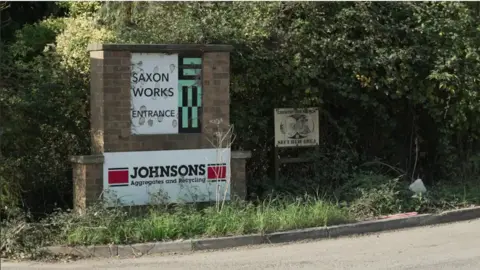
It emerged after Cambridgeshire County Council studied what life was like for people whose homes were within 1km (0.6 miles) of Saxon Pit in Whittlesey.
One local told the BBC of his fear that potentially poisonous material was being released into the environment.
Yet the Liberal Democrat-run council's report does not investigate the cause of issues reported by residents - or attribute blame. So what was the point of it?
What was the study?
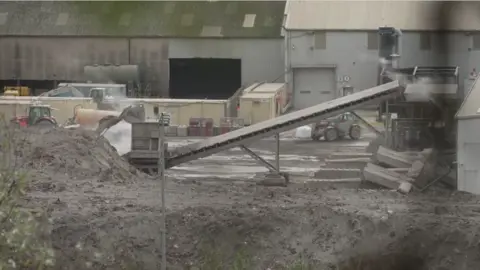
The former brickworks is used to process ash left at the bottom of an incinerator furnace after burning.
The study was commissioned to build an understanding of what it is like to live near Saxon Pit after prolonged concerns raised by residents.
Some had spoken of hosing down their cars and windowsills because of dust they believed was coming from the site.
More than 200 people responded to share their lived experiences - something that is not typically recorded in environmental surveys.
"What we did find is people are experiencing a range of impacts," says Sally Cartwright, the council's director of public health.
She said the responses, many of which reported similar concerns, gave local health leaders a deep evidence base to inform future decisions about the site.
"It gives that more robust view of the evidence that we didn't have before," she added.
What did it find?

Dust was the most commonly identified issue among residents, with 88% of survey respondents experiencing it.
Perceived poor air quality (73%), odour (61%) and noise (58%) were also frequently reported.
A total of 93% of residents reported experiencing several of these problems at once, and most reported four issues on average.
The odour was described as like "wet cement, wet plaster or damp concrete" by some.
Officials found the impacts generally reduced the further people lived from the site.
The study also found some people had adapted their daily routines in response to the conditions, including keeping windows closed and spending less time outdoors, as well as feeling embarrassed when guests are over.
It is important to note that some residents reported little or no impact from the site.
East Midlands Waste Management (EMW) and Johnsons Aggregates, who both operate at the site, have not responded to requests for comment.
What have residents said?
 Phil Shepka/BBC
"Some of this metal may well be toxic, particularly the remains of melted down batteries," says Clive Vaughan, who lives close to the site.
He fears there are no adequate facilities at Saxon Pit to contain dust that could be rising from the site.
"We're concerned about the machinery they're using and we're concerned about the level of experience they have," he says.
"This stuff, if it's poisonous and if it gets released into the environment, is a couple of hundred metres away from our homes."
 Phil Shepka/BBC
Tony Ellingford says "dust clouds" frequently gather above his home.
"It's landing on the car, it's landing on the windowsills. We're continually out there with a hose, hosing it down," he explains.
"It's very, very irritating and, of course, the major thing is what we're actually breathing in – what's in that?"
Ellingford believes the problem has been particularly bad for the past four years.
The uncertainty of not knowing what is in the dust was listed as a big strain felt by residents, according to the survey.
What happens next?
 John Devine/BBC
The findings are due to be considered by an oversight group that includes councillors, residents, operators, regulators and public health officials.
Any actions to follow will be set out in due course, the council says, adding a "systematic account" of resident experience had not been available before.
Cartwright says air quality tests - which are assessing what is in the dust - are ongoing and the results will be available in early 2027.
She explains that while the dust might be "irritating", it is not yet known if the small particulate matter it consists of is harmful.
"What we're worried about from a public health perspective is, is this causing impact on health?" the health director says.
"It's the small particulate matter dust that we're really concerned about and that we want to get the evidence base on, first and foremost."
Do you have a story suggestion for Cambridgeshire? Contact us below.
Follow Cambridgeshire news on BBC Sounds, Facebook, Instagram and X.
