Second blue plaque for suffragist Millicent Fawcett

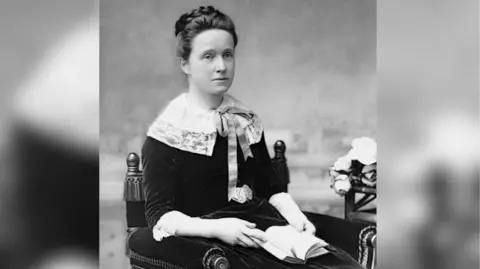 Getty Images
A campaign to get a second blue plaque for suffragist Dame Millicent Fawcett has been successful with a date set for the unveiling this month.
Fawcett, who led Britain's largest women's rights association, attended a meeting in Littlehampton United Church to celebrate achieving the first votes for women in 1918.
The plaque will be placed on the wall at the church on Saturday 18 April at 10:00 BST with the Lord Mayor of Littlehampton in attendance.
Christina Merry, one of the campaign organisers, said it had been her "long-time wish" to have the plaque made - Fawcett also has another blue plaque in Cambridge.
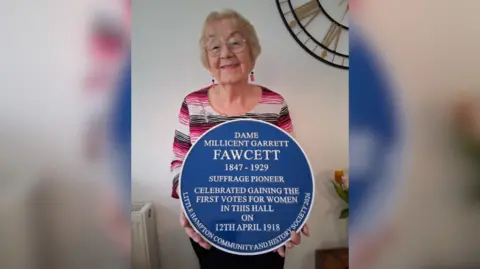 Christina Merry
Merry said she got into contact with Angela Tester with her idea about a second blue plaque, after reading Tester's book, The Suffragettes at Littlehampton (A Concise History), in 2018.
The pair worked with other local historians to raise the £800 needed for the plaque - it included a tabletop sale held last December.
"I can't believe the plaque. We're really thrilled with it," Tester said.
"People that I've met said, 'We didn't realise anything so local was important with the suffragettes', so it's a piece of hidden history."
The first blue plaque in honour of Fawcett was unveiled at Cambridge's Guildhall in 2018. It was placed next to her husband's, Henry Fawcett.
The equal rights campaigner, who dedicated her life to getting the women's vote, also co-founded the all-female Newnham College at Cambridge University in 1871.
She formed the National Union of Women's Suffrage Societies in 1897, which campaigned peacefully and held non-violent demonstrations.
Mr Fawcett, who was a former MP and postmaster general, introduced parcel post and postal orders before his death from pneumonia in 1884.
A statue commemorating Fawcett's life was also unveiled opposite Parliament in London in 2018 - it was the first statue of a woman in Parliament Square.
There are two other blue plaques in Littlehampton with suffragette connections which were erected by Arun District Council - they both commemorate Mary Neal.
Neal was a key figure in the fight for a woman's right to vote and a social worker in the late 19th century and later set up a holiday home for girls, known as Green Lady Hostel, off East Street in Littlehampton.
One of her plaques is at the site, now Roland House, and the other at her former home on St Flora's Road.
Follow BBC Sussex on Facebook, on X, and on Instagram. Send your story ideas to southeasttoday@bbc.co.uk or WhatsApp us on 08081 002250.
