Floating wetlands plan to boost coastal ecosystems

 University of Portsmouth
A new project will "transform" degraded coastal environments through the installation of "pioneering" floating wetlands.
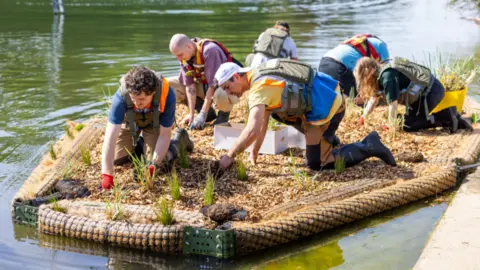
The project, led by the University of Portsmouth in partnership with Southern Water, will see specially designed floating rafts deployed in coastal waters.
Their purpose will be to recreate crucial lost "green" habitats in areas dominated by concrete infrastructure, such as seawalls and flood defences.
If successful, Southern Water says the floating wetland technology could be deployed widely across the UK in both marine and freshwater environments.
Researchers say the approach offers a "practical, scalable solution" to the "widespread loss" of essential coastal ecosystems.
They say more than 85 per cent of aquatic and marine vegetation, including saltmarsh, seagrass and kelp, has been lost over the past 50 years.
The floating wetlands will host a diverse range of saltmarsh plants, with marine species being trialled on a floating system - which has only been trialled six times previously.
They are designed to deliver multiple environmental benefits, including improving water quality by absorbing nutrients and pollutants.
By effectively creating a floating saltmarsh, the project aims to provide vital habitat for fish and marine life, enhance biodiversity, and restore valuable ecosystem functions to heavily modified coastal environments.
Dr Ian Hendy from the Institute of Marine Sciences at the University of Portsmouth, who is leading the project, said: "This is an exciting step forward in how we think about restoring coastal ecosystems.
"By creating a floating saltmarsh, we are reintroducing habitat into spaces where it has been completely lost to development.
"These systems can provide refuge for marine species, improve water quality and help rebuild biodiversity in some of our most impacted coastal areas."
The wetlands have been set up at the Southcoast Wake Park in Portsmouth as part of a long-term research programme, using a before-and-after monitoring approach to assess their environmental impact.
Scientists will track changes in water quality, biodiversity and ecosystem resilience over time.
Joff Edevane, environment and water quality lead for Southern Water, added: "This is a wonderful opportunity to pilot a floating wetlands approach to improving water quality and providing Natural Capital.
"The vision is to use this nature-based solution in protected areas in the future."
