These bookshops let Chinese readers question their country - now the doors are closing

 AFP via Getty Images
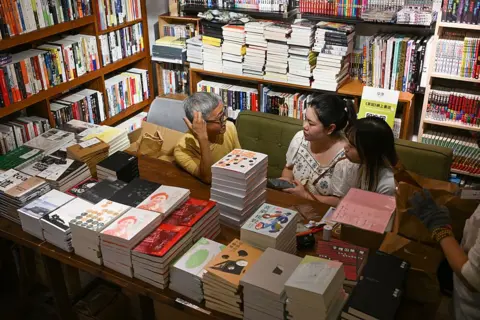
When Chen Zhu heads to Hong Kong from mainland China every month, there's one place she always goes: Hunter Bookstore.
Founded four years ago by a former councillor, the independent bookshop has earned a reputation for stocking what authorities would consider sensitive books - from accounts of Hong Kong's pro-democracy campaigners, to famous allegories on authoritarianism, such as George Orwell's Animal Farm or Hajime Isayama's Manga series Attack on Titan.
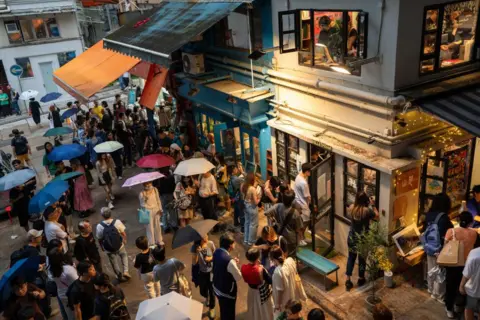
It's a short journey from Zhu's home in Guangzhou on China's southern coast to the crowded street in Hong Kong's Sham Shui Po district, where Hunter is sandwiched between fabric sellers, garages and trendy cafes.
But, for the 23-year-old, it is also a passage into a different, freer world - where she can find answers to forbidden questions.
When she learned the bookshop had been raided by police in late June, Zhu broke into tears: "I was devastated."
Hong Kong saw a boom in independent bookshops after huge pro-democracy protests rocked the city in 2019. But it has been increasingly difficult for them to survive as China's control over the city has grown.
While Beijing defends its far-reaching National Security Law (NSL) as essential for stability, many Hong Kongers and rights groups argue it has crushed free speech. Thousands of locals, including activists and former lawmakers, have left in recent years, as tough new security laws have led to a slew of arrests and convictions.
 Getty Images
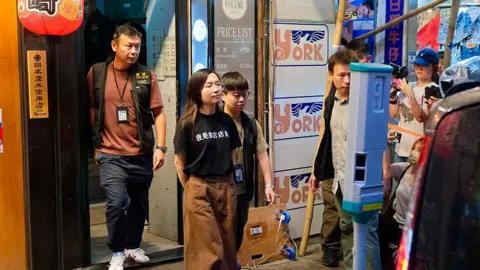
When police searched Hunter Bookstore on 24 June, they accused owner Letitia Wong, 33, and a 32-year-old man, of violating those laws and arrested them for sedition and money laundering. They deny the charges and have since been released on bail.
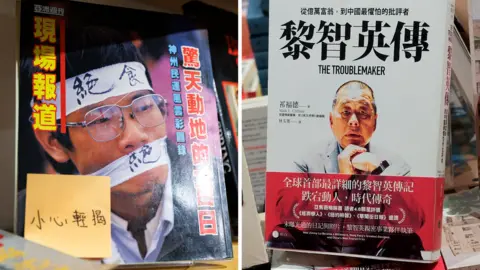
In March, they arrested the owner of Book Punch, along with three employees on the same charges, and reportedly seized copies of a biography on Jimmy Lai, the jailed democracy campaigner.
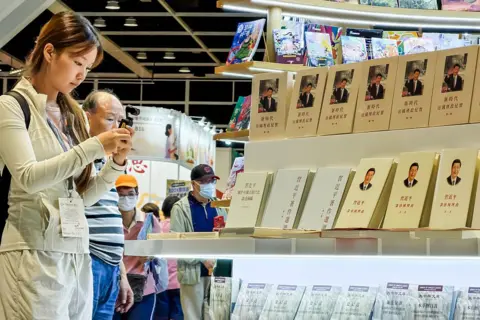
On 15 July, when the annual Hong Kong Book Fair opened, national security police searched two more independent bookshops, Greenfield Bookstore and Have a Nice Stay, arresting five people for sedition. They, too, have been released on bail.
At the end of the month Greenfield posted on social media, saying: "Our store will be closing after our lease expires. Thank you for walking with us, through wind and rain, for 50 years since our opening." It was the third independent bookshop to shut within a month.
These bookshops have long had a loyal following not just in Hong Kong, but also among many mainland Chinese readers. Some like Zhu travel to the city in search of a single book.
For 19-year-old Li from Shanghai, who didn't give her first name, these are places where she "can see so many possibilities, and where existing ideas can be challenged". Others treasure them as spaces that offer a sense of freedom and community they feel is missing on the mainland.
Now they fear China is eroding that spirit in Hong Kong too.
 Getty
GettyWhen Zhu began university in 2021, she became increasingly curious about lesser-discussed chapters of Chinese history - such as the 1989 Tiananmen Square massacre, a taboo topic that has been scrubbed off the country's tightly controlled internet.
The massive student-led protests ended in a bloody army crackdown whose toll is still contested. Beijing said at the time that 200 civilians died, but according to de-classified UK diplomatic cables, at least 10,000 people were killed.
Zhu sought out films which touch on the era-defining event, but neither epic romance Summer Palace nor the secretly filmed gay drama Lan Yu could satisfy her curiosity.
She became set on tracking down The Unburned Book by Taiwanese poet Yang Du, a bittersweet reflection on protesters who later went into exile.
In 2023, as soon as the China-Hong Kong border reopened after the pandemic she made her way to Hong Kong to find it.
This was when the city's independent bookshops were taking off. People were sharing walking routes online, complete with neighbourhood guides and curated recommendations.
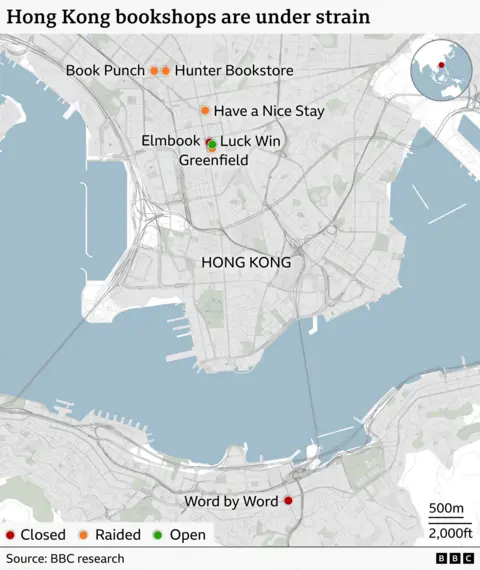
In bustling Mong Kok there was Luck Win, known for its generous discounts, and Greenfield, with its packed floor-to-ceiling shelves. A short walk away were the cosy Have a Nice Stay, founded by former journalists, which held popular late-night reading sessions, and Elmbook, whose cramped but beloved shelves made regulars feel like they were on a treasure hunt.
Then there was Book Punch on trendy Tai Nan Street, with a collection as defiant as its motto, "one punch to wake the reader", and the food lovers' favourite, Word by Word in historic Wan Chai, and, of course, Hunter, with a sofa outside where passers-by can take a break.
That's where Zhu foundThe Unburned Book. She had tried - and failed - in other stores, so she was surprised when she finally spotted it.
Hong Kong, once a refuge for those fleeing China post 1989, commemorated the killings every year with a vigil. They gradually disappeared as the new laws targeted political gatherings.
Still, when Chris, 20, whose name we have changed, travelled to Hong Kong in early June, he found that one bookstore was displaying relevant books, white candles and rolls of masking tape printed with the Roman numerals "VI-IV" - 6-4, a coded way of representing the 4 June anniversary.
These young people may not be from Hong Kong, but they describe feeling a deep sense of belonging in these bookshops: politically vibrant spaces that engage with the history their governments would rather they forget.
But it's more than just about the books.
 Getty Images
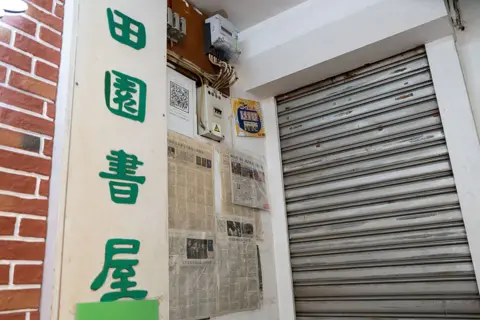
Li visited Hong Kong during the Lunar New Year earlier this year, months after a massive apartment blaze in the north-eastern Tai Po district claimed 168 lives.
At Hunter Bookstore, she discovered a wall covered in black sticky notes, where visitors had left messages of encouragement for those affected by the tragedy.
Li says this sense of community is difficult to find in mainland China. She says while they have message boards there too, they wouldn't be focused on solidarity with victims of one particular incident, perhaps because authorities are wary of any outpouring of public sentiment. "People can only express themselves indirectly," Li says.
She was equally struck by another small detail: handwritten notes left by staff alongside the books. Using sticky notes, booksellers had shared reflections on books they had read or highlighted passages they found particularly meaningful. It's not something she had ever seen back home.
Zhu experiences something similar. "We all love books. We all value independent bookshops. That's why we choose to buy books here."
She rarely speaks to strangers while browsing, but she never feels like an outsider. The books and events the shops host give her the feeling she's escaped to somewhere with "at least a little freedom of expression".
"You've left mainland China behind. Of course, you know [this] freedom has its limits. But it's still better than not being able to say anything at all."
 Getty Images
But now Zhu can sense this freedom being curtailed.
She says she finds herself encountering authorities more often in Hong Kong than in mainland China. At one bookshop event, she recalls government officials entering the premises. "They just sat there listening alongside us."
Increasing raids have not only targeted explicitly political shops, according to a bookseller who asked not to be identified because of possible repercussions.
"Luck Win Bookstore and Elmbook have always kept a very low profile," the bookseller says.
"They rarely make public statements or organise events. I genuinely can't think of anything they could have done to offend the government."
In the weeks leading up to this year's book fair, both shops were criticised in Wen Wei Po, a newspaper controlled by Beijing's liaison authorities in Hong Kong.
The paper accused them of selling books promoting "soft resistance". This included The Hong Kong Diaries by the last governor of Hong Kong, Chris Patten, before the city returned to Chinese rule, and 300 Short Essays by late Apple Daily columnist Lee Yee. The newspaper was shuttered and several senior staff, including its owner Jimmy Lai, were jailed for violating the new security laws.
"The authorities don't want people to know exactly where the boundaries are," says Tong Kin-long of University College London. "They want people to work out the red lines for themselves, or to censor themselves before crossing them."
Watching these changes unfold in Hong Kong has felt strangely familiar to a man we are calling K, in his 30s from Sichuan.
He remembers a time when mainland China's bookshops were also vibrant spaces for public discussion. Liberal books and magazines would be prominently displayed. Bookshops regularly hosted talks and discussions. But around 2015, he began to notice a gradual tightening.
At first it was books about the country's leaders. But then less obviously sensitive books started disappearing. Public events became less frequent, and the atmosphere changed.
Zhu has a friend who currently runs a bookshop in Guangzhou. She says police occasionally visit the shop to harass the bookseller. During film screenings organised by the bookshop, the electricity has even been cut off.
"Hong Kong," she says, "should be a freer place".
 Getty Images
Still, mainland Chinese readers are keen on bringing books home from Hong Kong, even though customs authorities can confiscate those they deem harmful to national sovereignty, security or unity.
K feels anxious every time he returns from Hong Kong. He chooses busier border crossings, avoids books prominently featuring politically sensitive figures and has hidden books inside his clothes, or deep in his luggage.
But that is no longer his only worry. "In the past, people would simply think, 'If I can't buy a book in mainland China, I'll go to Hong Kong'. Now the feeling is different. You don't even know which bookshops will still be here the next time you come."
A week after learning it had been excluded from the Hong Kong Book Fair, Elmbook announced it would close its physical shop in April next year. Soon afterwards, Have A Nice Stay said it would close at the end of August, citing economic difficulties and unpredictable "red lines" over what material was considered problematic.
Many within Hong Kong's bookselling industry have grown pessimistic. Some believe things will only get worse before they get better.
But readers are not powerless, an industry insider says. "We can still buy books. We can still read. And we can still read a great many books."
Chris was frightened after hearing about the arrests at Hunter Bookstore, but he says he will keep going.
"Buying a book has become a quiet way of showing support, and a quiet form of resistance."
