'Community damage' warning over battery storage

 Harmony Energy
An MP has described plans to install an energy storage system for lithium-ion batteries near a city beauty spot as "environmental vandalism".
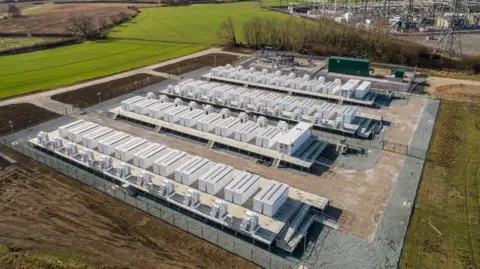
Wakefield Council refused Harmony Energy's application to install a battery energy storage system (BESS) on farmland near Heath village.
The firm appealed the decision to the government's Planning Inspectorate, saying the proposal would "assist the council and the UK in delivering meaningfully on climate and biodiversity agendas."
Jon Trickett, the Labour MP for Normanton and Hemsworth, told a public inquiry that it was "the wrong proposal, it is in the wrong place, it is environmental vandalism acting in the name of ecological improvement"
BESSs store excess energy created by renewable energy sources and release it when demand is high, helping to ensure a stable and continuous supply even when renewable sources are unavailable.
The council rejected the original application in July 2025, following objections from MPs, councillors and more than 1,200 residents, according to the Local Democracy Reporting Service.
Trickett said the 72-container plan would damage both the local community and agricultural land, and was "totally unacceptable".
'Support policy'
He described Heath Common as "the jewel in the crown of Wakefield".
It was a well-known spot for people to relax and "escape for a day out", which was of "particular importance given the deprivation in the vicinity", he added.
Trickett disagreed with Harmony's claims that the site should be redefined as "grey belt", a concept aimed at freeing up some greenbelt areas for development, saying this would be in breach of planning guidance.
"There are no local people or organisations at all in favour of this development, except those that have a commercial interest," he added.
Stephanie Hall, representing Harmony, previously noted Wakefield Council had declared a climate emergency in 2019 but had failed to allocate any sites for renewable energy in its Local Plan, which outlines plans for future developments.
She said the company's appeal was "strongly supported by government policy" and would help deliver "meaningfully on climate and biodiversity agendas".
The heritage impacts of the development were "reversible and temporary", she said, and other parties had "overstated the importance of what is now a modern agricultural field".
The hearing continues.
Listen to highlights from West Yorkshire on BBC Sounds, catch up with the latest episode of Look North
