Three senseless killings: Is Scotland's youth knife crime on the rise again?

 Supplied
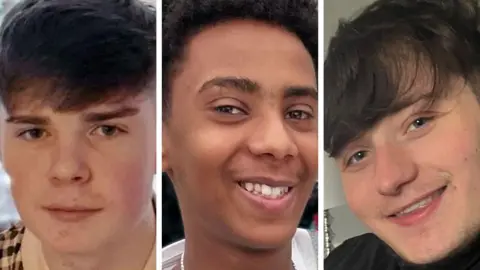
Three senseless killings in the space of six months, all involving teenagers and bladed weapons, have raised concern over youth-related knife crime in Scotland to a level not seen for many years.
The deaths of Amen Teklay, Kayden Moy and John McNab last year left many wondering whether the country was going backwards to the shameful time when Scotland endured one of the worst homicide rates in western Europe.
However, the reality is that most of the publicly available statistics on youth-related violence and knife crime tell a different story.
Official data shows a reduction in the number of teenagers involved in violence, caught with blades, or referred to the Children's Reporter over knife offences.
But the number of under-18s involved in attempted murders bucked that downward trend and any flicker of optimism will be of no comfort whatsoever to the people who've lost loved ones through a teenager wielding a knife.
Gang violence
No-one would argue that the current level of violence is in any way acceptable, or anything other than tragic, just because Scotland's homicide rate is far lower than it used to be.
It's also clear that videos on social media glorifying gang violence are contributing to a fear of knife crime among people, perhaps out of proportion to what's going on in communities.
That can lead to some youngsters choosing to carry a knife for protection, with tragic consequences.
A police-led working group is now looking at teaching children as young as eight about the consequences of violence.
The first of the three Scottish teenagers to die last year was Amen Teklay, stabbed through the heart with a sword in a Glasgow street.
Earlier this month, two teenagers were cleared of the 15-year-old's murder after standing trial, but there was no dispute over the cause of his horrific death.
In May last year, 10 weeks after Amen's death, Kayden Moy was chased and fatally stabbed at Irvine Beach in North Ayrshire.
And in September last year, after lying in wait for hours, a masked teenager pursued and murdered 22-year-old John McNab in Edinburgh.
That unprovoked attack earned the 16-year-old killer a life sentence with a minimum jail term of 17 years.
The number of homicides in Scotland involving victims of all ages has fallen from a peak of 137 in 2005, to a 50-year low of just 45 in 2024/25.
In 2005, when the fall began, a ground-breaking violence reduction unit at Strathclyde Police began to treat the death rate as a public health issue.
According to figures from the Scottish government, the greatest reduction in homicide victims over the past 20 years has been among young people aged 16-24.
In the year 2025/26, there were three homicide deaths linked to under-18s, a figure not untypical with other recent years.
Official figures show that violent offences involving young people fell in 2025/26, but still averaged 20 a day.
The number of bladed weapons or "pointed articles" found in schools went down to 127 last year - and police caught 117 children with knives through stop and search, again lower than the previous 12 months.
Alarmingly, attempted murders involving under-18s leapt up from 18 to 29, a 61% rise on the previous year.
The Scottish government does not hold an age breakdown of knife-related crimes within its annual recorded crime publication.
At the G20 Youth Project in Wyndford in Glasgow, one of the volunteers has a story which tells where Scotland has been and where it is now.
Connor McGurn was two when his older brother Jamie McColl was stabbed to death in a gang fight in Glasgow in 2007.
Jamie was 17, the same age as his killer, but on that night's news bulletin, a brief mention of his death came after reports on a train strike, a Conservative party conference and the retirement of a Labour MP.
Depressing proof of how common it was at the time.
In 2026, the killing of a teenager is far more likely to be headline news.
Nearly two decades after his brother died, Connor says he could have easily have suffered the same fate.
"I've been involved in so many situations like that," he admits.
"I went through life thinking, I need to carry that (knife), kill or be killed, when it just wasn't the case. If you live by a knife, you'll die by a knife.
"That's why I want to change now and do better, and show young people that there's a lot better things to do with your life than get involved in selling drugs and gang violence."
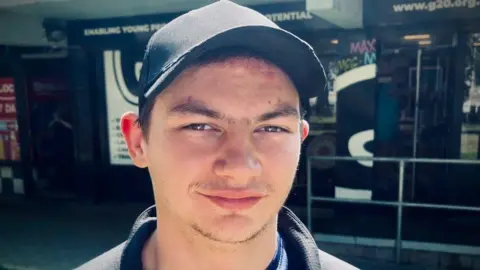
The G20 project runs a youth club and community cafe in a building which was unused for years and carries out one-on-one mentoring with young men like Connor, inspired by Homeboy Industries, an anti-gang initiative in Los Angeles.
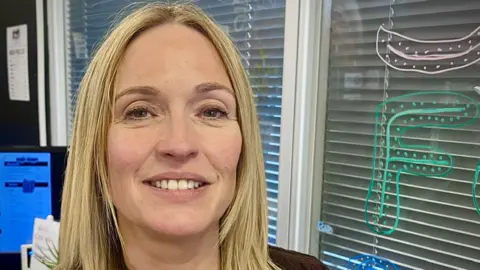
Asked what Scotland should do to address youth crime, the project's founder Emily Cutts said: "It's 100% about childhood, about how we treat our children, how we're bringing up our children. That's at the core of this.
"What do children need, what do young people need and have they got it in their community and often that's lacking.
"People come to our project and say, 'I wish they had this in our area'."
The violence reduction unit, set up by Strathclyde Police more than 20 years ago, now covers all of Scotland.
Along with a youth engagement team at Police Scotland, it has set up a Violence Prevention Primary School Working Group to develop and test innovative approaches to the issue.
A police briefing paper says it's looking at how it can help children aged 8-11 understand the consequences of violence and build confliction resolution skills at an earlier age.
Will Linden, deputy director of the violence reduction unit, said: "We've been speaking to young people and children in primaries four and five and we're hearing them talk about violence, we're hearing them talk about knife crime.
"The overwhelming majority of young people don't get involved in it, they won't pick up a knife, but they're feeling that fear about knife crime.
"As they start to get older, then they may start to pick up weapons and may start to get involved in violence, so when we want to look at violence prevention, we need to go really early."
 Lisa Petrie
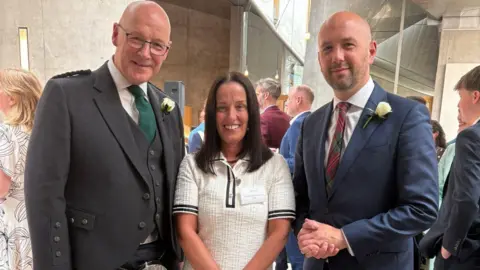
In the nine months since her son was murdered by a teenager on bail for another knife attack, John McNab's mother, Lisa Petrie, has campaigned for something positive to come from his death.
She's pushing for stricter security around the sale of knives and tighter supervision of people on bail for knife offences.
The care worker has also distributed more than 100 bleeding control kits around Edinburgh, and won a manifesto commitment from the SNP, promising to roll out more of the kits in community settings.
With the party now back in power at Holyrood, the task of delivering on that promise has fallen to the new justice secretary, Neil Gray.
He said: "I'm very grateful to Lisa for the work that she has done in horrific, horrible circumstances.
"We are in dialogue to look at how we can ensure that the manifesto commitment can be implemented.
"A bleed kit is there when there's already been an incident. I want to prevent that incident happening in the first place.
"Getting into schools, getting into the minds of young people as early as possible is paramount and that's where the priority has got to be."
The Scottish government is drawing up a new violence reduction framework, with a greater focus on young people and weapons.
When her son's killer was jailed, Lisa Petrie said: "Our family has been given a life sentence of grief. His life mattered. He mattered."
She is now seeking a meeting with Scotland's first minister John Swinney and won't let downward trends in dry statistics stop her campaign for change.
