'Parkinson's walking football created a community'

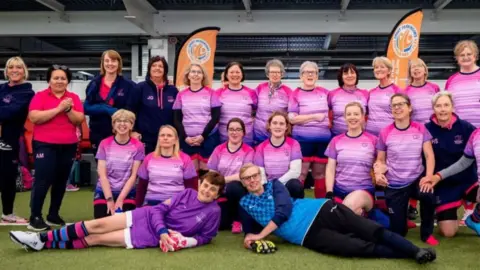 Parkinson's Pioneers
A group of women living with Parkinson's disease said joining an all-female walking football team has given them a sense of community.
The Parkinson's Pioneers, based in Solihull, formed after founder Annie Booth said she wanted to create a support network for women diagnosed with the condition.
Three years later, the team has more than 30 active members from all over the country, aged between 42 and 73.
Booth, 58, told the BBC: "I was playing football with mainly men who had Parkinson's - and I thought there have to be women out there who want to build a community, support each other and learn a new skill like football."
According to Parkinson's UK, there are 166,000 people living with the condition - with one person diagnosed every 20 minutes.
The condition sees parts of the brain become more damaged over time and symptoms include involuntary shaking, slow movement and balance problems.
"My aim was always to build a community where women felt safe, women could learn something new and women could feel supported," Booth said.
"That is the reason why we do this, we just happen to do it with the kick of a ball."
Ellie Finch-Hulme was diagnosed with early onset Parkinson's when she was 29, before she had children.
"I remember once I was carrying my baby and someone came up to me and asked why they were shaking, but it was actually my tremor," she said.
The team meet up once a month for training and recently took part in an all Parkinson's walking football tournament at St George's Park, in Burton-on-Trent, Staffordshire.
Walking football is a version of the game in which running is against the rules and players take part at a walking pace.
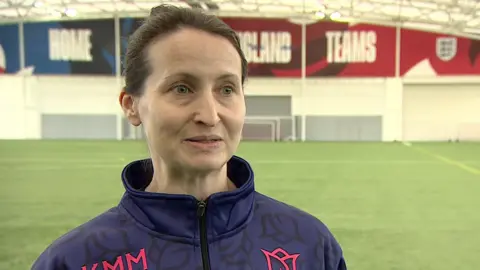
Finch-Hulme said it took a year and a half for her to get a diagnosis and what began as a tremor led to her whole left side of her body being affected.
"It's mad to be around such a big group of women with Parkinson's. I don't know why because there are loads of us," she said.
"It's not just about the football, it's about uplifting and inspiring and encouraging other women who are part of something together.
"The sense of community is amazing - I haven't been playing with them for long but I'm part of the family now."
Booth said, as well as keeping members of the team active, being part of the Pioneers had helped take away feelings of isolation felt by those living with it.
"Parkinson's is like taking the sunshine out of your brain," she said.
"You feel low, you struggle and knowing there someone with you gives you that sense of peace and belonging back again.
"It's brought me so much in my life. It can be very isolating and challenging but a community like this gives you somewhere to go."
Follow BBC Birmingham on BBC Sounds, Facebook, X and Instagram.
