Japan earthquake: What we know so far
Japan is reeling from the latest major earthquake to hit the country, which has left at least 13 people dead and search teams looking for survivors underneath collapsed buildings.
Many people were also said to be in "cardiopulmonary arrest" - a term often used in preliminary reports in Japan before a death is officially confirmed.
Rescue workers continue to search the rubble of Aeon shopping mall and a paper factory after the 6.8 magnitude earthquake hit Kyushu island on Tuesday.
The region has faced more than 100 aftershocks on Wednesday as the Japan Meteorological Agency (JMA) warned residents there could be more to come in the following days.
When and where in Japan was the earthquake?
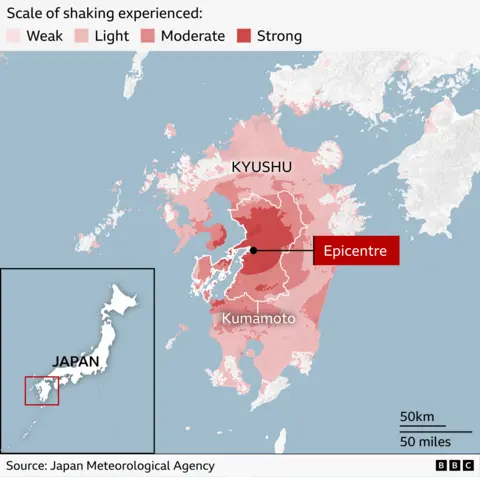
The quake hit Kumamoto prefecture on Kyushu island at 16:27 local time (07:27 GMT) on Tuesday, with hundreds of thousands of people being told to move to evacuation shelters.
The JMA reported the earthquake had a magnitude of 7.1, which the US Geological Survey later measured as a 6.8. Quake magnitude figures are often updated as seismologists obtain and analyse new data.
Kumamoto - where the collapsed Aeon Mall is located - is a city on the Kyushu island of Japan.
The southern island of Kyushu is the third-largest of the four main islands in Japan, and the second most populous.
The area is no stranger to earthquakes. A total of 278 people were killed in 2016 by powerful quakes in Kumamoto and neighbouring Oita prefecture, according to Japan's public broadcaster NHK.

What happened at the shopping centre?
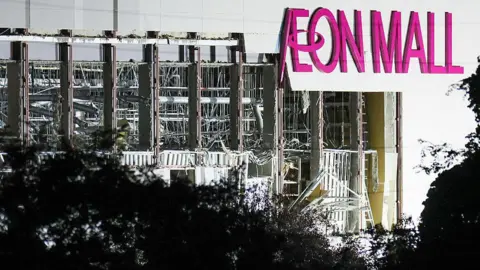
Three people have died at the Aeon Mall following the quake, while another three - who all worked there - were still missing, the mall's president Akio Yoshida has confirmed.
Some 2,700 people were employed at the site, officials said.
Yoshida said four people were taken to hospital from the mall, adding that one person had been rescued from a restroom and another person was in cardiopulmonary arrest.
"We sincerely apologise for this incident," Yoshida said at a press conference on Wednesday.
A witness reported seeing an explosion and smoke at the shopping mall after the quake and said the second floor of the building collapsed.
The mall's operator told AFP that an explosion occurred after staff and customers had evacuated.
 AFP via Getty Images
Where else has been affected?
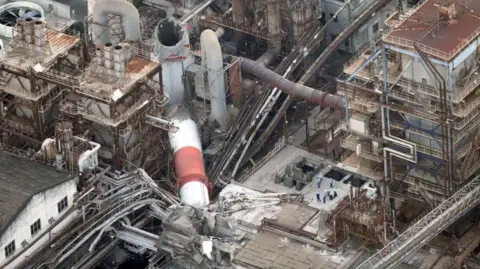
Elsewhere in Kumamoto prefecture, a chimney reportedly collapsed at Nippon Paper's Yatsushiro Plant, according to police, who are being cited by public broadcaster NHK.
Two people were found to have no signs of life and nine others were unaccounted for, NHK reported.
An aerial photograph of the site obtained by Reuters news agency appears to show a broken and collapsed chimney.
 Reuters
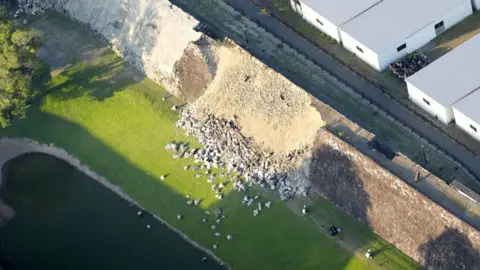
Tremors also caused historic walls at the 17th-century Kumamoto castle to tumble.
It is not the first time the castle has succumbed to an earthquake. When a 7.3 magnitude quake hit the region in 2016, parts of the 400-year-old castle were also damaged as turrets and curved walls collapsed.
 Reuters
A footbridge also collapsed in the Kumamoto region.
It is unclear if anyone was injured, or when the collapse took place. Traffic appears to be travelling on the bridge that runs parallel to it.
Some 36,700 households are without electricity, according to local officials. There has also been damage to roads.
Trains have been suspended on Kyushu island, Japan Railways announced.
This comes after public broadcaster NHK said seven people were injured by the quake while on the Kyushu Shinkansen. It also reported that people had to spend the night on these bullet trains after broken tracks left them stranded.
There have been more than 100 aftershocks ranging in magnitude from 1 to 4, JMA said.
"For the next week or so, especially the next two to three days, we would like people to watch out for potential earthquakes with a maximum seismic intensity of 7," a JMA official said.
A tsunami warning was issued immediately after the quake, but was lifted within two hours.
