What does the law say about unauthorised encampments?

 BBC
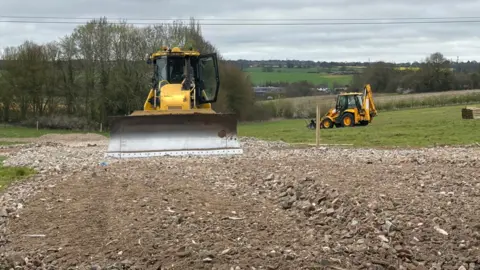
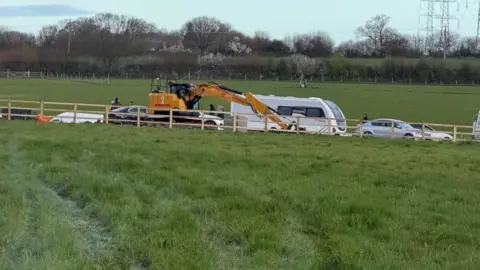
BBCThe rapid creation of an "unauthorised encampment" of caravans on the outskirts of a village over Easter was "like a military operation", according to residents.
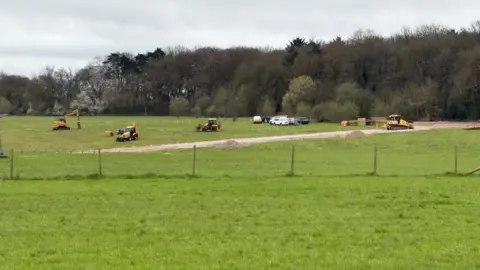
Diggers and bulldozers arrived on a green field site in an area of outstanding natural beauty (AONB) in the Chiltern Hills, near Flamstead, Hertfordshire, on Thursday.
A temporary stop notice - a planning enforcement tool used to halt work - was issued by Dacorum Borough Council on Saturday and Hertfordshire Police said it was investigating a "number of allegations" in the wake of the arrival of the caravans.
What took place in Flamstead and what does the law say about unauthorised encampments?
What took place and when?
 Supplied
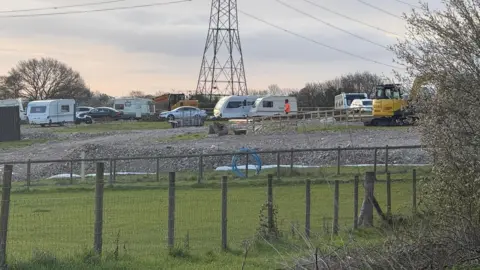
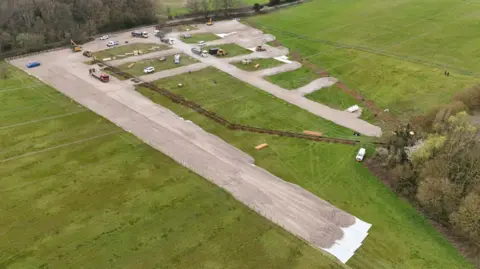
Diggers and bulldozers started arriving in the village on Thursday after 17:00 BST, according to a spokesperson for Flamstead Parish Council.
"Before we knew it we had lorry after lorry load of concrete, JCBs putting in drainage and and sewage pipes," said the spokesperson.
"Signs were put up on the site claiming squatters' rights... it's like a military operation."
Flamstead is home to about 2,000 people, has three pubs and "has a thriving church community, lots of volunteers and is very community oriented - like England in the 1960s, everyone says hello", the spokesperson said.
The parish council is not sure who owns the field and the borough council said it is "unable to confirm that at this time".
Dacorum Borough Council moved swiftly to get an emergency injunction from the Royal Courts of Justice and issued a stop notice, but the villagers feel "really isolated as a community and we don't deserve that," the spokesperson said.
"We have planning rules for a reason, but if the laws are only there for people who want to uphold them then that really is an eye-opener," they added.
The problem is not new
 Flamstead Parish Council
Senior judges have grappled with issues relating to unauthorised encampments more than once in recent years.
Supreme Court justices published a ruling about a case centred on unauthorised encampments in 2023.
Justices considering the case heard how between 2015 and 2020, 38 different local authorities, or groups of local authorities sought injunctions against "unidentified and unknown persons", which in "broad terms" prohibited "unauthorised encampments".
In 2024, a High Court judge heard that between 2016 and 2018 there had been 65 encampments on land maintained by Luton Borough Council; in 2017 there had been 212 encampments in Hampshire; and, between 2015 and 2017, South Gloucestershire Council dealt with about 100 unauthorised encampments.
The solution is not simple
Flamstead villagers were shocked to discover the police were unable to prevent the development from taking place.
Hertfordshire Police said while it is "aware" of the "unauthorised encampment" in Flamstead, "in these circumstances, police have no enforcement powers to prevent access to the land or building work taking place; this is a civil matter being led by the borough council".
Nevertheless, they say they are "continuing to monitor the situation" and investigating a number of allegations of offences.
They said a "police presence remains in the area" to "prevent a breach of the peace and deal with any criminal matters".
Villagers described a police car being pushed into a ditch at 07:00 BST on Sunday, but the police spokesperson denied that.
"A small amount of damage was caused to a parked police car by a passing vehicle, but no police cars were rammed/pushed into a ditch," they said.
Dacorum Borough Council added it is taking steps to stop work continuing and had begun civil court action.
'Not a crime'
Law firms, councils, police forces and the Crown Prosecution Service have published online advice to landowners.
The Metropolitan Police explained some of the legal difficulties in its guide, Trespassers on private land.
"Entering private land without the owner's permission is trespassing," it said, while pointing out that "trespassing is not classed as a criminal offence".
It added that in "most cases", trespassing "is not a matter for the police".
The Met recommend taking the case to a civil court judge, explaining: "The best and safest course of action may be to get a court order to evict them. If the court order is breached, it could become a criminal matter."
Police powers
 Supplied
The Country Land and Business Association (CLA) explained trespassing on the land is a tort.
This means that it is a civil wrong for which the landowner may seek a remedy through the civil courts.
Andrew Gillett, the CLA's chief legal adviser, says: "There is a common law right to ask people to leave or forcibly remove them.
"But if you use more force than is necessary, than you could be guilty of a criminal offence."
The CLA offers landowners "tips for deterring trespass" in an attempt to prevent any unauthorised encampments in the first place.
But while trespass has largely been a civil matter until now, that changed in 2022, Gillett adds, giving police more powers.
It is now an offence for someone over 18 to reside on land without the owner's consent and have, or intend to have, at least one vehicle with them.
"The CLA would like to see police following adequate training to understand what the new law is - and for local authorities to provide adequate number of legal sites so travellers have somewhere to go," he says.
What does the injunction say?
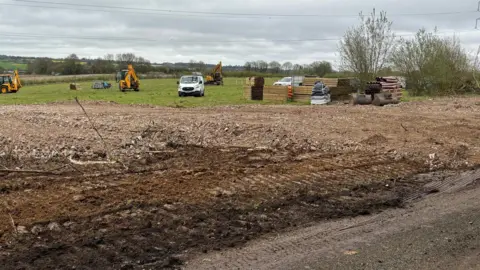
The injunction obtained from the Royal Courts of Justice by Dacorum Borough Council prohibits the bringing of any more building materials or machinery and caravans or mobile homes onto the site.
It also prohibits the installation or connection of services such as running water, electricity or sewage.
Gillett says an injunction can be a "very effective deterrent" because, if the trespasser breaches such an order, they can be in contempt of court and face a prison sentence.
What if this is not trespass?
 Flamstead Parish Council
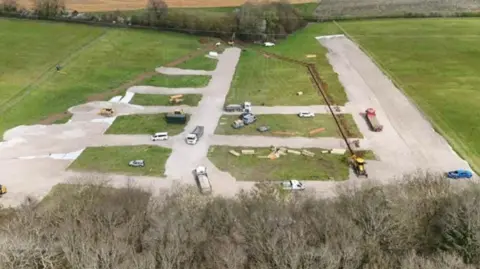
A judge has been told that about 20 adults occupying the site near Flamstead want "retrospective planning permission" to create a "gypsy site".
Lawyers representing people who have moved in near Flamstead say there is a "lack of unsuitable available lawful alternative accommodation" in the district.
People who erect homes or buildings usually require planning permission, which, in most cases, is granted before construction works start.
But retrospective planning permission can be granted after building has begun - according to the Town and Country Planning Act 1990.
Rules say people who build homes - or other buildings - must to prove that planning permission would have been granted in the first place.
Traveller Sites
Cliff Codona, chair of the National Travellers' Action Group, has spent decades advocating for the travelling community and criticised councils for not providing enough legal sites.
"Money is not being spent on developing spaces for people to live and they are taking matters into their own hands in desperation - they've got an overwhelming need for somewhere to live," he said.
Friends, Families and Travellers, a non-profit organisation, has previously said the provision of official spaces for traveller communities is "virtually non-existent".
The organisation said "too many families remain stuck in limbo", adding more than 3,000 families have no lawful place to stop.
"An unfavourable planning system and the abject failure of local and national government to ensure sufficient sites are built means that around 10,000 people live on land without permission," it has reported.
Codona said: "I've worked with a lot of local authorities and help them the best I can, but if we walk into a council and say we went to develop land, the locals will start action against it.
"We've never got permission anywhere apart from taking it in our own hands."
Gillett reiterated the CLA's call for local authorities to build more legal sites.
"We don't think local authorities are good at providing sites because there tends to be local opposition when they are proposed - they need to be forced by government to ensure they provide sufficient sites," he said.
Do you have a story suggestion for Beds, Herts or Bucks? Contact us below.
Follow Beds, Herts and Bucks news on BBC Sounds, Facebook, Instagram and X.
