Distillery claims 'world first' in bid to produce low-carbon whisky

 Getty Images
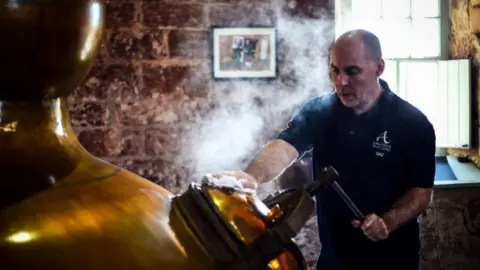
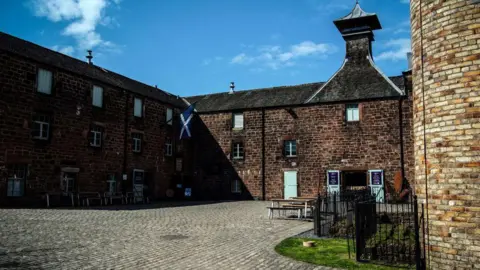
A south of Scotland distillery claims to be the first in the world to use a new environmentally-friendly way of producing the heat needed to make whisky.
Annandale Distillery in Dumfries and Galloway wants to be a pioneer in producing "low-carbon" whisky.
It has commissioned a project which, it says, produces a heat of 1,200C using low and zero carbon electricity, rather than fossil fuels.
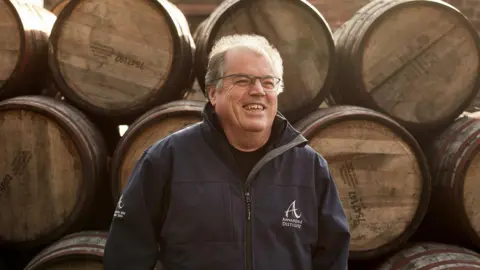
"This is a first - not just for the whisky industry or Scotland - but globally," said Prof David Thomson, a co-founder of the distillery.
He told BBC Scotland News that a heat storage system is used to generate the steam required for the distilling process.
"And it works very simply - we take green electricity which has been generated by wind turbines locally," he said.
"Rather than storing the electricity in a battery, we store it as heat in a giant heat store.
"And then when we want to create steam we blast cold air through the heat store and it heats up to a very high temperature - about 5-600C.
"We pass that through something that's quite similar to a regular steam boiler and that's how we produce steam."
 Annandale Distillery
The distillery is working on the project with Exergy3, a clean-heat technology company, and local boiler-makers Cochran Ltd.
It says the new system has a physical footprint no larger than the average garage and requires only minimal infrastructure.
At Annandale, three modules totalling 30Mwh storage capacity supply hot air to the 3MW Cochran boiler which converts it into green steam at 10 bar pressure.
 Getty Images
Prof Thomson said: "The whole point is it allows us to produce whisky with a much lower carbon impact. We are definitely pioneering.
"The only problem we have is the price of electricity is very high still. We have the highest electricity costs in Europe. Even though we can buy off peak electricity very cheaply, once the green levy is added to it, it's very expensive."
It is part of the distillery's decarbonisation plan, with bottling a maturing whisky on site to reduce road miles and switching to electric vehicles where possible.
They are also exploring alternative waste-reuse options for spent grain and carbon dioxide.
Annandale Distillery closed in 1919 but it was brought back to life earlier this century after a major restoration project.
It was officially opened by the Princess Royal in 2015 and in 2024 its owners celebrated their first 10-year-old single malt since resuming operations.

Scotland's whisky industry has long been keen to innovate in the name of sustainability and has a target to fully decarbonise operations by 2030.
Some producers have begun using electric lorries to transport the whisky on short journeys to bonded warehouses. Others have trialled using paper bottles instead of glass.
On the Dornoch Firth, the Glenmorangie distillery even created an oyster reef so the tiny molluscs can filter-clean the residual effluent created by the distilling process.
Annandale is embarking on one of the most difficult areas to decarbonise: creating the high-temperature, high-pressure steam needed for production.
With industrial processes like this accounting for 13% of Scotland's planet-warming greenhouse gas emissions, these are issues that need to be tackled if climate change is to be halted.
