The rural pubs forced to adapt in 'hit-and-miss' market

 Glenys Crampton
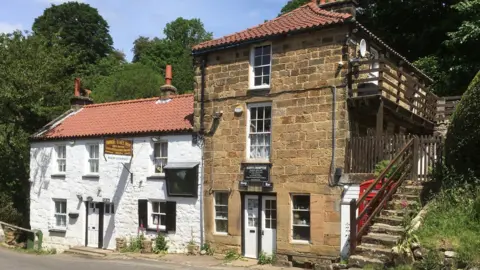
"The main challenge is that people have to travel to get here and at the moment everybody is a little bit short of cash," says Glenys Crampton, landlady of The Birch Hall Inn. "It can be very hit and miss whether you have a busy day or not."
Crampton has been running the pub at Beckhole for more than 45 years.
It is in a tiny hamlet of just nine houses and a farm, in a deep valley between Goathland and Whitby. The nearest public transport is a mile-and-a-half away up a hill with a 1:3 gradient.
Crampton says it's a special outing for people when they visit.
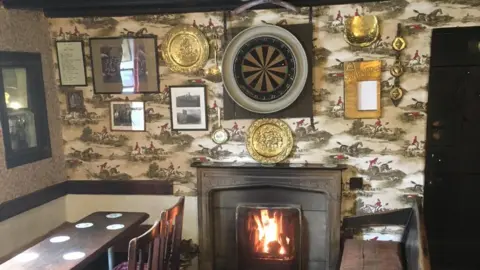
"It's a one-off. It's almost exactly as it was in 1860 when it opened," she says.
"When you come in you step back in time and everything sort of sinks around you. I always think of it as one of those snow globes, you shake and then everything just settles down.
"You can see people come in and they're all jingly-jangly from having driven and thought about where they're going and then they sit in the bar with the fire on and you can just feel their shoulders drop. You can't get that in many places."
 Glenys Crampton
Recent figures from the Campaign for Real Ale (Camra) show the number of pub business closures in North Yorkshire in 2025 was 35. That was more than double the number in 2021, when there were 16.
Nick Love from Camra says footfall and transport can be a challenge for rural pubs.
"The advantage is obviously the competition is low, they might be the only pub for miles," he says.
"But the problem is the resilience level is low as well so they'll have lower turnover because they're not in the middle of a city."
Crampton says customer habits have changed as well over the years, so the pub has adapted too.
She sees fewer people with younger families, and fewer customers visiting in the evenings, so has shortened the hours the pub is open and shifted to a more daytime operation.
"We're primarily a walkers' pub. People are out and about in the mornings, they call in for lunch and then move on to somewhere else.
"It's seasonal in a big way. On average in the winter in a week the takings will be what they would be in a day in the summer."
'Hard to keep motivated'
That is something Andrew Hields - who owns three pubs in the Yorkshire Dales - agrees with.
"As much as rural pubs are beautiful places to go to, they are seasonal. Great summers but very, very hard winters," he says.
"Add on top of that the additional energy costs and business rates, it just keeps piling up… it's hard to keep motivated with all these challenges coming at us."
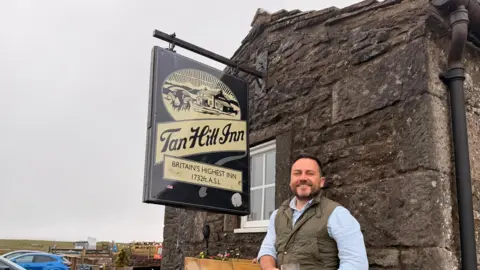
Hields runs "Britain's highest pub", the Tan Hill Inn in Swaledale near Keld.
It is 1,732ft (528m) above sea level and six miles from a main road.
 Andrew Hields
Hields says it faces a specific challenge because of its "off-grid" status, meaning it is not connected to any mains service - no electricity, water or gas, and it runs off a generator.
He says the generator costs £80,000 a year to "keep the lights on and put the kettle on" and with the recent rise in diesel costs, he says that is now in excess of £100,000.
Hields says his three businesses have also suffered from recent road closures.
"We appreciate roads need maintaining but we've literally had road closure after road closure and all at the same time as well."
He says it has cut off communities.
"It's OK if there's a diversion in place but that diversion can take an extra hour-and-a-half."
'Location is so important'
Victoria Wells, Professor of Sustainable Management at the University of York, says pub customers tend to keep travel to a minimum.
"Our research has really shown that people go to the nearest best pub," she says.
"And if that's in a city they might have to travel 300 metres, but in a rural situation it's really, really hard to get there.
"Location is so important and rural pubs are often so distant from places that it's difficult to get that trade."
She says rural pubs have faced the "added impact" of the cost-of-living crisis.
"Often people have to travel to go to rural pubs and if you're asking someone to pay travel costs, especially when there aren't that many options for public transport, so you're asking someone to get in their car and travel as well as paying to go to the pub.
"This is really, really hard for them."
Listen to highlights from North Yorkshire on BBC Sounds, catch up with the latest episode of Look North.
