How I coped on a treadmill in Miami World Cup heat

 BBC
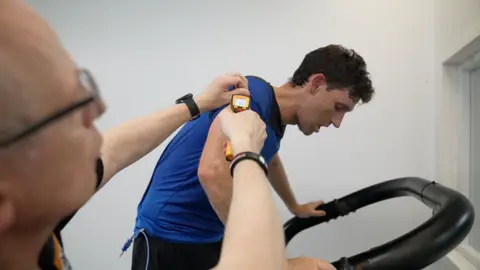
BBCThe Three Lions will face 90 minutes of soaring temperatures and humidity in Miami for the World Cup quarter finals - but recreating the conditions in a laboratory, I could only manage a third of that.
The University of Brighton's Environmental Chamber can simulate a range of hot and cold temperatures from -20°C to 50°C (-4°F to 122°F), as well as different humidities and altitude conditions.
So, with the weather conditions a constant topic of discussion this tournament, I was tasked with seeing how I would fair in a 30-minute treadmill test.
In the end, I had to call it at 27 minutes.
'Catastrophic failure'
With monitors measuring temperature and heart rate, the test for heat acclimatisation was a run at 9 km/h (5.6 mph), with a 2% incline.
In Miami on Saturday, temperatures are expected to hit 32°C (89.6°F) and 70% humidity.
With environmental extremes expert Dr Neil Maxwell helping to recreate the conditions, the chamber reached 33°C (91.4°F), but it was the 73% humidity that made it so challenging.
In the sort of conditions we usually have in England, I would have found a run for that time, at that pace, quite easy, and it started off that way.
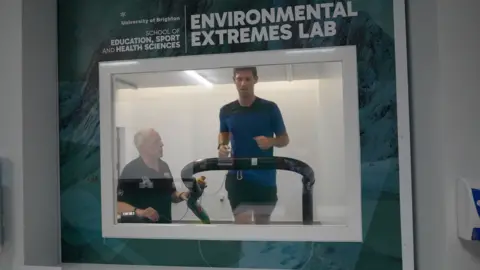
But around 20 minutes in, I started to experience what Neil called a "catastrophic failure", as my core temperature rose and it felt like there was nowhere for the heat in my body to go.
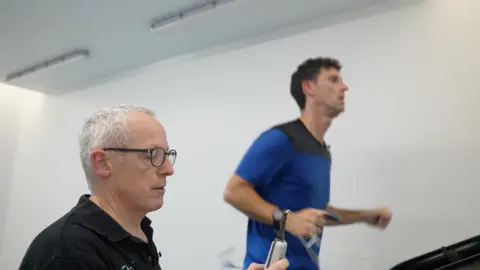
My form deteriorated, my heart rate reached a speed it hasn't in years, and with three minutes to go in the test, I had to call it and jump off.
What surprised me is just how fast it happened – I was talking and joking with Neil around 20 minutes in, and by the time I came off I could barely hold a conversation.
'Dual stressor'
With my feet in an ice bucket, Maxwell explained how it is even tougher to bring your temperature down if you are sprinting like a footballer, and dual tasks – like considering tactics alongside running – become more difficult.
"It's a dual stressor," he said. "They are trying to make complex decisions.
"The challenge the humidity will bring is that the sweat that is on the players' skin is going to drip off and it's only when you evaporate that sweat that you cool off."
And what of the hydration breaks that have become such a talking point this tournament? Maxwell said tests they ran showed they had limited benefit.
He said: "We had a group of students in and we were testing hydration breaks. We found there was no difference in the physiology at all.
"Perceptually they felt a bit better, but it was lost very soon."
England are due to face Norway in the World Cup quarter-finals in Miami at 22:00 BST on Saturday.
Follow BBC Sussex on Facebook, X, and on Instagram and listen to BBC Radio Sussex on Sounds. Send your story ideas to southeasttoday@bbc.co.uk or WhatsApp us on 08081 002250.
