North Korea's powerhouse women footballers are in Seoul to fight for title
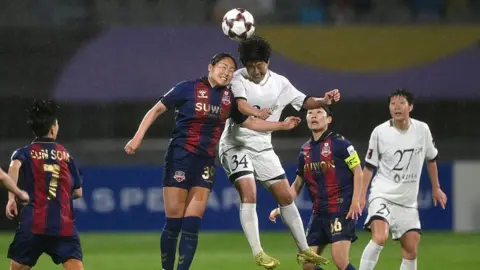
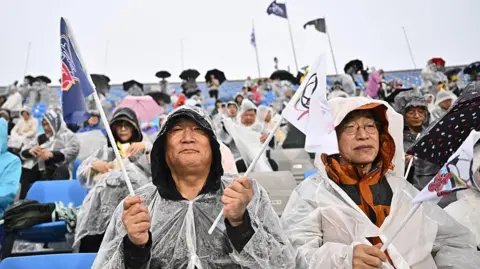
Pounding rain and strong winds did not stop more than 5,000 spectators from turning up at a football stadium in Suwon, just south of Seoul, on Wednesday night.
Wrapped in raincoats, they cheered and booed, their screams sweeping across the stands as a rare match unfolded on the pitch: North Korea vs South Korea.
But there was something more unusual. Hundreds of South Koreans appeared to be cheering with loud cries of "Naegohyang", the name of the visiting North Korean club. They had been brought together by local NGOs who wanted them to cheer both sides.
The North Koreans' participation was initially met with scepticism: the relationship between the two sides has soured in recent years as Kim Jong Un tested a record number of ballistic missiles and continued pursuing nuclear ambitions. In 2023, he formally abandoned Pyongyang's long-standing goal of reunification with the South and has since designated it a "hostile state".
But the team arrived as expected, the first athletes to travel south of the border since 2018 - and the Naegohyang Women's Football Club marked the return with a win in the semi-final of the Asian Women's Champions League.
They beat South Korea's Suwon FC Women 2-1, with second-half goals from Choe Kum Ok and Kim Kyong Yong. Tonight they will face Japan's Tokyo Verdy Beleza in the final.

 AFP via Getty Images
For football fans and those who have followed North Korea's record, the result did not come as a surprise.
North Korea has long held a strong reputation in women's football. It stands 11th in Fifa rankings, the second-highest ranked Asian side after Japan.
Founded in Pyongyang in 2012, Naegohyang won the North Korean league title in 2022. The squad includes several players from the national team and is currently managed by a former head coach of the women's national team.
"North Korea is highly focused on discovering and training young football talent," said Kim Yong-hyun, a professor of North Korean Studies at Dongguk University in Seoul.
Kim Jong Un, who like his father is known for his strong interest in sports, pledged to turn North Korea into a "sporting powerhouse" soon after taking power in 2011.
The Pyongyang International Football School, built in 2013 on Rungna Island in the capital, is regarded as a cradle for elite football players, training promising youth from across the country.
"Even in the 1990s, when I was training in North Korea, there was already a well-established system in schools to nurture young athletic talent," said Kim Sang-yoon, a former North Korean national boxer who defected in the 2000s.
"At elite sports schools, talented students were usually selected and trained from elementary or middle school."
 AFP via Getty Images
The reclusive dictatorship's footballing success often stands out given its economy has been hit hard by Western sanctions over its nuclear programme, which takes up a large portion of its national budget.
Although the families powering the regime lead wealthy lives, North Korea is still one of the poorest countries in the world. The average person struggles to earn much in a state-controlled economy, and leaving for a better life elsewhere is a dangerous choice. If caught, they could end up in prison or a labour camp.
And yet the top-down emphasis on women's football has paid off, analysts say, even serving as propaganda for a regime that is always looking for wins on the world stage.
For the athletes, success offers a rare opportunity to improve their social status.
In some cases, star athletes have reportedly been rewarded with luxury cars, apartments and even membership in the ruling Workers' Party. The last is a huge boost in status in North Korea's deeply hierarchical society.
The women's success has also brought them a lot of public attention in the country, making the game very popular, said North Korean defector and former athlete Han Seol-song.
North Korean women's football has already built an impressive record, including victories at the 2024 Fifa U-20 Women's World Cup, the 2025 Fifa U-17 Women's World Cup and the 2026 AFC U-17 Women's Asian Cup: achievements that far outshine those of the men's side.
"The biggest weakness of North Korean male athletes is their smaller physique," said Heo Jeong-pil, who studies North Korean sports.
"To compete with Western athletes in terms of physical condition, they would need comprehensive management, including a meat-heavy diet and sufficient nutrition, but in most cases that is not possible."
 BBC/Yujin Choi
North Korean women, on the other hand, "are very tough and resilient", Han said, reflecting a widely-held perception of them as hardworking and resourceful breadwinners in a country where everyday life can be incredibly hard.
He added, cautiously, that he did not want to sound "sexist" but he believed North Korean female athletes had a better chance of achieving strong international results than men because women's sports leagues have not always been as competitive globally - especially at the time when Pyongyang decided to focus on developing the sport.
Some observers believe this goes back to the late 1980s when Fifa agreed to start a World Cup for women. "Maybe someone came to Kim Jong-il and said to him that we could use this," Brigitte Weich, a filmmaker who followed the North Korean team for five years to make a documentary, told BBC Sport in 2024.
"North Korea is not the best in economics, science, human rights and the rest, but in countries like this they can be good at some sports because, from the top down, they can focus on training and nothing else."
It's impossible to know what ordinary North Koreans make of this week's win, or how many of them were even able to watch Wednesday's match given they have limited access to the internet or media.
But South Koreans will be watching - and on Saturday again, there will be a cheering squad, courtesy the Unification Ministry, although their decision to fund it has drawn some criticism.
Beyond the pitch, there are those who remain hopeful that sports could help rebuild trust and open the door to better relations between the two Koreas.
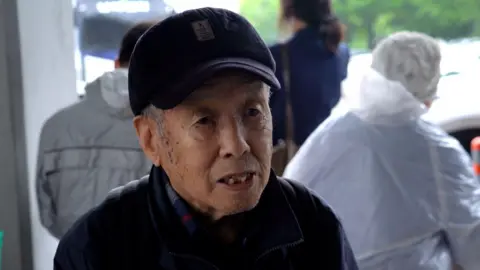
Choi Jong-dae, who was at Wednesday's match, is one of them. The 91-year-old was separated from his mother and four siblings during the Korean War. He was 16 when he ended up south of the border and he never saw his family again.
"I feel like these North Korean players are like my granddaughters," he said. "Who knows? One of them might be the daughter of one of my siblings or relatives. I hope they do well."
