Move to scrap German at GCSE and A-level described as 'short-sighted'

 Dr Syamala Roberts
Changes to GCSEs and A-levels will mean several qualifications in subjects including German, Economics and Engineering are to be scrapped.
The Northern Ireland exams board, CCEA, said the subjects will not be offered by it from the end of the decade.
Other qualifications to be withdrawn include GCSEs in Leisure Travel and Tourism, Learning for Life and Work and Contemporary Crafts, and the A-level in Professional Business Services.
CCEA said it had made the "difficult decision" on factors such as "candidate entry patterns and the long-term sustainability of these subjects".
Dr Syamala Roberts studied GCSE and A-level German at Methodist College in Belfast and is now a post-doctoral researcher in German at the University of Oxford.
She said she was "very concerned".
"I first learned German at school in Belfast and it quickly became one of my favourite subjects, preparing me for a life of travel, study, teaching and working with other cultures," she said.
She said it was a "short-sighted move" that will limit the perspectives of pupils.
"Knowledge of German offers pupils the chance to access study and employment in Europe's biggest economy, which enjoys close trade and economic links with Ireland and the UK."
She said she urged CCEA to rethink its decision.
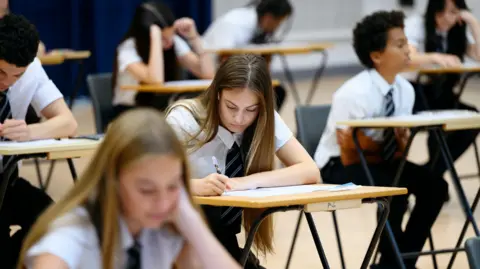 Getty Images
CCEA told BBC News NI that final courses in the GCSE subjects would begin in schools in 2028 with final awarding of qualifications in 2030.
Final courses in the A-levels would begin in 2029 with final awarding of qualifications in 2031.
"As with all changes to our qualifications offer, we are engaging directly with schools and colleges to ensure they have sufficient notice and are supported through the transition," a CCEA spokesperson said.
They added that alternative qualifications are available from other awarding bodies.
That means that if a school wants to continue offering the subjects to pupils, it will have to teach and offer them through English or Welsh exam boards.
Many of the subjects being withdrawn by CCEA had relatively small numbers of entrants.
For instance, 369 students took the A-level in Professional Business Services in 2026, while 206 took the GCSE in Engineering and Manufacturing in 2025.
However, 587 students took GCSE German in 2025 but only 49 took it at A-level.
 Dr Ian Collen
Dr Ian Collen from Queen's University of Belfast said that removing GCSE and A-level German from Northern Irish qualifications "sends the wrong message to young people and risks further diminishing language learning".
"Employers constantly tell us that languages matter," he said.
"This decision means that German will be the only school subject that pupils can begin at age 11 as part of statutory language learning but cannot continue to GCSE through a CCEA qualification."
 Adam Flanagan
Adam Flanagan, 25, studied German to GCSE and A-level and now uses the language in his career in information technology.
"In things like engineering and the technology industry, the sorts of industries you associate with Germany, it just seemed a very useful language to have familiarity with," he said.
"There is definitely an argument that learning a language, especially something like German, which has such a formalised, logical rigour to the language, does help you develop logical, analytical thinking."
