Burnham 'confident' early release of PC Harper's killers can be halted

 PA Media
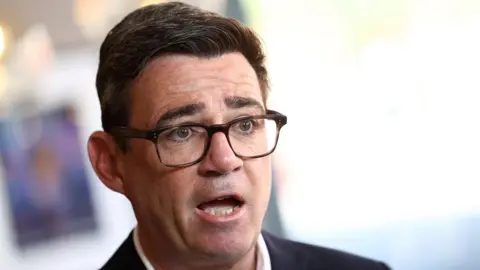
Andy Burnham says he is "confident" PC Andrew Harper's killers can be excluded from the government's early release scheme, as outcry over the case grows.
The prime minister has now ordered the justice secretary to find a way to bar Jessie Cole and Albert Bowers, who were jailed for 13 years for manslaughter in 2020, from early release.
It marks a shift from last week, when he said there was "nothing more" he could do without risking the collapse of the prison system.
The move comes after days of pressure to exclude Harper's killers from the scheme, which is aiming to free about 5,000 offenders in England and Wales to make space in overcrowded jails.
Harper's mother, Debbie Adlam, told the BBC she was in "turmoil" following conflicting reports about whether two of her son's killers would be released from prison early, describing the handling of the situation as a "hash".
Conservative shadow home secretary Chris Philp accused Burnham and Labour of "re-traumatising victims and their families with their constant U-turns".
On Tuesday evening, an open letter signed by 50 chief constables, commissioners and law enforcement leaders called on Burnham to examine "every lawful option" to determine whether the earlier release of Harper's killers can be prevented.
They welcomed the prime minister's intervention, adding: "This provides an opportunity not only to examine every lawful avenue in PC Andrew Harper's case, but to ensure similar concerns do not arise again."
Burnham said a new plan to prevent more prisoners from being freed long before the end of their sentences would be presented to Parliament in September.
It comes after he initially announced some prisoners convicted of rape, serious child sex and other grooming offences would be barred from early release, after a review of the scheme he ordered after he became prime minister.
In an article published last week, Burnham said he had "wanted to go even further" but had "pushed to the very limits of what is possible to do".
He added: "I know I can look people in the eye and say to them there is nothing more I could have asked for without risking the prison system reaching capacity and collapsing within months."
But on Tuesday, Burnham insisted he had never accepted "there was nothing more that could be done" to prevent the early release of more offenders, including Harper's killers.
"I came into office and started pushing on this issue, and I have pushed every single day in office," he added.
Burnham said he would seek to hold talks with other political parties to build "consensus" on the approach to early releases.
 Thames Valley Police
The government's early release scheme aims to address a severe overcrowding crisis in jails, where useable capacity is almost at 100%.
The number of places in jails in England and Wales has not kept pace with the significant rise in the prison population in recent decades under successive governments.
Ministers have said prison spaces might run out as soon as October.
To make more space in prisons, the Starmer government changed the law to give it the ability to release some offenders earlier than they would otherwise have been.
The release point for these prisoners will move from 40% or half of their custodial term to one third for some offenders, and from two thirds to half for others.
Since taking office, Burnham made exemptions for those convicted of some serious offences, but not manslaughter, prompting a backlash and pressure to block the release of Harper's killers.
Harper, 28, from Wallingford, Oxfordshire, died in 2019 when he was dragged behind the getaway car of three teenagers who had fled the scene of a quad bike theft in Berkshire.
Two of his killers, Cole and Bowers, will become eligible to be freed from jail next year under the release scheme as it stands.
The third man jailed for the manslaughter of Harper - the vehicle driver Henry Long - was given a longer 16-year jail term and cannot be considered for early release.
It is not yet clear how the government will prevent Cole and Bowers from being treated the same as other prisoners with similar sentences.
At the end of June, there were 1,015 people in prison in England and Wales for manslaughter, including 950 men and 65 women, according to the Ministry of Justice. It is not known how many of these are eligible for early release.
Probation strike threat
Last week, Burnham also ordered an "urgent" review to identify any grooming gang members who may be eligible to be freed from jail early.
The government has not confirmed whether the review will lead to the prevention of any early releases of offenders convicted of grooming-related crimes.
Offenders being released from prison partway through their sentences is a well-established feature of the UK's justice system.
It is not uncommon for offenders to serve some of their sentence in the community, under the supervision of the probation service and subject to restrictions, such as electronic tag monitoring.
The government has promised to put in place tougher probation conditions on offenders when the new early release scheme is rolled out.
But Napo, the probation union, said the system is already struggling to cope, warning a bigger workload will put public safety at risk.
It announced on Tuesday that said 90% of its members had backed potential industrial action if its concerns over "excessive workloads" in the system are not addressed.
"The government cannot keep treating probation as the place where the consequences of failures elsewhere in the criminal justice system are dumped," Napo national chair Ben Cockburn said.
