One big win and three defeats for Trump in dramatic day at Supreme Court
On the second-to-last day of Supreme Court decisions for this term, the justices delivered a big win for Donald Trump.
But beneath the headline-generating ruling on expansive presidential power, the court gave some indications that this particular president may not always get what he wants – and the three liberal justices may have a few unexpected allies amongst the six conservative justices on the high court.
Here's a look at the three biggest takeaways from an eventful Monday morning for America's judicial branch.
1. Sweeping presidential authority over 'independent' regulators
Nearly 100 years ago, the Supreme Court ruled unanimously that Democratic President Franklin Delano Roosevelt did not have unchecked power to replace commissioners on regulatory agencies set up by Congress to be insulated from presidential authority.
On Monday, facing a challenge by Republican Trump, the court decisively scrapped that precedent.
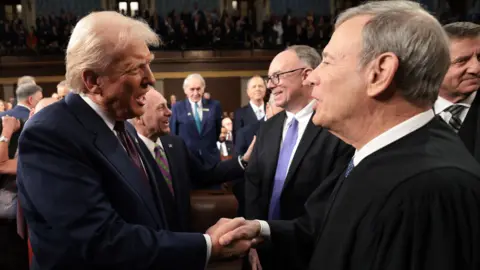
"Subordinates who exercise the president's power are subject to removal by him," Chief Justice John Roberts wrote in the majority opinion. "Then, and only then, can they remain accountable to the president, and the president to the people."

 Getty Images
In this ruling, the court's justices divided into familiar groupings. All six conservatives, three of whom were appointed by Trump, found in favour of the president. The three liberal justices, all appointed by Democrats, dissented.
The court's decision will give Trump, and all future presidents, broad power to remove and replace regulators from dozens of key agencies with whom they disagree.
The Federal Trade Commission was directly at issue in this case (as it was in Roosevelt's), but the precedent the court sets here will apply to regulatory bodies interpreting election laws, issuing communications policies, resolving labour disputes and establishing financial and environmental regulations.
By now, Americans are used to dramatic policy swings when a president of a different political party takes over the presidency – from Barack Obama to Trump to Joe Biden and back to Trump. This court's decision is sure to supercharge that trend.
"Ninety years of precedent has been completely and unequivocally overruled," Trump exclaimed in a Truth Social post after the decision, "greatly increasing presidential power at a time when it is most needed!"
2. Liberal justices find conservative allies – much to Trump's dismay
While the Supreme Court on Monday gave presidents broad powers over supposedly independent regulators, a different grouping of justices drew the line when it came to Trump's efforts to remove a member of the powerful Federal Reserve Board of Governors.
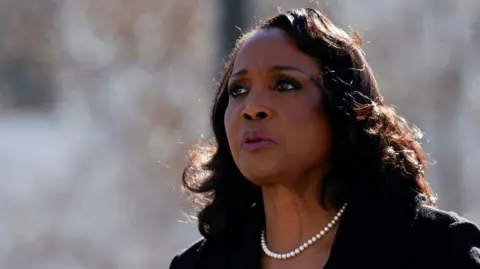
In a narrow five-to-four ruling, two conservatives – Chief Justice John Roberts and Brett Kavanaugh – joined the three liberals in blocking Trump's attempts to remove Lisa Cook from the central bank's board.
 REUTERS/Nathan Howard/File Photo
He has alleged that she committed mortgage fraud, but hanging over the particulars of this dispute were Trump's larger disagreements with recent decisions by the Fed (including Cook) not to lower US interest rates.
Writing for the majority, Roberts said that Cook deserved a chance to challenge her removal and rebut Trump's accusations, which would have to be further substantiated. Roberts warned of the "calamities that could arise" if presidents were able to impose their will on the Federal Reserve.
If that ruling weren't enough of a setback for the president, another court decision on Monday – on whether federal law prohibits states from counting mail-in ballots postmarked by election day but received after – broke against the president.
In that case, the three liberal justices were joined by Roberts as well as Trump-appointee Amy Coney Barrett, who penned the majority opinion.
States have broad powers to set the "time, place and manner" of holding congressional elections, Barrett wrote, quoting the US Constitution. She dismissed Trump's allegations that mail-in balloting is susceptible to election fraud, indicating that this was an issue best resolved through the "democratic process".
Trump was quick to call for just that, urging Congress to pass his election-reform package that would significantly curtail mail-in voting.
Although the Republican-controlled House of Representatives has approved this legislation, Democrats – and a handful of Republicans – have blocked a vote in the Senate.
The president may have won sweeping new powers, but when it comes to two of his big policy goals – lower interest rates and election reform – the court majority was not his friend on Monday.
3. Trump's defamation appeal quietly flops
If Trump's Truth Social account is any indication, the biggest source of his ire on Monday was buried in 28 pages of court orders released on Monday morning.
Listed among dozens of cases the justices chose not to weigh in on was "Trump, President of US v. Carroll, E. Jean".
With no further explanation provided, the court declined to review the $5m civil judgement against Trump that was the result of a 2023 jury finding that Trump had defamed Carroll, a former magazine writer who accused Trump of sexually assaulting her in a department store dressing room in the 1990s.
"I will continue the fight against this weaponization and lawfare case against me, including the ridiculous claim of defamation, with all my power and strength," Trump wrote on his social media website.
"This injustice cannot be allowed to stand!"
Although Trump plans to appeal a separate $83.3m finding of damages won by Carroll in a second case, this is likely the end of the line for Trump's efforts to block the $5m judgement.
When it comes to interpretations of the law, the Supreme Court's rulings are final – a point that was vividly illustrated for Trump, both to his joy and disappointment, on Monday.
 REUTERS/Adam Gray
Follow the twists and turns of Trump's second term with North America correspondent Anthony Zurcher's weekly US Politics Unspun newsletter. Readers in the UK can sign up here. Those outside the UK can sign up here
