'We won't allow riots to happen again like in 2001'

 PA Media
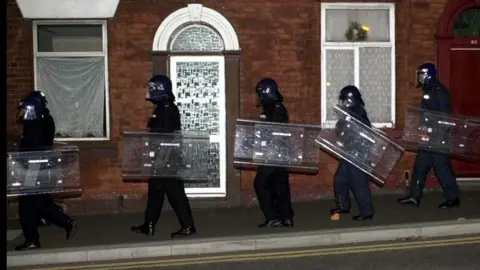
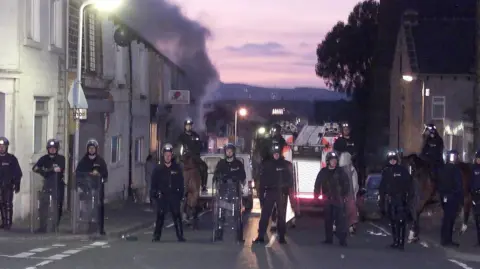
Just after the turn of the millennium – now a quarter of a century ago – the worst racial violence Britain had seen since the 1980s began in Oldham in May 2001.
It would spread to Burnley the following month, and cross the Pennines to hit Bradford in July.
Reports would later pin the blame partly on "deep seated" segregation, which authorities had "persistently failed" to face up to since the 1970s – leading to communities living what were termed "parallel lives".
The government and councils were advised by Prof Ted Cantle to ensure schools were less segregated - or at least that they mixed more – and to use housebuilding programmes and regeneration as a way to stimulate neighbourhoods to be more ethnically diverse over time.
After the debris was cleaned up, local politicians, volunteers and community leaders spent the next 25 years trying to build bridges.
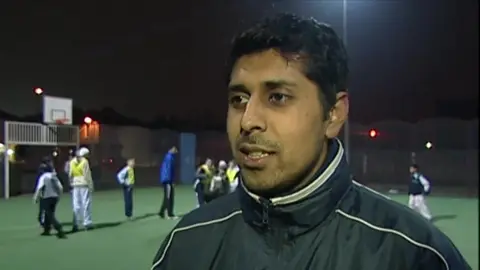
"This is a different Burnley from what we had 25 years ago, it's different communities, the challenges are different," said Afrasiab Anwar – who set up football classes for young people from both communities and went on to be a trustee of the cross-community group Building Bridges Burnley.
"What we've built over the last 25 years is that we recognise that we've been there and we won't allow it to happen again", said Anwar, who is also the Independent leader of Burnley Council.
The rioting in Burnley began with a fight between two gangs of Asian and white men, but it led to a rampage where an Asian taxi driver was attacked with a hammer, Asian-owned businesses were racially abused and a pub was targeted in retaliation because it was believed attacks were being plotted inside.
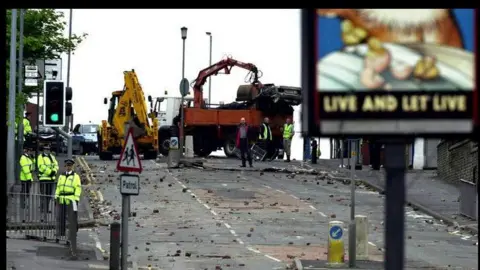
It came a month after three days of ongoing unrest across different neighbourhoods in Oldham, centered on the Live and Let Live pub in the Glodwick – which was attacked leading to pitched battles between police and hundreds of young people, as well as tit-for-tat exchanges between Asian and white groups.
"It does matter – it's part of the history here," said Asam Fiaz, a coach at the Nxt Gen ABC boxing club, based in Glodwick.
Last year the club received funding through Oldham Council's government-funded Community Cohesion and Resilience Programme to run a series of workshops around "building positive community relationships and tackling harmful narratives".
Matthew Rushton, 22, was a youth leader on the programme and told the BBC it was "good for everyone to get on the same page for once and put aside colour".
Fiaz said the club's weekly sessions are also attended by children from Oldham's different ethnic communities.
"I feel now people are moving on and educating the youth to be better," Fiaz said.
Kyle, 16, attends the club and told the BBC the classes are attended by "different races, different religions", adding "we're all together, it's like a little community".
Zergham, 18, said: "On the street we wouldn't even know each other – but now we come to the gym together we get on really good."
 PA Media
Cohesion work 'not the level it was'
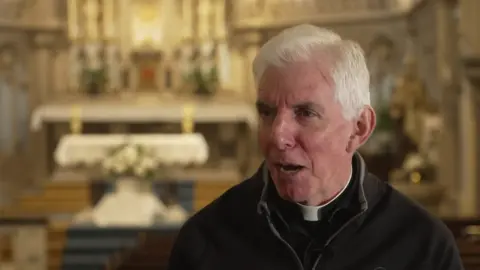
Fr Phil Sumner was transferred by the Catholic Diocese of Salford in the aftermath of the riots to Oldham from Moss Side, where he had worked to bridge divides between communities and police during disturbances there in the 1980s.
He worked with Muslim and Hindu counterparts to form the Oldham Interfaith Forum, which promotes "harmony among people of all faiths and backgrounds".
"We know we're not there, we know we're not a paradigm of what everyone should be doing, but I believe we've done quite a considerable amount," he said.
During the coronavirus pandemic in Burnley, the town's Ghausia mosque – built at the site of one of the 2001 flashpoints in Daneshouse – began collecting for a foodbank hosted as the West End community centre, which is sited in a white-majority part of the town.
"That had an amazing impact and a positive impression was created of two diverse communities coming together", said Chris Keene, one of the centre's trustees.
Half of the last 25 years have seen government austerity cuts hit some of the funding for projects and organisations that promoted integration and cohesion in Oldham and Burnley – including the West End centre which works with the campaign group Hope Not Hate and part-hosted a diversity festival last year.
Keene said volunteers had to take over the cost of running the community centre from Lancashire County Council – meaning "we have to raise a minimum of £50,000 a year to keep the doors open and the lights on".
"That's energy and effort that in the past would have been deployed identifying and meeting needs" in a community which is ranked by the Office for National Statistics as the 17th most deprived in England.
"There's a lot of high quality work that still goes on, but it's not the level that it was," said Keene.
Cantle's report called for twinning between schools from different communities, and for admissions policies which would avoid more than 75 % of pupil intake being from any one culture or ethnic background.
Afterwards all of Burnley's secondary schools were rebuilt and reorganised under the former Labour government's Building Schools for the Future programme, which it was hoped would raise standards as well as improve community cohesion.
There was less radical change in Oldham but Cantle later hailed the setting up of Waterhead Academy, which merged a predominantly white secondary school with one where the pupil roll was predominantly Asian.
His report also called for an "urgent" assessment of the way social housing was allocated and new housing was built in order to provide more mixed neighbourhoods.
Housing estates in both Burnley and Oldham were partially demolished and rebuilt under the former Labour government's controversial Pathfinder housebuilding programme, which was scrapped by the subsequent coalition government in 2010 before some of the new homes had been built.
Many new homes have now been built on the former Pathfinder sites – including on the Burnley Wood estate – but it has not led to the white-majority part of the town becoming significantly more mixed.
The 2011 census showed 96% of people in Burnley Wood were white and 1.7% were Asian, while the following and most recent census showed 94% of the population there were white while the Asian population remained static at 1.7%.
Other white-majority council wards in Burnley did become more ethnically-mixed between 2011 and 2021 with the Asian population increasing – but the Asian majority parts of the town became less mixed with white residents leaving.
The population of the borough was 82% white in 2021.
Mark, who lives in Burnley Wood, said Burnley was a peaceful town, but he added "do we mix enough? Possibly not no".
Tammy, who has lived in Burnley Wood for ten years, said "people are friendly, they say hello and made me feel welcome".
She said she doesn't often see people from other parts of the town, adding "but I don't mix either".
Parallel lives 'myth'
Fr Sumner said parts of Oldham had also become more mixed over the last 25 years.
"I don't think it's as divided – there has been a movement of people from traditionally Muslim or Asian communities into other communities".
Sonny Shah grew up in Glodwick in Oldham – scene of the clashes that started the riots – but was a young child at the time of the disturbances.
"In the community everyone's just getting on with each other, what you see on social media doesn't reflect how people are on the ground," said Shah, who was this month elected to represent the area as an independent councillor on Oldham Council.
Shah said it was "inevitable" that people from the town's different communities would lead separate lives because "you're only going to be friends with someone that shares the life you live – if you're a person that goes to the mosque you're naturally going to be friends with someone who goes to the mosque because you're doing the same thing.
"So long as you have respect for one another I don't think there's an issue if people live different lives," he said.
 PA Media
Oldham Council hopes its plans to build thousands of new apartments in the town centre will lead to a new mixed community.
Council leader Arooj Shah – who recently announced she is to step down – said the town centre was the "one communal area in the borough that everybody visits at some point."
The authority has recently opened a new indoor market along with a range of other projects, which are designed to counter a decline in footfall caused by changing shopping habits so that the town's communities still mix in the town centre.
She said claims people were segregated or led parallel lives in Oldham were "a myth".
"There is a natural factual case to be made about people from predominantly south Asian communities who tend not to move out as much and live near each other," she said.
"When grown ups make a decision to move somewhere and live somewhere – that is choice.
"The challenge that we have is that we have to continue to build hope and aspiration – but in the main people just get on with each other".
New challenges
Fr Sumner said Oldham's new challenges often revolve around "international events" – most recently the Israel-Gaza war – as well as disinformation on social media and what he called "a wave of populism" in politics.
He said the improved dialogue between different faith leaders meant the town was now "more resilient than some places" to address new challenges.
In 2024, gravestones in the Muslim section of Burnley Cemetery were vandalised in the week after the Southport knife attacks, which precipitated rioting in other parts of the country.
Afrasiab Anwar said the vandalism was intended to "provoke racial tensions" but he said he sought the help of local gym owner and former professional Mixed Martial Arts (MMA) fighter Buddy Khan.
Khan said tensions in the town could have "got absolutely out of hand" after the vandalism, but he said he and others were able to "de-escalate" the situation.
People from different ethnic minorities in the town came "close together" to have "a couple of meetings" meaning each "kept their boys quiet".
"Alhamdulillah (praise be to God) there was good in it," he said.
Those involved in bridging both areas' divides are convinced the lessons learned over 25 years helped to ensure they weren't visited by the wave of unrest that spread across England in 2024 – which saw violence that eclipsed that which hit the former mill towns at the turn of the century.
Listen to the best of BBC Radio Manchester on Sounds and follow BBC Manchester on Facebook, X, and Instagram. You can also send story ideas via Whatsapp to 0808 100 2230.
