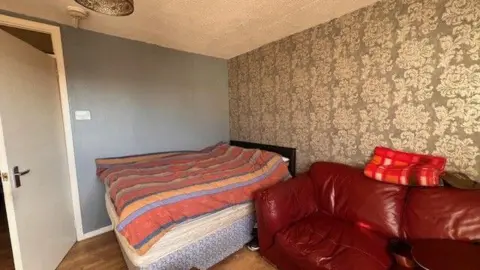
I sleep in the living room as the mould in my council flat is so bad

 BBC
BBCA council tenant has described how his Aberdeen flat is so mouldy and damp he has been forced to sleep in the living room for the past three years.
Gary Bennett - who has fibromyalgia and emphysema - said the conditions have harmed his health and he often goes camping with friends simply to get out of the property.
The 54-year-old wants the council to act, and he told BBC Scotland News: "It's had a massive effect, not only physically but mentally."
Aberdeen City Council said it was liaising directly with its tenant.
Bennett said that he has lived in the two-bedroom flat, in the Woodend area of Aberdeen, since March 2007.
It is a second floor flat in a block of three.
He said that as long as he has lived in the flat there have been problems with mould and damp, and he thinks inadequate insulation may be one issue.
But despite repeated requests to the council over the years, he claims only "band-aid" repairs have been carried out in his home.
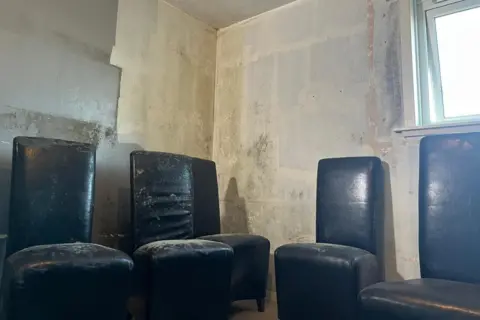
The mould is so bad, with walls, carpets and chairs damaged, he feels unable to have his two granddaughters over to his flat.
 Gary Bennett
The mould and damp has been made even worse by a more recent hole in the roof, which he is also trying to get fixed, he said.
He said others in the block have also experienced problems.
"Enough is enough for me," he said.
"Imagine 20 years breathing this stuff in. It's not easy getting up in this filth every single day.
"It's really, really having a huge, huge effect on my health. It's soul-destroying."
He said of his bedroom: "I can't see anybody wanting to sleep in here."
 Gary Bennett
Bennett said getting out surrounded by nature while camping and fishing was his "sort of reset".
Asked of his current situation, he said: "I just need some help.
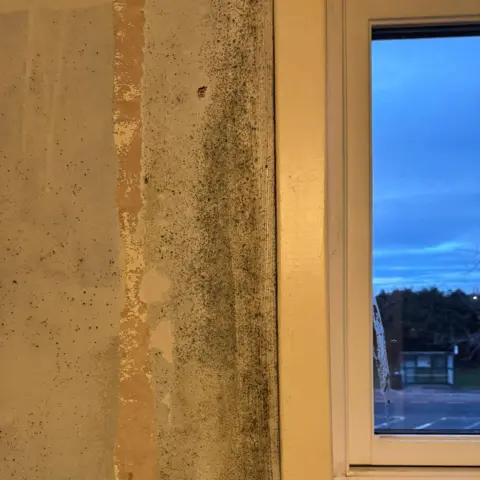
"I honestly don't know why the mould keeps coming back.
"Sometimes they'll wash it and then paint over it.
"I need them (the council) to take it seriously and go 'right, we're going to do whatever it takes'.
"Ultimately, I'd like them to fix the problem."
 Gary Bennett
He added: "I'm kind of stuck here, everything that I've tried to do with the council just falls on deaf ears.
"Why they feel it's okay to leave somebody for 20 years in a mouldy environment is beyond me."
An Aberdeen City Council spokesperson said: "We are aware of concerns raised and we are working with our tenant and will continue to liaise directly with them."
What does a fungus expert say?
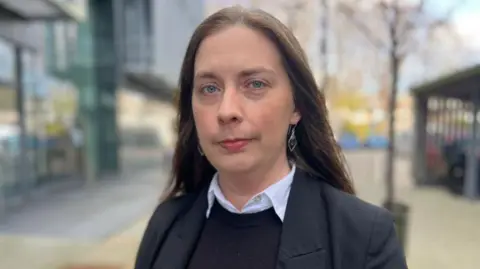
Dr Delma Childers is senior lecturer in medical sciences at the University of Aberdeen.
"Mould is part of everyday life," she told BBC Scotland News.
"What is really dangerous is when you are exposed to high concentrations of mould for a very long time.
"Mould can be very dangerous to individuals because it can irritate the lungs, the respiratory system, and cause allergic reactions or inflammation.
"These allergic reaction over time can become worse and worse, leading to more severe immune consequences."
She explained: "It is dangerous to live in a chronic mould situation especially with uncontrolled damp.
"Mould is part of our environment so we can never fully eliminate it, what we want to do is to try and reduce the amount of mould and damp that is in our home."

New measures are being introduced in Scotland to make it easier for social housing tenants to have damp and mould in their homes fixed.
The move came in response to the Awaab's Law campaign, named after two-year-old Awaab Ishak who died from mould exposure in Rochdale in 2020.
What is Awaab's Law?
 FAMILY HANDOUT
In 2022, a coroner concluded toddler Awaab Ishak had died from a respiratory condition caused by exposure to mould in his home.
His father, Faisal Abdullah, had repeatedly raised the issue with Rochdale Boroughwide Housing (RBH) but no action was taken.
Campaigners demanded reforms and the previous Conservative government carried out a review of guidelines on mould.
Changes to the law in England, via the Social Housing (Regulation) Act, received royal assent in July 2023 - this included new measures on damp and mould, which would be known as Awaab's law.
Awaab's father said he hoped legal changes would "stop any other family going through the pain that we went through".
