Blue plaque honours pioneering female mathematician

 National Portrait Gallery
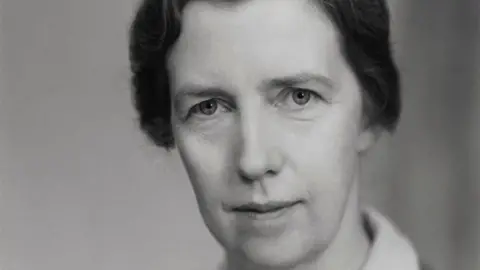
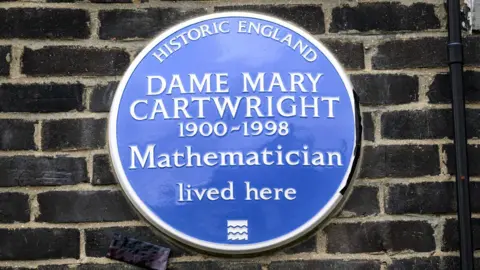
A mathematician who helped pave the way for women to advance in the academic field has been honoured with a blue plaque.
Dame Mary Cartwright was one of the most eminent British mathematicians of the 20th Century whose work laid the foundations for chaos theory.
Dame Mary, who died aged 98 in 1998, taught at Cambridge University's Girton College, where she was mistress from 1949 until 1968, the longest-serving head in the college's history.
The plaque has been installed at her former home, 38 Sherlock Close, Cambridge, where she lived for more than 20 years.
Dame Mary was the first woman mathematician elected a fellow of the Royal Society and the first woman to serve as president of the London Mathematical Society.
She also became the first woman to graduate from the University of Oxford with a first class degree in mathematics, working in both theoretical and applied mathematics.
 PA Media
During World War Two, Dame Mary worked on problems linked to radars that had behaved in unexpected ways.
Alongside leading mathematician J. E. Littlewood, they showed that the problem was not faulty equipment, but that some systems do not behave in predictable ways and that small changes can lead to different outcomes.
It helped lay the foundations for chaos theory, which explains why complex systems, such as the weather or electronic signals, can be difficult to predict.
Their work helped create more effective early warning systems, which were crucial in conflicts such as the Battle of Britain.
 PA Media
Claudia Kenyatta and Emma Squire, co-CEOs of Historic England, said: "It is one thing to know something, and another to truly understand it. Mary Cartwright had a deep love for complex and often obscure ideas, and her work helped unlock new ways of understanding the world through mathematics.
"Just as importantly, her career helped open academic mathematics to future generations of women."
Baroness Twycross, heritage minister, said: "Dame Mary Cartwright's extraordinary achievements are tangible and enduring.
"As well as being a trailblazer for female mathematicians across the world, she played a key role in the nation's survival during the Second World War through her groundbreaking work on radar and radio.
"I know this plaque will serve as a wonderful reminder of her legacy and the work she continues to inspire today."
Do you have a story suggestion for Cambridgeshire? Contact us below.
Follow Cambridgeshire news on BBC Sounds, Facebook, Instagram and X.
