'This memorial means so much'. Remembering the sailors who survived notorious Yangtze incident

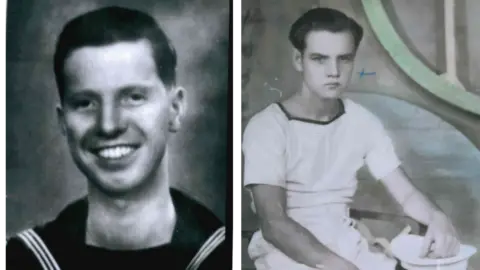 Andrew Bannister/ Raymond McCullough
For the proud sons of two Royal Navy sailors caught up in one of the most notorious incidents of the Chinese Civil War there was only one mission - to have those involved publicly honoured.
Now, following an eight-year campaign, Andrew Bannister and Raymond McCullough can celebrate success in their aim of paying tribute to the Northern Ireland sailors caught up in 1949's Yangtze incident.
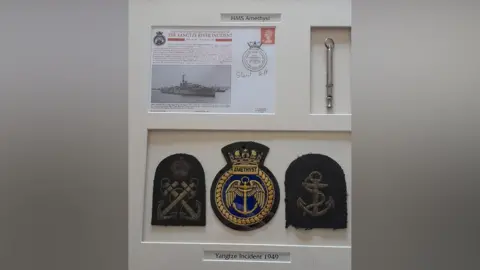
In it, eight sailors from Northern Ireland - including their fathers, Sammy Bannister and Raymond McCullough Snr - and their crewmates on the HMS Amethyst were captured after being attacked by Communist forces as it sailed up the Yangtze River.
The ship was there to evacuate British citizens from Nanking during the final months of the civil war, but the attack resulted in the deaths of more than 20 men and the wounding of more than 30.
Those on the warship were held captive for months, with the incident later dramatised in the 1957 film Yangtse Incident: The Story of H.M.S Amethyst.
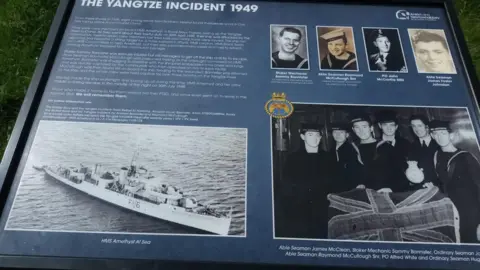
Now those involved - including Andrew and Raymond's fathers, who both survived the attack and its aftermath - have had their names etched on a memorial plaque unveiled in Newtownabbey, County Antrim.
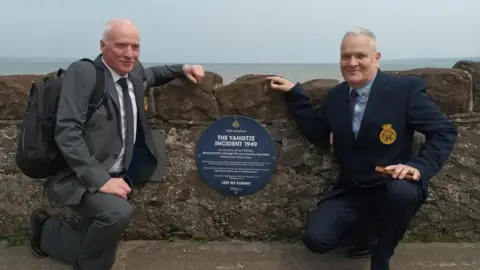 Andrew Bannister
The memorial in Hazelbank Park remembers all eight sailors from Northern Ireland who were on board.
Raymond McCullough Jnr said the plaque was a "fitting tribute" to the two men, which would allow "generations coming after us" to remember them.
"I can't emphasise enough, even though we're doing this for our dads, that there were young crew members of the other ships involved who never returned home."
Bannister said they were "still in a bit of shock" adding that there were a "lot of heroes in this country and I think we need to recognise that".
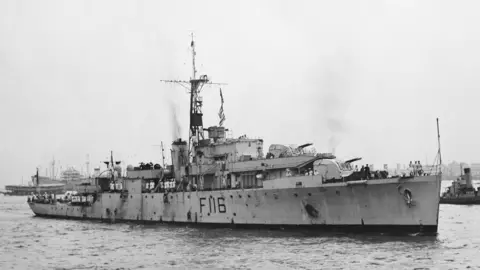 Hulton-Deutsch Collection/CORBIS/Corbis via Getty Images
What was the Yangtze incident?
HMS Amethyst was caught up in fighting between nationalist and communist forces on the River Yangtze in April 1949.
A total of 46 British sailors were killed when communist Chinese forces shelled the ship and the vessels that came to her rescue.
Over the next few months wounded sailors managed to escape and make their way back to Shanghai.
Overnight, on 30 and 31 July, the vessel slipped anchor and its crew made the 140-mile journey to open sea.
Bannister said his father Sammy, a stoker mechanic who was 21-years-old at the time, sustained shrapnel wounds to his chest when HMS Amethyst came under fire.
He had followed the captain's orders to abandon ship.
"My dad and one of his shipmates were on the shore and tried to escape. But because they were both injured, they were easily captured by the Communist faction," Bannister said.
"They treated them for their injuries, but my dad needed an operation to remove the shrapnel. Ultimately they did save his life.
"But then the two guys realised that they were now being held as pawns."
His father returned to the ship before the crew and vessel made their escape to Shanghai.
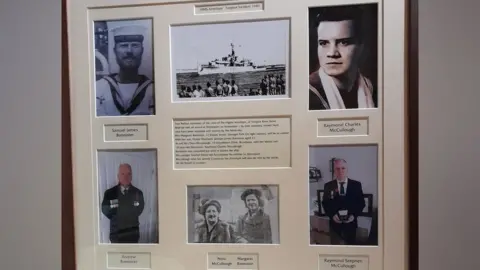 Raymond McCullough
Raymond McCullough's father, Raymond Snr, was 17 at the time.
He was told to go overboard but was then called back to help the wounded and secure the ship, which was flooding.
However, his name was not removed from the overboard list and his family received a telegram that said Raymond was missing in action.
Speaking about the other ships that attempted to rescue HMS Amethyst, his son said: "My dad and Andrew's dad had to watch as these three ships, one after the other, left and said: 'We can't help you.'"
McCullough Jnr said there were a lot of injuries, death and blood, which his father had to clean up, leading to "nightmares for years".
 Raymond McCullough
The attack was later immortalised in the 1957 film - both sons said, ironically, it was only when they were older that the full impact of what it depicted dawned on them.
"I innocently thought he [dad] had been an actor," Bannister told BBC News NI.
"And then, later on in life, he showed me the scars and told me the story that his part was being portrayed by Ian Bannon, an actor, but he was one of the sailors involved in this incident."
McCullough Jnr said: "We didn't understand, even then, the trauma and the hurt that they went through and what they had to sacrifice when they not only served... but when they came home."
The search for medals
 Andrew Bannister
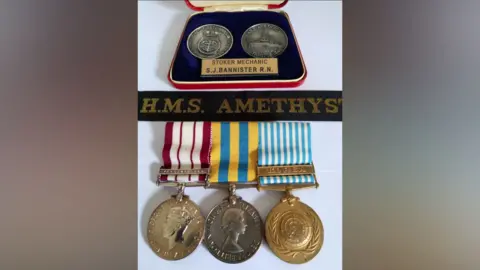
Bannister said his father didn't see himself as a hero and, during a period of financial hardship, sold his medals.
So, he made it his mission to get the medals back.
Following years of research in 2012 he tracked down a collector in east Asia who had his father's medals and was willing to sell them for a large sum.
Bannister sold his car and got a bank loan to get them back.
"Unfortunately, my dad had died in 1996, but it was still nice to have them back in the family where they belong," he said.
It was an appearance by Bannister on the Antiques Roadshow at Stormont in 2018 that brought the two men together.
McCullough Jnr reached out to tell him his father was also on the ship.
"We just joined forces and we have never looked back since, and it was great to have a kindred spirit on this journey," Bannister said.
But this wasn't the only time the pair's paths crossed.
Bannister found a picture of his grandmother with another lady - who turned out to be McCullough Jnr's grandmother.
"When they were both down at the docks waiting on their sons coming back from the Yangtze incident, the newspaper had taken their photo," Bannister said.
 Andrew Bannister
The installation of the memorial was the culmination of a dream - but there were setbacks along the way.
Bannister said they had a "a lot of doors slammed on our faces", and while some organisations liked the idea, they couldn't help them.
Then, they had a meeting with DUP councillor Alison Bennington who helped them with their mission.
McCullough Jnr said they believe that their campaign was for all the sailors on that ship as "any one of those explosives could have killed our dads and we wouldn't be here to tell their story".
"Their story is that important to us and this memorial, it means so much."
Bannister couldn't agree more.
"Since 2012, we've been fighting for this and... we still can't believe that we've achieved it," he added.
