Inside the mine that now grows pak choi

 STFC
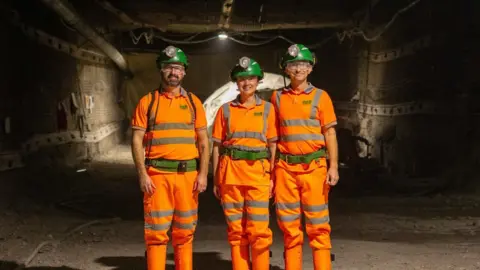
STFCThe world's deepest vertical farm has been launched as a way of growing sustainable food without high energy bills.
The University of Sheffield said the "pioneering research" farm was 0.7 miles (1.1km) underground in a North Yorkshire mine and could transform agriculture.
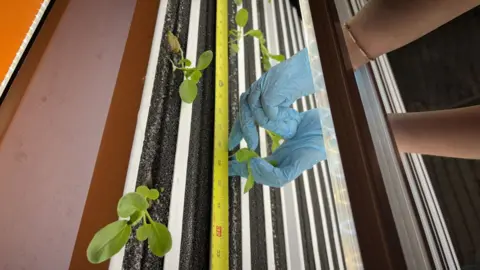
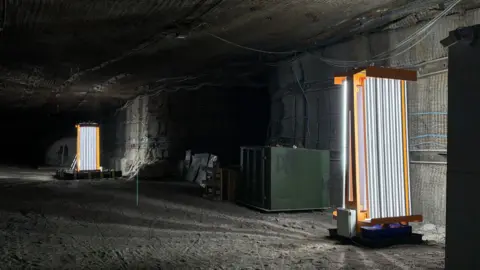
Crops, including lettuce and pak choi, have been planted in the working mine in upright growing light beds.
The university said if successful, it could mean "thousands" more disused mines could be repurposed to grow affordable food.
According to the university, the collaboration with socially conscious food producer Farm Urban means information could be gathered to see if the new growing methods could be commercially viable in future, using the first "real-world evidence" of underground farming.
"We're currently growing and, later this week, harvesting salad crops," said project co-lead Jacob Nickles.
"In the next trial we'll aim for either higher value halophytic (salt tolerant) crops, or a mix.
"We're currently discussing samphire, sea fennel, quinoa, rocket, basil, mustard and possibly a tomato variety."
Root vegetables like carrots and potatoes cannot be grown however because the system is designed for hydroponics and does not suit the morphology of such plants.
Nickles said there would also be challenges due to the ambient salt or heat from mining activities, but said that the year-long study would lead to understanding similar opportunities at other sites.
Many UK mines, he said, are "in economically deprived areas" so repurposing them could create skilled jobs as well as improving access to fresh produce and supporting local communities "while breathing new life into heritage sites".
 STFC
STFCThe vertical farm, part of the Science and Technology Facilities Council (STFC) at Boulby Underground Laboratory, is near Whitby.
The working polyhalite and salt mine already has consistent temperatures and infrastructure, such as lighting and ventilation, so academics said the high energy costs associated with vertical farming may therefore be reduced.
Nickles said underground farming was "not new" but until now there was very little real-world evidence to show how it could work, and this was the first time crops were tested at such extreme depths.
 STFC
STFCProf Sean Paling, director of STFC Boulby Underground Laboratory, said other research also goes on at the complex.
"Boulby Underground Laboratory is a unique place for science, hosting research that can only be done in the special deep subterranean environment," he said.
"More than a kilometre underground, shielded from cosmic radiation, we conduct low-background physics including the search for dark matter and neutrino studies, alongside a range of pure and applied research. And now we're growing food."
Paling said the vertical farm study was "a natural extension of our science portfolio", "using our unique environment to answer questions that can't easily be answered anywhere else".
He added: "If this can work here, it opens real possibilities for what disused mines across the UK could become for the public."
Listen to highlights from North Yorkshire on BBC Sounds, catch up with the latest episode of Look North.
