Paramilitary and paedophile rumours 'led some to believe in a Noah Donohoe cover-up'

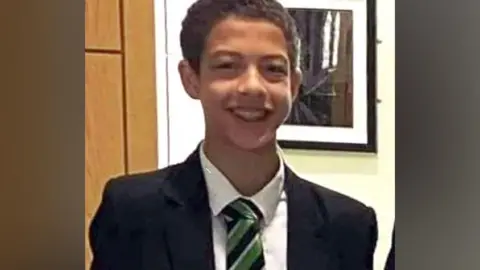 Pacemaker
A police officer involved in the search for Noah Donohoe has said social media posts suggesting paramilitaries or paedophiles were involved in his disappearance led some people to believe police were "covering up" what happened to the schoolboy.
Philip Menary told the inquest into Noah's death that social media "trolling" also caused some members of the public to be angry at police during searches.
The 14-year-old's body was found in an underground water tunnel six days after he disappeared in north Belfast almost six years ago.
There has never been any evidence to support claims that paramilitaries or paedophiles were involved in the disappearance of Noah.
The witness explained there were claims the local community was "harbouring paedophiles" and that paramilitaries from the area were involved in the schoolboy's disappearance.
Menary, a retired Police Service of Northern Ireland (PSNI) officer, told the coroner, Mr Justice Rooney, that "a number of people were haranguing the police" but he clarified it was not the majority of the crowd.
The inquest was also shown part of a television documentary in which members of a community rescue team paid tribute to a large number of people who attended the scene to try to find Noah.
Menary, who was a member of the PSNI's Tactical Support Group, was part of a police hazardous environment team that began searching a culvert three days after Noah's disappearance in June 2020.
His body was found more than 600m downstream in the tunnel.
Police team 'couldn't just dander into' tunnel
Menary said the search operation of the culvert and tunnel had to be conducted in line with health and safety legislation and could not be carried out in a "willy nilly" manner.
The witness has previously been challenged about delays and the timing of various aspects of their operation before Noah's body was eventually discovered by divers.
During questioning from a barrister for the PSNI on Monday, the coroner and jury heard about the risks and dangers the underground search team had to consider inside the tunnel.
Menary said his team could "not just go dandering" into the tunnel.
Asked by the barrister to reply to suggestions that there may not have been any risk of noxious substances, or a low risk, the witness said the possibility of potential gases was "a critical, major factor in how we proceeded".
He said: "If I'm putting people into that thing, I'm responsible for those people."
Menary also explained that he had discussions with the Department for Infrastructure at the early stages of their operation, and a risk about potential gases being released inside the tunnel was among the matters they considered.
He told the inquest there was a potential for the release of gases if silt in the tunnel was disturbed.
The jury was shown footage that showed varying levels of silt in parts of the tunnel close to where Noah's body was found.
'Hindsight's a great thing'
The inquest also heard that a specialised underground tracking camera was unable to make progress on the day before Noah's body was found because of the level of silt.
Divers were subsequently deployed, and they found Noah's body the following day.
The witness also clarified a comment he made during his evidence last week when he said he believed it was a failure on his team's part not to have found Noah.
He explained that he meant his team's operation had to conclude before they found Noah because the conditions in the tunnel prevented them from progressing their specific operation any further at that stage.
Asked by the barrister for the PSNI about his reflections on his team's operation, the witness responded: "Hindsight's a great thing."
Referring to the risks involved for members of his team, he then added: "I counted them all out, and I counted them all back in again."
Asked by the barrister if he stood over the operation, he replied: "Absolutely, 100%."
