Firm behind new land speed record celebrates triumph
The leader of a team of British engineers behind a new land speed record has said he is "incredibly proud" of the achievement.
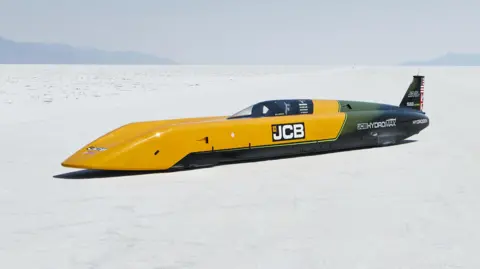
On Wednesday, the JCB Hydromax reached a speed of 406.3mph (654km/h) at the Bonneville Salt Flats in Utah, the fastest a hydrogen-powered car has ever travelled.
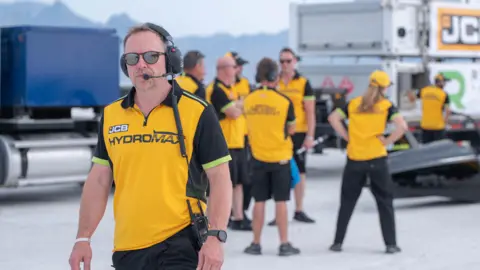
Celebrating the record, the vehicle's driver, Andy Green, praised the work of Prodrive - the Banbury-based motorsport firm involved in building and running the car.
Race team principal Simon Dowson from Prodrive said those involved had "achieved something genuinely significant".
Green's record was measured as an average of two runs in a car powered by two hydrogen internal combustion engines, with a combined 1,600 brake horsepower (bhp).
He more than doubled the previous official hydrogen combustion record of 185.5mph (298.5km/h) which was set in 2004.

 Prodrive
Green, a former RAF fighter jet pilot, said the pace of the project had been "really remarkable".
"JCB started planning the design of the car just over a year ago and earlier this year they built the car in a space of five weeks," he said.
"Most teams will allow a minimum of five or six years to develop a car with that kind performance and the JCB Hydromax team have done it in that number of days."
The University of Oxford graduate praised Prodrive as "an extraordinary group of individuals" who had been "the core of this amazing racing team".
Dowson added: "To progress from an idea to a new FIA World Record in such a short period of time is a remarkable accomplishment and one that everyone involved should be incredibly proud of."
 Prodrive
Prodrive played a key role in putting the components of the vehicle together, as well as running track-side operations in Utah.
The success is the latest achievement in the company's storied motorsport history, which includes six 24 Hours of Le Mans class wins and multiple World Rally Championship titles.
Chairman David Richards said: "What stood out throughout this programme was the way engineers, technicians, drivers and support crews from different organisations came together as one team to overcome every challenge put in front of them."
Richards added that the achievement was "helping to demonstrate not only what is possible when talented people collaborate, but also the exciting potential of hydrogen combustion technology".
