'Makes no sense' council chief tried to distance herself from DUP, says lawyer

 PA Media
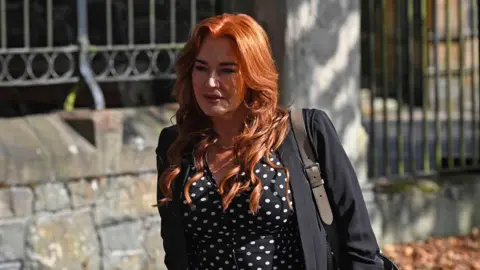
The suggestion that a former chief executive of Mid and East Antrim Council illegally deleted emails to distance herself from the Democratic Unionist Party (DUP) "makes no sense", her barrister has said.
Anne Donaghy's lawyer said she had not acted because of a perception she was too close to the DUP but instead out of concern about leaking.
This, he said, explained why the only email deleted was one sent to a personal email address – that of then-DUP leader Arlene Foster.
The 56-year-old of Clonmore Road, Dungannon, denies three charges related to deleting or attempting to delete an email in contravention of the Freedom of Information Act and aiding and abetting another person to do so.
"The prosecution motive that Anne Donaghy wanted to distance herself from the DUP makes absolutely no sense," he said.
"She only asked for one out of nine emails [to DUP politicians] to be deleted and it was the one sent to someone on their personal email.
"If she was trying to distance herself from the DUP she would surely have been trying to delete all these emails."
On Tuesday the court heard that, in 2021, Donaghy arranged a meeting at her house with a member of staff who handled Freedom of Information (FoI) requests at Mid and East Antrim Council, to discuss deleted emails.
Her barrister added that leaking was a massive problem at the council at the time, and said that, at the time the email to Baroness Foster was deleted "there was no live FoI request" because the request sent by Brendan Hughes had been refused and he had not appealed it.
Her co-accused, Aaron McClelland, 49, of Clonmakate Road in Portadown, denies one charge of attempting to delete an email.
He was described in court as having oversight of the council's FoI system.
McClelland's barrister said his client was also concerned about leaking and was also aware there was a hard copy of the email he asked one of Donaghy's PAs to delete.
The lawyer said there was "nothing sinister" about the request and that he had wanted to prevent leaks prior to all the information being disclosed.
Both Donaghy and McClelland's legal representatives said their clients would have known a hard copy of the email would have existed.
Paul Thompson gave evidence on the second day of Donaghy's trial.
Thompson said that on 26 June 2021, he was called by McClelland and asked to attend a meeting the next day, which was a Sunday.
The meeting ended up taking place at Donaghy's house where Thompson said he was asked for his opinion about emails being deleted.
The emails at the heart of the case were sent to Democratic Unionist Party (DUP) politicians Arlene Foster and Gregg McKeen, forwarding on a letter Donaghy had sent to the Cabinet Office in London raising concerns about the safety of staff carrying out post-Brexit checks at Larne Port.
The letter to the Cabinet Office was sent on 30 January.
In it, Donaghy said "sinister graffiti" had appeared at Larne Port threatening the security of staff working at border control posts.
Border Control Posts were built at Larne harbour, and two other facilities in Northern Ireland as a consequence of Brexit.
They were for inspecting food and live animals when they arrived from other parts of the UK.
The DUP had criticised the arrangements.
In subsequent days Donaghy forwarded the letter to DUP politicians including Foster and McKeen.
A few days after she forwarded the emails, the council received a FoI request from Belfast Live journalist Brendan Hughes, who now works for the BBC.
He asked for correspondence, internally and externally at the council, relating to "alleged threats to staff" over the Northern Ireland Protocol.
More than two months later, Donaghy, asked one of her PAs to delete the email which had been sent to Foster, which her PA agreed to do.
McClelland asked another of her PAs to delete the email which had been sent to McKeen, which she refused to do.
Thompson was also asked during his evidence about a meeting at the council headquarters after it received Hughes' request.
He said there had been a discussion at that meeting about whether or not exemptions under the FoI Act could be used to deny the request.
McClelland attended the meeting, but Donaghy did not.
The request was subsequently refused.
A defence barrister put it to Thompson that he had "no information that she [Donaghy] had anything to do with that".
Thompson replied: "No."
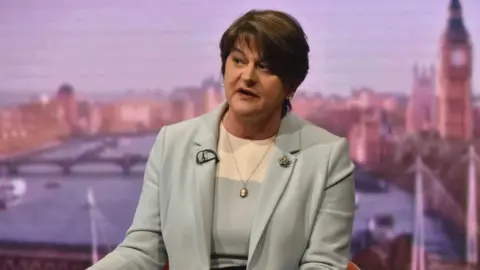
On Monday, the court was told that in Donaghy's police interviews she admitted asking her PA to delete the email to Foster.
She said she had acted because Foster was going through a libel action and during this period resigned as first minister and Donaghy was worried about leaks from council and did not want Foster's personal email being revealed.
She said she knew there were hard copies and had only asked for the digital version to be deleted.
In McClelland's police interview, he said he thought it was legitimate to delete the emails because they needed to prevent leaks before the FoI process was complete and that there were hard copies.
He said he had hard copies in a locked cabinet in his office.
The trial continues.
