'It's not a secret - it's maths': The truth behind 'two-tier policing'

 Reuters
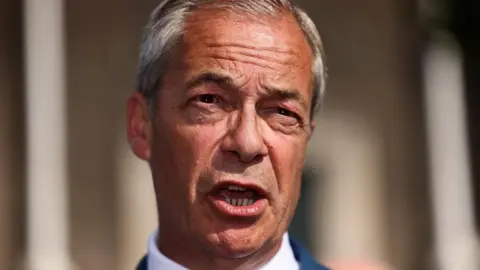
Some have hailed Nigel Farage as courageous for calling out the UK's so-called "two-tier policing", while others claim the comments are divisive and have caused further tensions within polarised communities.
The Reform UK leader argued that white people are treated differently by police because of their race. Critics say this claim risks overlooking the long‑standing experiences of Black and minority ethnic communities.
When it comes to race, Lord Marvin Rees OBE, former mayor of Bristol, said the maths is clear that black people will get worse outcomes than other ethnicities from the criminal justice system.
"It's not a secret - it's maths," he added.
Despite the statistics, after the murder of 18‑year‑old Henry Nowak - who was handcuffed as he lay dying after his attacker had accused him of being racist - some people have claimed anti-racism guidelines issued to officers have resulted in unfair treatment of white people.
So why does two-tier policing resonate so strongly and why does it provoke such anger?
The Henry Nowak case and the origins of the debate
Nowak was fatally stabbed in Southampton in December by Vickrum Digwa, who falsely claimed he had been racially abused and had acted in self-defence.
Digwa was jailed for life on 1 June, with a minimum term of 21 years.
But the release of police body cam footage showing Nowak being handcuffed as he lay dying has led to intense scrutiny of the police.
After footage of the incident was released, disorder broke out in Southampton.
Twelve police officers and a police dog were injured during the protest which initially saw crowds demonstrating against their perception of two-tier policing.
Farage has also repeatedly insisted this incident showed evidence of two-tier policing, arguing that anti-racism guidelines issued to officers had led forces to treat "different ethnic groups in different ways".
Two-tier policing is a term used to describe the idea that some groups of people, or some behaviour (for example protests and demonstrations) are dealt with more harshly, more robustly, than others by law enforcement.
Trust in policing
Concerns about trust in policing remain acute among some communities.
A new report by the Children's Commissioner said Black children are eight times more likely to be strip searched by police than their white peers in England and Wales.
Leigh McKenna, lead mentor at Mwanzo, a youth crime prevention centre, said the young people he works with in Bristol, "specifically Black and Asian communities do not trust the police to protect them".
"Sometimes it can be because they feel like if they bring things to their attention they will be criminalised.
"Sometimes it's because they haven't had positive experiences with the police because often they don't believe the police are pursuing justice.
"There is a big crisis in confidence with young people," he added.
Rees said that race was a key factor when it comes to people's experience of the criminal justice system.
"[Black people] are more likely to be arrested, if they are arrested, they are more likely to be charged, if they are charged, they are more likely to be found guilty, they are more likely to get a custodial sentence and it's more likely to be longer.
"That's just the maths," Rees said.
Government figures published in 2024 show that black people are 2.2 times as likely to be arrested as white people – there were 20.4 arrests for every 1,000 black people, and 9.4 for every 1,000 white people.
Rees added that people born in the most-deprived areas are also more likely to end up being in the criminal system.
"So race and class are key determinants to people's experience of the criminal justice system," he said.
"It's not a statement about individual police officers, it's a statement about how power works in British institutions in an imperfect world."
Police chiefs reject two-tier policing claims
Senior police figures have strongly rejected the claim.
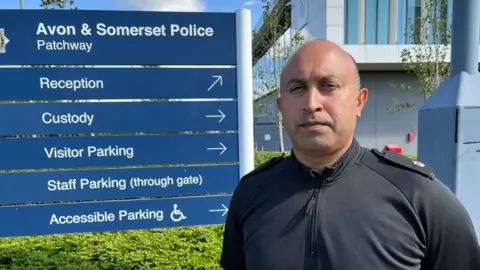
Supt Deepak Kenth, from Avon and Somerset Police, said in his 24 years of police and service, he has seen no evidence of two-tier policing and he believes the phrase is unhelpful.
"To be honest I think it puts communities against each other.
"We need to have honest conversations with our institutions and communities about how people feel," he added.
Acting Chief Constable Scott Green, from West Midlands Police, acknowledged the challenges of operating in what he described as a "more polarised society", but said officers aimed to "police without fear or favour".
"What I see every day from the officers and staff and volunteers on the front-line is people out there doing the very best they can every day, for the communities they serve," he said.
 BBC Image
The debate has drawn in politicians from across the spectrum.
Conservative leader Kemi Badenoch said police guidance should be examined, but criticised Reform UK's language.
In Parliament she said: "The circumstances around Henry Nowak's wrongful arrest and tragic murder must be a wake-up call to the entire country and the institutions that every life matters, and it is the responsibility of everyone in this to bring people together not divide them."
Reform UK's home affairs spokesman Zia Yusuf defended Farage's remarks, saying he had been right to call out "racism and prejudice in the police wherever we see it".
"He was courageous to say that white lives matter as much as black lives or as anyone else's do," he added.
He said that the body cam footage showing how Nowak died is evidence of structural anti-white racism in the police.
Professor Mike Savage, who specialises in class, social stratification and regional inequality at the London School of Economics, said Farage's comment "does not appear grounded in the actual reality of policing practice".
"Race has been used, rather cynically, by right-wing forces", to drive a wedge between different classes and heritages, Savage said.
He added: "The underlying issues are that the UK is hugely socially and economically divided, and that large numbers of working-class people feel they have little influence on policy making or a chance to improve their lives."
'Over‑policed and under‑protected'
Supt Kenth said police were aware that some communities felt "over‑policed and under‑protected".
He said forces needed to be clearer about the intentions behind decisions and improve community engagement.
An Avon and Somerset Police spokesperson said the force has developed an anti-racist strategy to address bias, promote inclusivity and strengthen the bond between policing and the diverse communities we serve."
They added that all frontline officers receive Race Matters training delivered by external facilitator Representation Matters.
Supt Kenth said that British police are leading globally for "police by consent", which means the UK police base their legitimacy and authority from the general approval and cooperation of the public, rather than from the power of the state.
It implies, officers are essentially citizens in uniform.
'A recipe for discontent'
Police forces and many politicians emphatically reject accusations of two-tier policing. But it has proved a potent and polarising issue, especially following the Henry Nowak case.
There is plenty of evidence that some ethnic minorities come out worse in the criminal justice system. As a result forces have taken steps to counter potential bias in attitudes and actions.
But there are also some important areas where young white males, especially from poorer backgrounds, are faring less well.
School attainment, university participation and rates of suicide and drug-related deaths are problem areas.
Add to this many years of economic stagnation and you have a recipe for real discontent, and anger at any potential advantage afforded to others.
That, coupled with a big rise in net migration to the UK from 2021-2024, has much influenced public attitudes and political debate
Follow BBC Bristol on Facebook, X and Instagram. Send your story ideas to us on email or via WhatsApp on 0800 313 4630.
