The Somerset prime minister who 'lost America'

 Getty Images
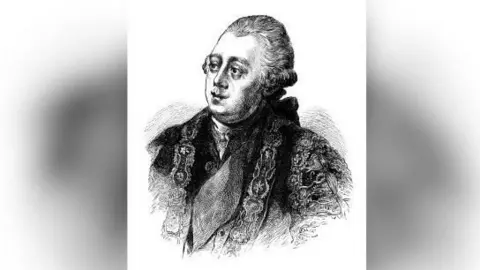
There are a number of things for which Lord North could be remembered.
In a modern era where the UK is set to have its sixth prime minister in 10 years, he held the top job for 12.
He was "really funny", well-respected and, according to the government's own biography, an "outstanding parliamentarian".
Yet, if you look up Lord Frederick North, to use his full name, you will notice none of these are the main thing for which he is known. Instead, the politician who owned a large estate in Somerset, is referred to as "the man who lost America".
Lord North, the second Earl of Guildford, was born in London in 1732.
A Conservative, he became prime minister in 1770 and was still in power when both when the American War of Independence began in 1775 and when the United States declared independence on 4 July 1776.
"I think the 'losing America' tag does fit, at least chronologically," said Martyn Powell, the dean of Arts, Law and Social Sciences at the University of Bristol.
However, Powell said Lord North was "one of a number of ministers", who helped spark the US' violent exit from the British Empire.
"It's a roll call of individuals who probably are too hardline on America and misjudge the impact of public opinion," he said.
Before Lord North became prime minister, Charles Townshend, as chancellor of the exchequer, implemented the Townshend Duties, which placed taxes on various goods imported into the colonies, including tea.
These were hugely unpopular and led to the famous Boston Tea Party incident in 1773, when American protesters dumped hundreds of chests of tea into Boston Harbour.
"You could argue that Lord North is constantly playing catch-up in terms of what he can do to bring the American colonies back," Powell said.
 Bhagesh Sachania Photography
The Somerset connection
Lord North married a woman called Ann Speke, who was from Ilminster, with the wedding giving him ownership of the Dillington Estate in the town.
"He did seem to have enjoyed living at Dillington House and used to escape there from the pressures of political life," said Lord Ewan Cameron, whose ancestors bought the estate following Lord North's death in 1792.
"However, Lord North was not very good at his household finances and he did seem to spend a lot. He almost certainly overdrew from the estate during his lifetime," Lord Cameron said.
He was also not necessarily well-liked in the West Country, as he had a hand in a tax on cider, which was introduced in 1763 and led to riots.
"[He] didn't really care about public opinion," said Powell.
"And I think we can see that then track forward to the American War of Independence, [he] still doesn't care about the American colonists rioting either."
Follow BBC Somerset on Facebook and X. Send your story ideas to us on email or via WhatsApp on 0800 313 4630.
