Overlooked memorial tells Waterloo soldier's story
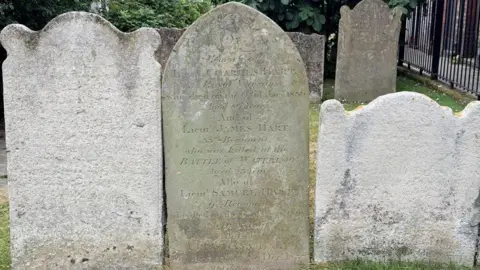
People walk past it every day, but a gravestone in Dover town centre marks the story of a local soldier killed at the Battle of Waterloo.
The memorial for Lieutenant James Hart, in the disused graveyard of St Mary's Church in Biggin Street, is believed to be Dover's only known Waterloo commemorative grave.
Hart served with the 33rd Regiment and was killed on 18 June 1815 during one of the most famous battles in British military history, at the age of 23.
Today, the memorial sits just steps from shops, pubs and the town centre in Kent, but local historian Phil Eyden said that many residents were unaware of its significance.

 BBC / Steve Ladner
He told Secret Kent: "It lies right here, right in the middle of the high street, and hardly anybody knows anything about it."
Eyden said that Hart came from a family with strong military connections.
His father, Charles Hart, was a career soldier and several members of the family served in the army.
Commissioned as an ensign in 1809, James Hart joined the 33rd Regiment and was later promoted to lieutenant. He served in India before returning to Europe during the campaign against Napoleon.
'Forgotten Dover hero'
Two days before Waterloo, Hart played a role in saving his regiment's colour during fighting at the Battle of Quatre Bras. Eyden said that a French cavalryman seized the flag before Hart and another soldier recovered it.
Regimental colours were important military symbols, and their loss was considered a major blow.
Eyden said: "The very fact that he actually saved the colours gives him an important part in regimental history, and I think that's something we should be commemorating."
 Getty Images
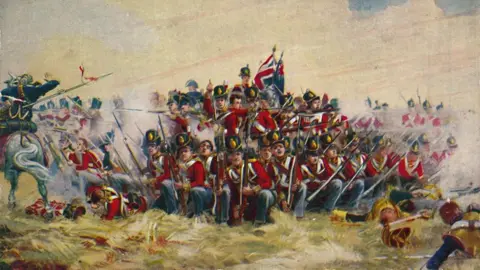
At Waterloo, Hart's regiment came under repeated artillery and cavalry attacks.
Hart was killed when a cannon shot entered the square formed by his regiment as soldiers lay down to avoid incoming fire, Eyden said. It struck him on the shoulder, killing him instantly.
He said that a surviving officer wrote a report, which is how historians know what happened.
Eyden believes that the site deserves wider recognition from residents and visitors alike.
"Dover should be proud of him," he said.
"He's a forgotten Dover hero."
Follow BBC Kent on Facebook, X, and on Instagram and listen to BBC Radio Kent on Sounds. Send your story ideas to southeasttoday@bbc.co.uk or WhatsApp us on 08081 002250.
