Friendship or leverage: Why is Xi Jinping in North Korea?

 Xinhua
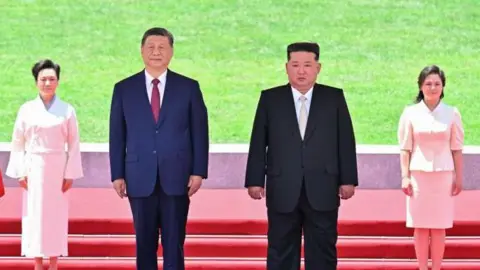
The Chinese President Xi Jinping has vowed to strengthen his relationship with North Korea's Kim Jong Un in a rare state visit to Pyongyang.
Cheering crowds shouting welcome in Korean and Chinese lined the streets of the capital - all the way from the airport to the central Kim Il Sung square where a military honour guard was waiting and a banner which heralded the bond between the two as "unbreakable".
Xi told Kim that he was willing to work together to guide the relationship to new heights.
But it has not always been this way - and there is much more to this visit than simply reaffirming neighbourly ties.
For Xi, North Korea is the neighbour China can neither control nor afford to lose.
The two sides often describe their relationship as one "forged in blood", a reference to the Korean War.
Yet in recent years, mistrust has strained ties. And now Beijing is trying to reassert sway over a strategically vital yet deeply unpredictable partner.
China wants stability on its border and influence in Pyongyang, but without being dragged into crises triggered by North Korea's nuclear ambitions.
So Xi's visit this week is likely to be less about friendship, more about leverage.
Seoul believes he may try to position China as a mediator between North Korea and the United States, but Beijing may have other motives.
Western diplomatic sources tell the BBC that China has become increasingly concerned about the growing partnership between Pyongyang and Moscow.
After meeting Russian leader Vladimir Putin last week, Xi may want to ensure he also keeps North Korean leader Kim Jong Un in check, especially as Beijing increases its presence on the global stage.
A thaw in strained ties
The cooling between Beijing and Pyongyang was visible, even if subtle.
They barely marked the 75th anniversary of diplomatic relations in October 2024. Public messaging was muted.
China's ambassador did not attend North Korea's founding celebrations the previous month. There were no senior level exchanges throughout the year, a stark contrast with Pyongyang's increasingly warm relationship with Moscow.
That growing closeness with Russia has unsettled Beijing.
After Russia's invasion of Ukraine, North Korea has expanded military cooperation with Putin, culminating in a mutual defence pact that was signed during Putin's visit to Pyongyang in 2024.
About 2,300 North Korean soldiers have died fighting for Russia against Ukraine, according to a BBC investigation. Pyongyang is also accused of supplying ammunition for Russia's war effort in exchange for oil and aid, a development that has alarmed Washington and its allies, and quietly rattled China.
"China wants to ensure that its interests vis-a-vis North Korea are protected at a time of rapid convergence between Moscow and Pyongyang," adds Ankit Panda, a nuclear policy specialist at the Carnegie Endowment for International Peace.
 AFP via Getty Images
China has only one formal defence treaty, and that is with North Korea.
So Beijing is unlikely to welcome a scenario where Russia becomes the dominant influence in Pyongyang. A more confident, less dependent Kim would mean reduced Chinese leverage.
Beijing has responded by trying to reset the relationship. Late last year, Xi invited Kim to a military parade in Beijing, keeping him prominently by his side alongside Putin.
It was their first formal summit in six years. Xi praised the two as "good neighbours, good friends and good comrades bound by a shared destiny", and called for closer strategic coordination. Notably absent from the public statements was any mention of North Korea's nuclear arsenal.
Beijing has "mixed feelings" about the growing partnership between Pyongyang and Moscow, says Lee Seong-hyon, a visiting scholar at the Harvard University Asia Center.
On one hand, the partnership "distracts Washington and complicates US strategy in multiple theaters, which indirectly benefits China", Lee says.
But, he adds, expanding military cooperation between Russia and North Korea could spark a stronger trilateral military response from the US, Japan and South Korea, which would worry Beijing.
That is also why China is not endorsing Pyongyang's nuclear programme - because that would increase US involvement in the region and its alliances here.
But neither is China confronting the issue head on. In 2022, China and Russia vetoed a US-led United Nations resolution to impose new sanctions over North Korea's missile tests.
If China takes a strong stance against Pyongyang's nuclear programme, "this would only push North Korea more into the arms of Putin", says Victor Cha, president of the foreign policy department at the Center for Strategic and International Studies.
The pragmatic partner
But Kim cannot afford to alienate his biggest source of aid either.
China's exports to North Korea surged to around $2.3bn (£1.7bn) last year, the highest level in six years. Passenger train services between Beijing and Pyongyang restarted earlier this year after a six-year hiatus.
Analysts say this too is a calculated effort by Beijing to pull Pyongyang back into its orbit.
For Kim, it is the pragmatic choice. If the war in Ukraine ends, Russia's need for North Korean support could diminish. And unlike an isolated Putin, Xi has been welcoming world leaders to Beijing.
So Kim needs to ensure he is not left relying on a weakening partner.
 Getty via KCNA
But this relationship was troubled from the start.
Kim inherited power with priorities that differed from his father's. While Kim Jong Il visited China repeatedly and relied on Beijing's backing, his son moved quickly to accelerate North Korea's nuclear programme. In his first six years in power, Kim oversaw around 90 ballistic missile tests and four nuclear detonations - more than his father and grandfather combined.
This alarmed Beijing. And then the execution of Kim's uncle, Jang Song Thaek, seen by China as a stabilising figure, deepened the rift.
Xi responded with rare diplomatic signals of displeasure, visiting South Korea in 2014 before ever meeting Kim: a move that was widely viewed as a snub.
North Korea responded by calling China a "turncoat and our enemy."
It was only in 2018, as sanctions over his nuclear programme began to bite, that Kim made his first known foreign trip.
He got on his armoured train and headed to Beijing. That meeting marked the start of a cautious recalibration.
Kim would go on to meet US and South Korean leaders, but it was always after consulting China. The message was clear: Pyongyang would not negotiate without Beijing's backing.
Today, North Korea serves as both buffer and burden for China. It keeps US forces at arm's length, but its weapons tests destabilise the region.
Kim, meanwhile, wants Chinese protection - without Chinese control.
Neither side fully trusts the other. But for now, they both believe they need the other and that is enough to keep them talking.
Additional reporting by Kelly Ng
