'It still hurts 20 years on from when the Peugeot factory closed'

 PA Media
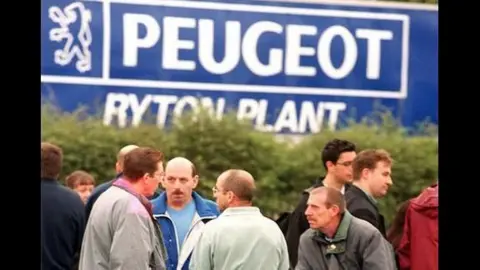
When he looks back at the time the factory where he started work, run by the huge car maker Peugeot, closed and was knocked down, Terry Rahilly admits it hit him hard.
"That hurt a bit, because it was the place where I started work," he admits. "Every day I drove past Ryton while they were demolishing it."
The factory was a massive deal in the West Midlands and one of Coventry's biggest employers at the time.
But 20 years ago, on 18 April 2006, Peugeot announced the closure of the Ryton on Dunsmore plant, ending more than 65 years of production on the site and, with it, the loss of 2,300 jobs.
The end for the workforce came quickly - by December the same year, the final car had rolled off the production line.
At the time, Des Quinn worked there and was also the regional officer for the Transport and General Workers Union (TGWU).
The job was tough, he admitted, but the colleagues made it worthwhile.
"It was hard, it was monotonous, but the people you worked with got you through it, it was good fun," he said.
"You never miss working on a production line but you miss the people you work with."
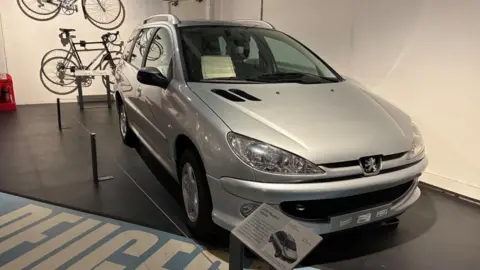
Quinn said the scale of what the factory produced was hard to imagine.
"When I started... you were talking about 150,000 [cars] a year. That's roughly a car off the line every minute and three quarters," he said.
"It was quite fast paced, it was shift work and there was a lot of pressure on you because of quality"
More than 1.3 million Peugeot 206 models were built at Ryton with more than four million cars produced in total on the site since it opened in 1940.
But in 2004, Peugeot decided not to make its new 207 models at the Warwickshire site and uncertainty over its future began.
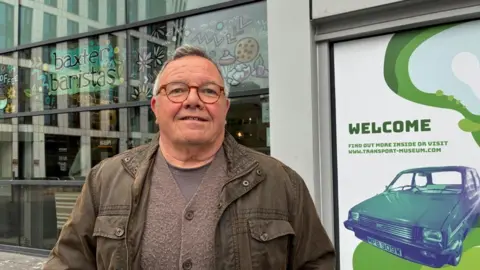
Gari Cross began working on the line fitting exhausts before moving to the repair shop and then to training staff.
He said looking back he had fond memories.
"Work is a massive part of your life, but there, there was without any shadow of a doubt more highs than lows. And the people were smashing"
But the 69-year-old said the announcement of the closure was a tough time.
"There have been rumours, but it hit us all really hard," he said. "We'd change shifts, we'd done longer shifts, we'd introduced a Friday, we'd done everything that was asked of us, if not more.
"So when it was announced, it was really disappointing, upsetting, to a certain degree, a little bit of a kick in the teeth."
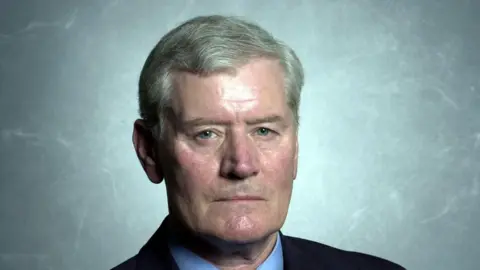
On the day of the announcement, Peugeot's director of communications, Jon Goodman justified their decision.
He told BBC Coventry and Warwickshire: "Ryton is by far the most expensive manufacturing plant we have in Europe. Car production at Ryton costs over €400 per car more than any other plant in Europe."
The MP for Coventry South at the time was Jim Cunningham and he hit back at Peugeot's reasons for the closure.
"If he's talking about comparing costs to Europe, he's probably talking about comparing costs to Eastern Europe," he said.
"We've always had a suspicion that that's exactly what they wanted to do was shift to Eastern Europe so. I notice he's not closing any plants in France by the way."
By 12 December 2006 the final Peugeot 206 had rolled off the line, the site closed weeks later and was demolished in November 2007.
What used to be Peugeot's factory is now the site of a Prologis distribution centre.
Follow BBC Coventry & Warwickshire on BBC Sounds, Facebook, X and Instagram.
