Anchoring restrictions at popular seaside spot

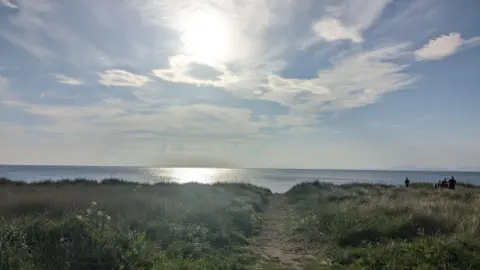 Federica Bedendo/BBC
A new restriction for boats is due to come into force at a popular seaside spot.
Government body the Marine Management Organisation (MMO) has announced a new anchoring bylaw will come into force on 30 July in Allonby, near Maryport, in West Cumbria.
It means anchoring will not be allowed across the 10.8 square miles (28 square km) of inshore waters to protect ecosystems, unless the purpose was to save a life at sea.
The MMO said the restriction would "allow full recovery of all species and habitats and associated ecosystem processes" within the Allonby Bay Highly Protected Marine Areas (HPMA).
Allonby is popular with day trippers and holiday makers who enjoy its sandy beach and scenic promenade.
The area is one of three HMPAs in England, which were set up by the previous government as part of a pilot scheme to help ocean recovery.
The other two are the North East of Farnes Deep, off the coast of Berwick-upon-Tweed, and Dolphin Head, in the eastern English Channel.
 Google
Allonby is considered important due to its mix of habitats, typical of areas with "dramatic currents and tides", according to HMPA designation papers from the Department for Environment, Food and Rural Affairs (Defra).
The area attracts many types of birds such as curlew, oystercatcher and guillemots, as well as providing habitats for a number of fish species.
"One of the best examples of honeycomb worm reefs in the UK is found here," the Defra document said.
"Honeycomb worms create a complex sediment network of tubes attached to rock, providing vital habitat for a range of species including crabs and molluscs."
These conditions are considered important for water purification and carbon erosion protection, Defra said.
The HPMA is also within the Allonby Bay Marine Conservation Zone and the Solway Firth Special Protection Area.
