Can flat-pack houses help with housing crisis?

 FastHouse
A Limavady-based firm has become Ireland's largest manufacturer of so-called flat pack houses after a deal to buy two factories in Monaghan.
FastHouse is buying the businesses from Kingspan, the Irish construction giant.
The deal has again raised the question if offsite construction can help tackle the housing crisis on both sides of the border.
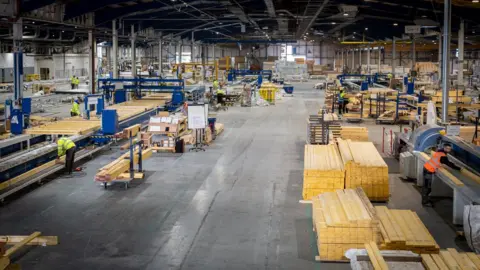
It is a building method where structures are made in a factory before being transported and assembled on site.
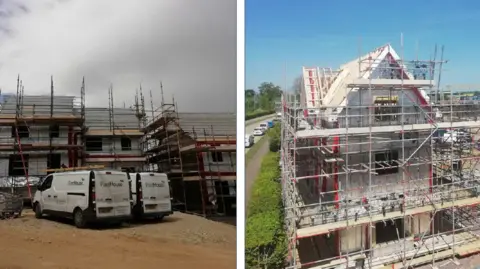
FastHouse specialises in making timber frames for houses.
They are an alternative to the usual method of building the skeleton of a house from concrete blocks.
The exterior of the house continues to be made from bricks.
FastHouse currently makes about 1,700 house kits a year in Limavady and the two Monaghan factories will add an initial 1,300 kits, with a plan for further investment and growth.
 FastHouse
The deal also takes employment at FastHouse from 190 to about 380.
"In a market where housebuilding requirements are beyond what are currently being delivered by the construction industry, we see growth opportunity in housebuilding in general," FastHouse's managing director Colin Clements told BBC News NI.
"We also see timber frame becoming an even larger part of delivering that.
"It's competitive from a cost standpoint; it's a fast build on-site. And then it's very good from an environmental standpoint."
Around a decade ago offsite construction was being hyped as a potential solution to the low rates of housebuilding across the UK.
Investors poured hundreds of millions of pounds into factories which were focused on building almost complete modular houses which could be quickly assembled on site.
The insurer Legal & General (L&G) opened a factory in Leeds which aimed to produce 3,000 homes a year.
These ventures have largely been commercial failures.
L&G has closed its factory and other major firms have collapsed into administration.
Clements said that experience had exposed some of the limits of a maximum offsite approach.
"First, aesthetically, there's a limit to what can be done. You also have to get the planning right from the get-go," he said.
"A timber frame system like ours is flexible; we can take architectural drawings designed for a traditional block build and produce the timber structure that goes under the skin."
Another challenge was the sheer physical size of the modules.
Clements said the FastHouse kit for a pair of semi-detached houses could fit on a standard 40-ft trailer whereas a fully modular building would be "six trailers worth of loads".
 FastHouse
The shortfalls in house building on both sides of the Irish border reflect a range of complex economic and policy problems.
They include a lack of enabling infrastructure, like sewage systems, lack of funding for social housing and slow moving planning systems.
The Economic and Social Research Institute (ESRI), a Dublin-based think tank, has also identified a shrinking and aging construction workforce as another limiting factor.
Clements said this was the part of the problem where offsite construction can start to make a difference.
"The kit goes to site and the erecting team has a crane to lift panels into position. They'll have a pair of semi-detached houses constructed - the structural timber frame and roof trusses - in about two days.
"Then the bricklayers come and do the external facade. They aren't laying the blockwork for the superstructure anymore, just the facade.
"It alleviates the pressure on brick and block laying. It means the limited resources out there can put up proportionally more houses in the same calendar period."
He said as they invested in their factories they would be looking at a middle way between what they do now and those unsuccessful fully modular experiments.
"The future will be exploring if more elements can be brought back into the factory. We are fortunate that our sister company is Lagan Homes, so we have house building divisions where we can trial innovative solutions," he added.
