What is a hosepipe ban, why are they needed and who decides to implement them?

 EPA
EPAThe latest heat-health alert has been in force across the north-west of England since Wednesday and will remain in place until 21:00 BST on Sunday.
Last month a more severe - amber - warning of extreme heat was issued in our region as temperatures soared to record levels for June.
We are still relatively early in the summer, too, with our hottest weather normally coming in late July and August.
If the hot and dry weather continues, will talk of hosepipe bans be far away?
What is a hosepipe ban?
A hosepipe ban, also known as a temporary use ban, is imposed by water companies to try to save water during periods of high demand or low supply.
In north-western England that responsibility falls to United Utilities (UU), which supplies three million households and 200,000 businesses.
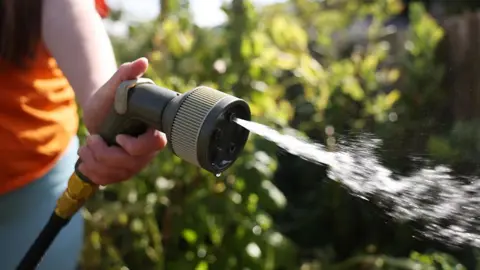
People living in areas with a hosepipe ban are not allowed to use them to:
- Water a garden or plants
- Wash vehicles, boats, paths, patios or windows
- Fill a swimming pool, fountain or paddling pool
Anyone breaking these rules could be fined up to £1,000.
Buckets and watering cans can still be used, while rainwater from a water butt through a hosepipe is also permitted.
Hosepipe bans are designed to ensure enough water is saved for drinking, people who are vulnerable and for other essential use.
On average, a person uses about 140 litres of water per day for showers and washing but this often increases when the sun shines.
How does UU decide whether a ban is needed?
All water companies follow a statutory drought plan which sets out how supplies are managed during prolonged dry weather.
Within these plans, drought trigger levels are used to monitor water resources and determine when action is required.
UU only imposes a ban when water supplies fall below sustainable levels and voluntary savings - asking people to use less water - are no longer enough.
The company tries to avoid a ban by prioritising operational water-saving - fixing leaks, managing pressure and asking customers to reduce usage.
 PA Media
What does it look for?
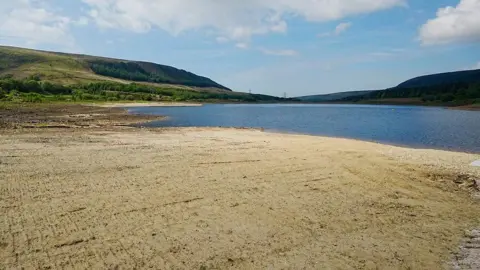
Reservoir levels: United Utilities monitors key reservoirs such as Thirlmere, Haweswater, Rivington, and Stocks. When storage drops significantly below seasonal norms, restrictions become more likely.
Drought status: A hosepipe ban is typically considered only after the Environment Agency declares a drought. Even then, United Utilities may avoid a ban if supplies remain secure.
Demand pressure: Heatwaves and prolonged dry spells increase household water use. If demand threatens essential supply, a ban becomes a tool to reduce non‑essential water consumption.
Environmental protection: Low river and lake levels can harm ecosystems. Restrictions help stabilise flows during drought conditions.
Drought Plan triggers: United Utilities follows its statutory drought plan, which sets out specific thresholds for escalating actions, including temporary use bans. The 2018 ban, for example, was implemented under this plan.
Are there exemptions?
Businesses are exempt if hosepipes are needed for commercial purposes.
Sports clubs, golf courses, commercial food growers and professional car washes are therefore unaffected.
A hosepipe can also be used to clean hazardous spills, or fill a pond or tank used to keep animals, including fish.
Blue badge holders are also exempt.
When was a ban last imposed?
United Utilities last imposed a hosepipe ban on 9 July 2010 after the driest December-to-June period in more than 70 years.
It was lifted the following month.
A planned hosepipe ban, due to start on 5 August 2018, was called off a few days beforehand after the rain started to fall.
 EPA/Shutterstock
Why UU often avoids hosepipe bans
United Utilities' supply area includes the Lake District, one of the wettest regions in England.
This gives the company more resilient water resources compared with many other water companies.
For example, last year, it avoided a drought despite reservoirs being lower than usual.
It said it used "its vast interconnected system of treatment works and pipes to move water from one part of the region to another to 'top up' areas that are lower".
A wet start to the year also helped reservoirs recover from last year's dry spring, with storage levels above where they were at this point in 2025.
UU also said leakage levels were at their lowest.
It is currently fixing about 900 leaks a week and targeting a 26% reduction by 2030.
So far this year, it has fixed 23,481 leaks.
It is also investing £380m to upgrade more than 925km (575 miles) of water mains with more durable, flexible pipes to help reduce bursts and leakage.
Listen to the best of BBC Radio Lancashire on Sounds and follow BBC Lancashire on Facebook, X and Instagram. You can also send story ideas via Whatsapp to 0808 100 2230.
