Lyons group 'extremely vulnerable' amid fresh wave of violence fears

 Getty Images
The "decapitation" of Scotland's Lyons crime group could trigger a fresh wave of underworld violence, a former senior police officer has warned.
Martin Gallagher said the gang's reputation was "in the gutter" after the arrest of boss Steven Lyons in Bali.
Lyons, 45, is currently in the Netherlands awaiting extradition to Spain - less than a year after two senior associates were shot dead on the Costa del Sol.
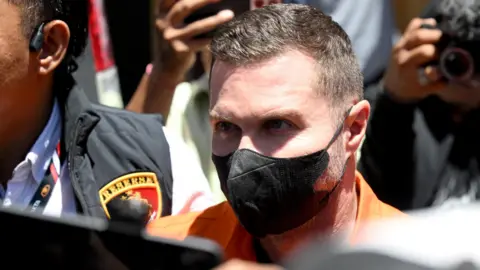
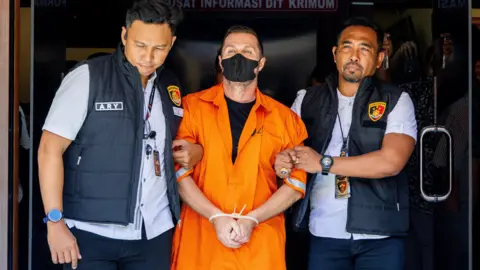
Since his arrest on 28 March he has been photographed wearing bright orange overalls, a black face mask and with his hands bound by cable ties.
 EPA
EPAAsked what he thought when he saw the images from Indonesia, Gallagher told BBC Scotland's Scotcast: "Decapitation. That's the end of the road, really, for the higher echelons of that organised crime group.
"Organised criminals operate on their reputation and the projection of power.
"Look at those images. What does that project? The ultimate weakness. The ultimate failure.
"So I think you would have to say that this looks like the end - or the beginning of the end - for that organised crime group."
Last May, Steven Lyons' brother, Eddie Lyons Jnr, and Ross Monaghan were shot dead in a beachfront bar in Fuengirola on the Costa del Sol.
Both men had spent the evening watching the Champions League final before they were targeted by a lone gunman.
Gallagher said organised crime operates on reputation, which is maintained "through fear and through example".
He added: "You have two of the top people in the Lyons crime group murdered in a very public manner in Spain.
"That sends a very strong message that this organised crime group is vulnerable."
 Spindrift
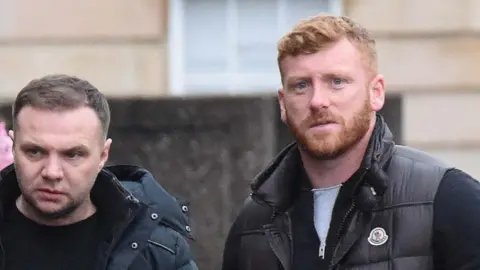
Michael Riley, 44, from Liverpool, has been accused by Spanish police of the murders.
He had challenged an extradition bid but the Crown Prosecution Service confirmed in October that he had given his consent to be taken to Spain to face prosecution.
In the days after the double shooting a Spanish detective said the suspect was a member of the rival Daniel gang.
It has been involved in a bloody feud with the Lyons group which dates back more than two decades.
The dispute was reignited in March last year as a fresh wave of gangland violence broke out in the east and west of Scotland.
A number of properties were set alight in Edinburgh and the surrounding areas before the attacks spread to Glasgow at the beginning of April.
Police Scotland launched Operation Portaledge in response and it has so far resulted in more than 60 arrests.
But at the end of last month the focus switched to South East Asia.
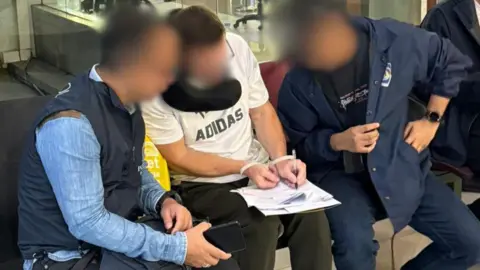
On 28 March BBC Scotland News broke the story of Lyons' arrest at I Gusti Ngurah Rai International Airport after he stepped off a flight from Singapore.
The crime boss - who was the subject of an Interpol Red Notice - was detained on the same day his wife, Amanda, was arrested in Dubai.
Their arrests came the day after a joint Scottish-Spanish operation targeted alleged members of the Lyons crime group in a series of simultaneous raids in Bellshill, Glasgow, Gartcosh, Whitburn, Caldercruix, Cumbernauld, Coatbridge, Barcelona and the Malaga area.
Bali police chief Daniel Adityajaya later told reporters Lyons was alleged to be the leader of "a large-scale transnational criminal organisation engaged in drug trafficking and money laundering".
Gallagher, who is now a criminologist, said the images of Lyons published since his arrest were hugely significant.
He added: "You look at Steven Lyons during his extradition and I've got to be honest, he looks quite sad.
"He's a wee Scottish guy in a pair of shorts surrounded by cops in a very foreign country.
"It doesn't send a message of power. It certainly doesn't send a message of control.
"It sends a message that they're extremely vulnerable.
"They've lost their senior people and their credibility in organised crime circles will be in the gutter."
 Ngurah Rai Immigration Office
The Lyons group have been involved in a bloody feud with the rival Daniel group for more than 20 years.
And in the early hours of Tuesday one of the most significant landmarks in the dispute was firebombed.
A van and two cars were set alight at Lambhill Motors on Balmore Road, in the north of Glasgow.
The garage, formerly known as Applerow Motors, became a crime scene in December 2006 when 21-year-old Michael Lyons was shot dead.
Steven Lyons was also injured in the attack, which claimed the life of his cousin, and later he left Scotland to live in Spain before re-locating to Dubai.
The fire was started hours after a 31-year-old man was stabbed in Musselburgh, Edinburgh.
It is understood both incidents are being investigated by detectives from Operation Portaledge.
Asked what is likely to happen next, Gallagher said: "Nature abhors a vacuum, so if we're having the top level people in Scottish organised crime from one side of the fence removed, then something else is going to fill that."
The ex-police officer said the most likely candidates were the Daniel crime group but he also singled out Edinburgh gangster Mark Richardson, who is nearing the end of lengthy prison sentence.
Gallagher said: "Looking back at when organised crime groups have essentially been defeated, you have a reckoning.
"So at that stage, you're going to have people in the defeated organised crime group, either looking to get out of organised crime or moving across to their rivals.
"There'll be a taking over happening, and as that happens, there will be inevitable push back into violence.
"I think it's almost inevitable that it's going to happen."
