From attic to museum floor - the rare egg collection spreading its wings

 BBC
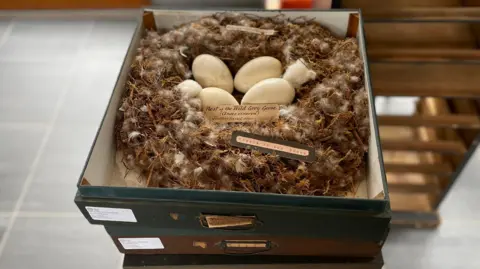
BBCWhen Paddy Mackie bought Castle Espie in 1977, he had big plans to transform the site into the wetland centre we know today – what he didn't expect was to become the owner of one the UK's largest bird egg collections.
Fifty years in the making, the collection was largely assembled by 19th-century naturalist Robert Henry Read, and transferred to Mackie when he took ownership of the historic site.
Dozens of handwritten notebooks detail Read's many journeys across Scotland and Europe. These, alongside thousands of specimens such as eggs and nests, paint a rare picture of historical bird populations.
After decades under the care of generations of Castle Espie stewards, the collection will soon be on its way to a new home in the Natural History Museum in England.
The story of the collection's survival is closely tied to the Mackie family, who owned Castle Espie until its transformation into a conservation centre managed by the Wildfowl and Wetlands Trust in the late 20th century.
When they left, the eggs came too, travelling with the family until they were eventually stored safely in an attic for half a century.
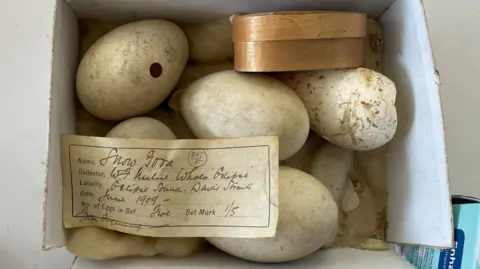
Five snow goose eggs, meticulously logged in June 1909, sit in the collection alongside an egg from the Eurasian eagle-owl, gathered in Romania in April 1891.
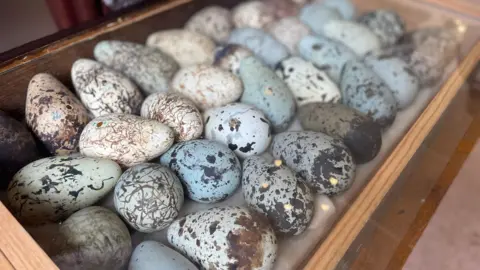
Dozens more from around the world - some speckled, some white, others a pale blue - make up the perfectly preserved collection, despite their years in storage.
Egg collecting was once a common pursuit, both for scientific research and as a hobby.
It declined during the 20th Century and has been illegal in Northern Ireland since 1985.
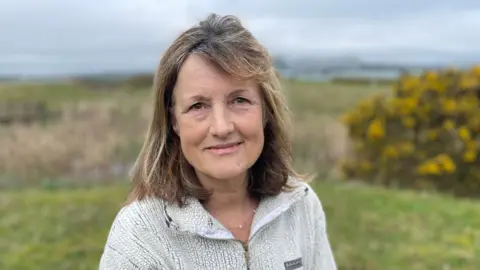
Mackie's daughter, Tara, said her father knew the importance of what he had, but it came as a surprise for the wider family.
"Castle Espie came with the collection, the previous owner had acquired it himself and had acknowledged wherever he was going next he would not be able to take all of the collection with him," she said.
"My father recognised it was important so he put it in an attic and kept it safe for the past 50 years.
"We didn't really know how important the collection was until the team from the Natural History museum arrived and said 'this may the best collection we have seen in the past 100 years'.
"This collection has been part of our family history for generations.
"Knowing it will now be preserved, studied and shared on a global stage is incredibly important to us."
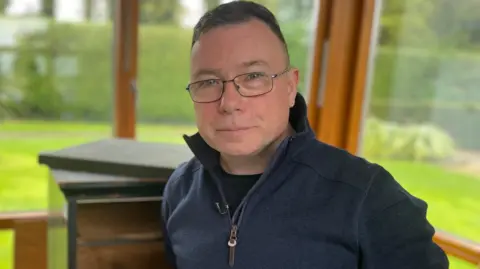
Douglas Russell, senior curator at the Natural History Museum, said the collection was exceptionally important because of its scale but also its scientific potential.
"Read's meticulous notes, alongside the specimens, provide a rare, data-rich record of historical bird populations and environments," he said.
He added that moving the collection will open new avenues for research:
"What we've got here is a moment captured in time," he said.
"We have entire nests that have been collected and frozen essentially.
"So it's our ability to go back to the 1800s, it's a time travelling system that's what is so exciting about this."
The eggs will be carefully transported to the Natural History Museum Bird Collections held at Tring in Hertfordshire.
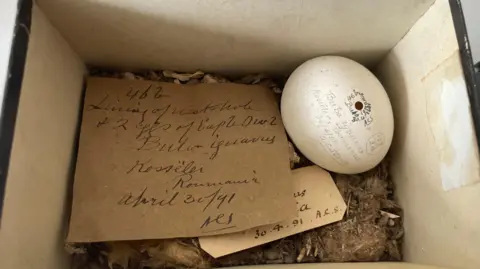
"Read was slightly unusual as a naturalist in that he collected nests and eggs together, and he was meticulous in his documentation and that's what makes all this an incredibly valuable scientific resource," Russell continued.
He said bringing the collection to the museum will allow researchers to unlock new research opportunities which will offer "powerful insights into biodiversity change and the impacts of climate change over time, and helping us better understand and prepare for future environmental change".
