I've got a motorway in my garden - it's my shelter in hot weather

 BBC
BBCNarelle Cowan and Aimee Lipley's gardens have a few things in common.
Both have pretty plants, chairs for al fresco dining - and one of the UK's busiest motorways.
About 75,000 vehicles travel over the elevated concrete monolith hanging about 45ft (14m) above their plot every day on the main route between London and south Wales.
"I call it my free gazebo," said Aimee. "I love it under here, when it's raining you can walk to the shops without getting your hair wet."
The two-lane carriageway in the sky was one of the first sections of the M4 and a relic of the 1960s motorway building boom after the explosion in post-war car ownership.
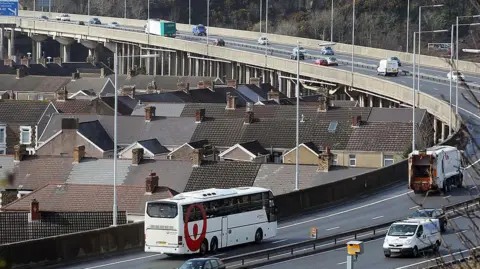
There are many examples of motorways built close to people's homes in the UK's biggest cities such as London, Birmingham and Glasgow but few are more stark than in Port Talbot where the M4 - which opened on 22 July 1966 - cuts the Welsh industrial town in half.
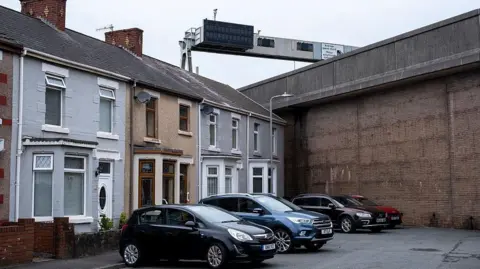
"I've got three pillars of the M4 in my back garden, I use one to help hang my washing line up," said Narelle.
"It's convenient because the motorway covers the back half of the garden so I've a dry area and it acts as my sunshade, which has been handy in recent weeks."
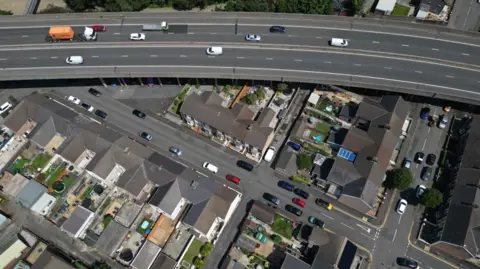
The 34-year-old mum-of-one told the BBC she "doesn't really notice vehicle noise especially when you've got the music on and enjoying yourself".
"The M4 is like a background murmur, you get used to it," added the property developer.
"I call it ambience. I know some wouldn't want a motorway in your garden but it doesn't bother me or my neighbours, we've got a lovely community and many have been around here for years and years. We love it."
This Port Talbot stretch of the M4 is a congestion hotspot which can frustrate drivers - but many passing over the 4.25 mile (6.8km) long section between Cardiff and Swansea may not think of the people living almost underneath them.

"We do get a lot of rubbish in our garden from people throwing things out of the vehicles on the overpass above," added 39-year-old Aimee, who has lived in the shadow of the M4 for eight years.
"We get to see what people are eating, sometimes you get cigarette ends and it's interesting to see what crisps people are eating."
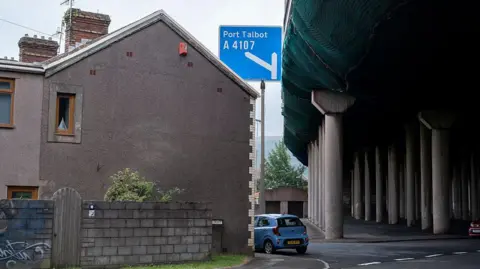
Under the section initially built as the Port Talbot bypass - before the M4 was bolted on at either end - the main noise is the rushing of the nearby River Afan.
"Yeah we hear the river and the road directly outside our house more than we've ever heard the motorway," said Aimee.
 Getty Images
"It's almost like the noise of the motorway is kept up there above us."
There's an area about 80ft (24m) wide running through the town that provides a man-made concrete canopy and a unique shelter from the elements.
"Kids can play underneath the M4 even when it's raining because they're protected," said Aimee.
"I had a childhood playing underneath the motorway. It's somewhere safe for the community."
Homes were demolished, chapels flattened and communities displaced in Port Talbot when Wales' first stretch of motorway was built at a cost of more than £5m.
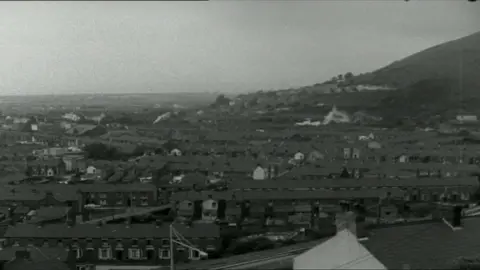
Despite imposing itself over the whole of Port Talbot with no compensation for affected locals, the motorway was widely welcomed because the old A48 main road through the town couldn't cope.
"Port Talbot was a congestion blackspot and a logical choice for Wales' first motorway," said history professor Martin Johnes.
"The A48 snaked through the town on a route that dated back to the days of horse and carts and had to cross a railway which meant it was shut for three hours a day causing tailbacks of several miles.
"The result was that for a five-and-a-half mile stretch on the A48 the average car speed was 18mph."
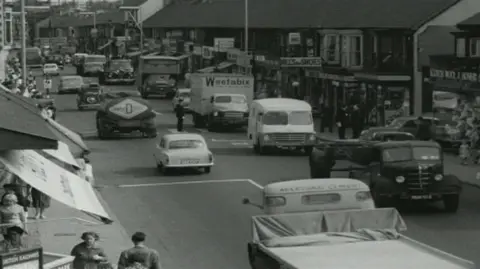
It took 13 years from the Port Talbot bypass being commissioned in 1953 to opening in 1966 when it cut journey times between Bridgend and Swansea by about 20 minutes.
Swansea University professor Johnes wrote that Wales' national newspaper, the Western Mail, produced a six-page supplement to mark the Port Talbot bypass' opening and called it a £5m miracle that would end the stop-go misery.
 Getty Images
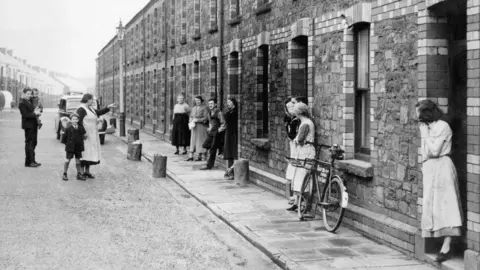
Historians recall the scheme - known locally as the road on top of a town - was seen as a symbol of progress by many although some suffered.
One side of the terraced row of houses on Llewellyn Street was demolished and replaced by the motorway, leaving the remaining side staring at either a huge concrete embankment or pillars propping up the M4.
 Moviestore Collection Ltd
Some felt the M4 had ripped the heart out of the town and a community had been broken, contributing to a feeling that disaffected locals should be compensated - and seven years later the 1973 Land Compensation Act became law.
That meant governments had to compensate people if public works like roads and aerodromes affected the value of property.
It therefore made it expensive to build so close to houses so contractors have to find cheaper routes away from urban areas.
While it may be scant consolation for those in communities around old urban motorways, bypasses like the one at Port Talbot are less likely to be built now.
 Getty Images
Many authorities have enforced a 50mph speed limit - another thing that irritates motorists.
Both Aimee and former lorry driver Narelle feel the 50mph limit on the M4 above their back gardens has reduced vehicle noise while official data shows pollution has dropped to below the legal limit.
Cutting speed on the M4 was imposed after the UK and Welsh governments were taken to court as Nitrogen Dioxide (NO2) levels exceeded legal limits around several stretches of road - including at Port Talbot.
Breathing air with high levels of NO2 can irritate airways, cause coughing, wheezing or make it difficult to breathe and worsen diseases like asthma.
 Getty Images
But since the speed limit, levels of NO2 have dropped below the legal threshold. Other factors such as vehicle efficiency and more people working from home has helped but analysis shows the limits had the biggest immediate change.
"Occasionally we could smell stuff in the air but I think that was from steelworks, not from the M4," added Narelle.
"We don't smell it any more, I guess that's because the blast furnaces have gone."
"Where we are has allowed us to get on the property ladder as the house with a driveway and garage is more affordable here than in another part of town," added Aimee.
