Female fossil hunter recognised with blue plaque

 Historic England
A blue plaque has been unveiled to honour one of the first female scientists to be employed by the Natural History Museum.
Dorothea Bate began working for the institution in 1898, aged 19, before being transferred to the museum's site in Tring, Hertfordshire, during World War Two.
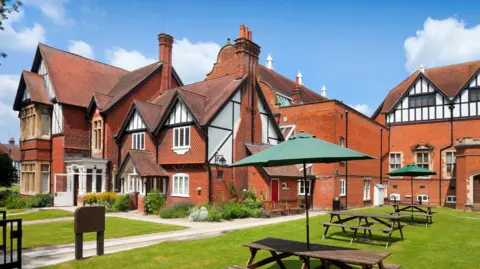
The plaque has been fixed to the wall of the original cottage on Akeman Street, facing Park Street.
Dr Sandra Knapp, director of research at the Natural History Museum, said: "The installation of this plaque not only honours her but also serves as a reminder that women have been, and continue to be, key contributors to our understanding of the natural world."
 Historic England
Bate, who died in 1951 aged 72, "transformed our understanding of prehistoric animals and ancient environments" through her research, Historic England said.
In Cyprus, she discovered a previously unknown species of dwarf elephant and in 1909, while in the Balearics, she discovered the myotragus, an extinct goat-like antelope.
She published more than 80 scientific papers, despite spending most of her career without a permanent paid position.
"As one of the first women to be employed by the Natural History Museum she was instrumental in paving the way for future women in science," said CEOs of Historic England Claudia Kenyatta and Emma Squire.
 Natural History Museum
Born in Carmarthen, Wales, in 1878, Bate developed a fascination with the natural world from an early age.
In 1900 she travelled to the Natural History Museum in London and asked for work behind the scenes despite having little formal education.
Her determination earned her a position as an assistant, beginning an association with the institution that lasted more than 50 years.
Karolyn Schindler, Bate's biographer and a scientific associate of the Natural History Museum, said: "From 1901, when she was just 22, to 1911, Bates explored the Mediterranean islands of Cyprus, Crete and the Balearics.
"In remote mountain caves and sea-battered cliffs, she discovered, against enormous odds, the fossilised remains of tiny hippos, elephants, the smallest mammoth ever discovered, and a curious little goat-like antelope unique to the Balearics."
 Trustees of the Natural History Museum
Do you have a story suggestion for Beds, Herts or Bucks? Contact us below.
Follow Beds, Herts and Bucks news on BBC Sounds, Facebook, Instagram and X.
