NASA given demonstration of robotic space rock lab

 University of Leicester
Samples from the Moon and Mars brought down to Earth could be stored and tested in a specialist space rock laboratory developed in Leicester.
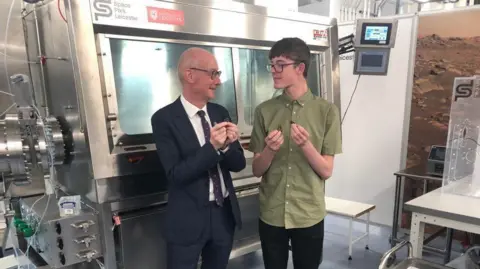
University of Leicester (UoL) scientists have created an ultra-clean miniature lab, the Double-Walled Isolator (DWI), at Space Park Leicester.
Experts from NASA and their counterparts at the European Space Agency (Esa) visited the East Midlands on Monday to see the storage and analysis system, which uses containment technology to prevent contamination and robotics for precision handling.
Originally developed for a potential mission to bring back Martian samples, NASA said the DWI could be used on future projects like its current Artemis II lunar mission.
NASA had requested to view the DWI to see how it could support future missions and was given a demonstration of a dummy sample being unpacked, weighed and repacked.
John Holt, DWI principal investigator at Space Park Leicester, said the request "underscores" NASA's interest in Leicester-developed space technologies, and said: "Over the coming years, NASA is expected to return new lunar samples, which will require efficient cataloguing and initial characterisation."
'Planetary protection'
The DWI's protection of samples is key, as the UoL said any organisms from Earth could prevent scientists from detecting any extra-terrestrial signs of life in rocks brought back from space.
The lab also offers so-called "planetary protection" as it could prevent any extra-terrestrial life from posing a risk to Earth's ecosystems.
The robotics offer a higher level of precision than human hands, which the UoL said could speed up the release of results to the scientific community.
NASA's visit to the UK also included a trip to two London-based DWI project subcontractors.
These were, curation experts The Natural History Museum, and containment specialists at the Francis Crick Institute, whose labs work with highly infectious viruses.
Listen to BBC Radio Leicester on Sounds and follow BBC Leicester on Facebook, on X, or on Instagram. Send your story ideas to eastmidsnews@bbc.co.uk or via WhatsApp on 0808 100 2210.
