'Deal with dissidents' may need to be made to increase recruitment in PSNI - Denis Bradley

 PAUL FAITH/AFP via Getty Images
The first vice-chair of the Policing Board has said that it may be necessary to make a deal with dissident republicans in order to increase recruitment from young people from nationalist backgrounds to the PSNI.
Denis Bradley said "dissidency still retains the power to frighten people away," from joining the force.
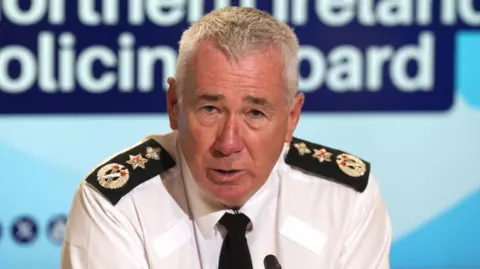
Bradley's comments come on the 25th anniversary of the Police Service of Northern Ireland (PSNI), which the Chief Constable Jon Boutcher said is a moment to look back on with "great pride".
While of the key objectives of the PSNI was to build greater community support for the police and increase Catholic officers Catholics remain under-represented in today's PSNI.
Bradley was speaking ahead of a two-day conference in Belfast marking the milestone, which is being attended by 160 delegates.
Jon Boutcher said the years had "not been without challenge" and repeated that the PSNI faces continued financial challenges, with a £1bn budget which has remained static for years.
"We have got to find a way to support policing by making sure the organisation is funded to do the job that all of us want it to do, to make sure we future proof for the next 25 years," he said.
'Residue of dissident activity remains'
A core goal of the Patten reforms was to increase Catholic and minority representation within the PSNI, speaking on Good Morning Ulster, Bradley said he finds it disappointing that it hasn't sustained.
He said a "residue of dissident activity" remained in communities.
He questioned how to get recruitment figures up and "how can young Catholics be expected to leave their homes, places of worship, local areas and join policing.
"While dissidence in some ways has faded to some great degree, it still retains a power to frighten people away" he said.
It can only be resolved by the two governments "making a deal" with the dissidents, "eliminating them" or "the dissidents themselves deciding to go away," he added.
Bradley was attacked by dissident republicans in 2005 with a baseball bat as he watched a football match in a bar. But he said that he thinks a "deal with the dissidents has to be made."
Bradley said that after some sort of political engagement, wherever it may be "policing becomes a vital cog within the wheel of change, within the wheel of peace"
He added that "policing hasn't been a complete success" but that "it has also stabilised the situation within our peace journey."
 PA Media
Speaking to the media on Tuesday morning, Boutcher acknowledged that the percentage of Catholic officers had "moved backwards" recently.
He said society, politicians and the police all needed to do more to encourage applications.
"Can I say when we will be truly representative? No I can't.
"Let's get our shoulder behind the wheel and then if we are still not making the progress we need, we will look at other options."
In March 2026, Boutcher said a return to 50:50 recruitment did not feel necessary, but "nothing is off the table".
 PA Media
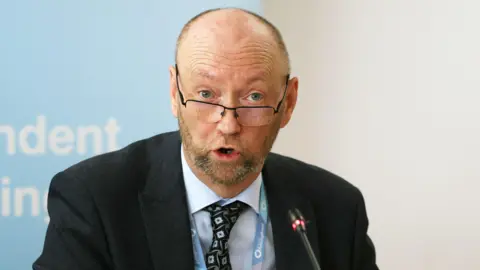
Brendan Mullan, the chair of the Northern Ireland Policing Board, said the anniversary was a "significant milestone".
He said those who worked to establish the PSNI are owed "a huge debt".
The conference, organised by the PSNI and the Policing Board, is being held at Queen's University Belfast and Ulster University.
Entitled 'Foundations And Future: Policing 2026 And Beyond' it will consider progress made over the last 25 years and examine future challenges.
The PSNI was created out of the Royal Ulster Constabulary (RUC) as a new beginning for policing, after work by Lord Patten, a former government minister.
In a video recording for the opening event, Patten, who was the last UK Governor of Hong Kong, said his work on policing was his most important job.
"I don't think there's anything I feel prouder of having done and I'm glad it has worked as well as it has," he said.
