UK economy returns to growth in May

 Getty Images
The UK's economy returned to growth in May, but the expansion was modest as businesses were affected by the impact of the Iran war.
The economy grew by 0.1%, the Office for National Statistics (ONS) said, driven by expansion in the UK's service sector, although this was offset by falls in the production and construction sectors.
May's growth comes after a slight contraction in April, and analysts said the latest figures suggested the economy had weathered the rise in energy prices caused by the conflict in the Middle East better than expected.
However, others noted the UK economy remained "fragile" and incoming Prime Minister Andy Burnham faced a challenge to boost growth.
Over the three months to May, the ONS said the economy grew by 0.7% compared with the previous three-month period.
"The economy recorded robust growth in the three months to May, though the pace eased slightly as the latest two months showed a weaker picture," said Liz McKeown, director of economic statistics at the ONS.
"Computer programming and advertising led the way, while the often-volatile pharmaceutical industry also performed well," she added.
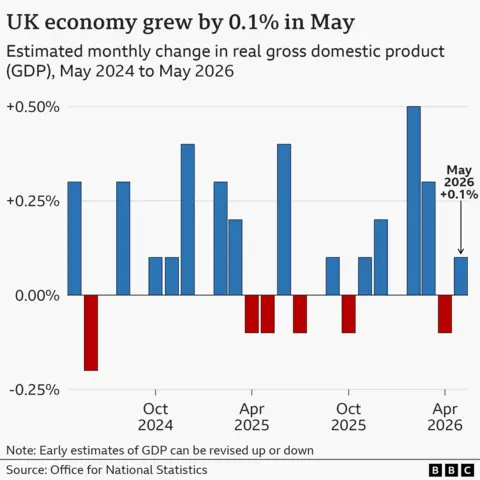
The economy saw a strong start to the year, but growth has faltered in recent months with the conflict in the Middle East having affected some businesses.
The Iran war has pushed up oil and fuel prices, and also disrupted supply chains.
The ONS said firms in a number of sectors had flagged the conflict as affecting activity, including some manufacturing industries, hospitality firms, travel agencies and entertainment companies.
Since hostilities resumed between the US and Iran last week, the price of oil has risen from about $72 a barrel to $84, although it remains well below the peak of around $120 seen earlier this year.
"Today's data confirm that growth remains fragile," said Fergus Jimenez-England, associate economist at the National Institute of Economic and Social Research.
"As energy prices climb once more, all eyes are now on the new prime minister to deliver much-needed stability."
Yael Selfin, chief economist at KPMG, said the warmer weather and World Cup might have boosted consumer spending into June and July, but this "may not be enough to offset weakness across other parts of the economy".
"The recent rise in energy prices, driven by a pick-up in tensions in the Middle East, could pose a risk to the growth outlook, with financial conditions also tightening as a result," Selfin said.
The growth in May "is not a bad welcome gift for incoming PM Andy Burnham", said Paul Dales, chief UK economist at Capital Economics.
"But with higher energy prices still restraining real incomes, he shouldn't get used to it."
Responding to the latest figures, a spokesperson for the Treasury said: "We have the right economic plan which has put the UK in a much stronger position than two years ago with the fastest growth in the G7 in the first quarter and the OECD agreeing that we have restored stability."
But Conservative shadow chancellor Sir Mel Stride said chancellor Rachel Reeves had "failed" in her attempts to boost growth.
"Two years of higher taxes have choked the economy, and now Andy Burnham wants even more taxes to pay for more benefits.
"Starmer and Reeves may be on their way out but the problem isn't just the chancellor, it's the Labour Party."


Sign up for our Politics Essential newsletter to keep up with the inner workings of Westminster and beyond.
