'Abattoirs are in crisis state and need support'

 BBC
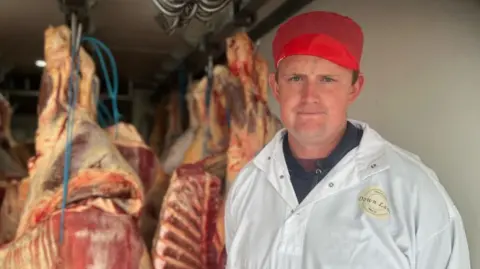
The man who runs the last abattoir in Sussex has backed the National Farmers' Union's (NFU) call for better protection for the sector which he says is in a "crisis state".
According to a joint letter, signed by the NFU and more than 150 organisations, the number of abattoirs in the UK has fallen from around 2,500 in the 1970s to approximately 200 today.
This dwindling number has prompted a call for the government to recognise local slaughter capacity as essential national infrastructure.
Luke Smith, from Down Land Traditional Meats in Henfield, said it was an "under-recognised sector" desperately in need of support.
Smith attributes the "terrible" landscape currently facing abattoirs to issues including red tape, costs, and staffing challenges.
He said: "We're covering a massive radius. It is becoming busier and busier by the week.
"At the moment, we are managing to try and support most of the farmers [who want to book], but there is still a certain percentage that we're struggling to [help]."
A Department for Environment, Food and Rural Affairs spokesperson said the government was "working closely with the sector to help relieve the financial and regulatory pressures smaller businesses face".
This included "consideration of proposals to provide support with the cost of Food Standards Agency fees", they added.
 Oliver Whitfield-Miocic/BBC
Of the 850 farmers and land managers who responded to the 2025 Abattoir Users Survey, two-thirds said they had experienced difficulty accessing suitable abattoir services, while one-third had seen an abattoir they used close.
The joint letter calls for the government to work with the industry to urgently review regulation and charging, including veterinary and inspection costs, and to establish targeted funding for local abattoirs.
In Smith's opinion, the number of small and medium-sized abattoirs has been allowed to decline because the sector is not treated as a "critical piece of infrastructure within the UK".
He said: "A lot of people love eating meat, lots of people love to know where it's come from, they love this whole story...but they don't want to realise the little bit in the middle, where it is processed."
 Oliver Whitfield-Miocic/BBC
Ed Perrett, who runs the Oaks Poultry Farm in Hassocks, shares Smith's view on the importance of abattoirs, and fears what would happen if Down Land Traditional Meats disappeared.
He said: "I [would] have to think about, economically, whether it's viable to travel further afield...[and] you've got the animal welfare to think about.
"If it closes, it would definitely have a massive impact on my business."
Perrett, who farms all types of livestock, said the loss of abattoirs would put an enormous squeeze on the entire sector.
"Without them, it would be very difficult for a lot of small holdings, and small farmers like myself, to trade and operate profitably," he added.
 Oliver Whitfield-Miocic/BBC
The Brighton and Hove Food Partnership (BHFP) is also backing this call for support, after research carried out alongside Wealden Food Partnerships highlighted how abattoirs support conservation grazing across Sussex.
Sophie Robinson, project manager at BHFP, said: "Local abattoirs are a fundamental part of a resilient local food system.
"They support farmers to sell locally, enable consumers to understand where their food comes from, and help keep more money within local communities."
Follow BBC Sussex on Facebook, on X, and on Instagram and listen to BBC Radio Sussex on Sounds. Send your story ideas to southeasttoday@bbc.co.uk or WhatsApp us on 08081 002250.
