I was in a coma for 42 days after a tick bite on a holiday to Greece

 Victoria Stellas
A woman has been left with memory loss and seizures and has to take 18 tablets a day after a tick bite on a Greek holiday left her in a coma for nearly six weeks.
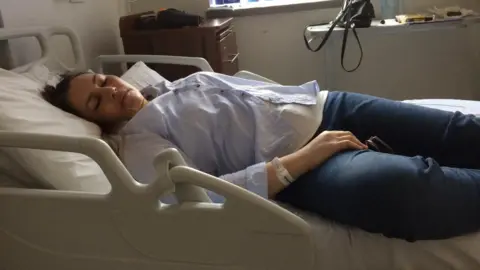
Victoria Stellas, from Anglesey, had flu-like symptoms while on the island of Syros in 2019, then - once back home - started having night seizures.
She went to hospital but "no-one knew what was wrong" so had an MRI scan and was flown by helicopter to Liverpool's Walton Centre, where she was put in an induced coma for 42 days.
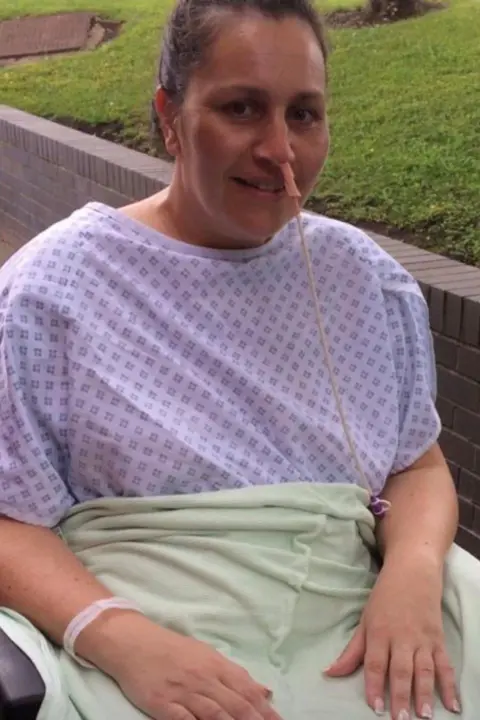
From there Victoria was diagnosed with tick-borne encephalitis (TBE), a potentially fatal brain inflammation.
"It's changed my life completely. Apart from the work I don't go out as much," the 51-year-old said.
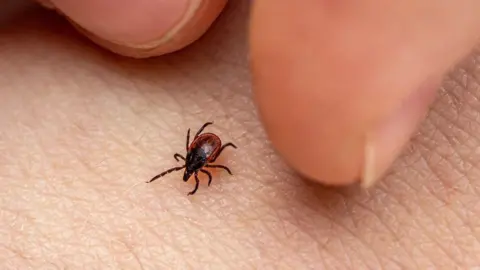
Mum-of-one Victoria believes she was bitten when she was at her brother-in-law's home as he has goats that can attract ticks.
She said: "I just kept on having seizures and no-one knew what was wrong. It was an unusual infection, and they didn't have the experts I think to diagnose this.
"Altogether it was about six months from when I was in hospital, the treatment afterwards.
"Sometimes I just keep quiet. I was outgoing before."
Victoria said she lost her jobs in a pub and as a teaching assistant at a school for children with special educational needs and disabilities, due to her symptoms.
 Victoria Stellas
She said: "Tell me a job that doesn't require memory? Everything you do in life requires a memory. Shopping, working, travelling.
"When I returned home and tried to go back to my job as a teaching assistant... I couldn't remember the names of children in different classes and staff.
"I would recognise everyone but not the names and that's still a problem to this day."
According to the NHS, TBE is a viral infection spread by bites from ticks found in Europe, Russia and parts of China and Japan.
The NHS said the risk of getting TBE in the UK was very low, as was the risk of getting seriously ill if bitten.
About a week after being bitten, symptoms include tiredness, headache and symptoms of an infection including seizures, confusion or slurred speech, and loss of movement in part of the body.
Anyone wanting to do activities in countries where infection is common should get a vaccine against TBE at least one month before visiting, the NHS advises.
Public Health Wales (PHW) said there had been no cases of anyone being diagnosed with TBE after being bitten by a tick in Wales, and "a small number of locally acquired cases" had been identified in England and Scotland since 2019.
 Victoria Stellas
Victoria, who was born and raised in Greece before moving to Wales when she was five, returns there every year for holiday but did not know about the vaccine.
She hopes to raise awareness about the infection and has urged people to make sure they get the vaccine when travelling to at-risk areas and spending time in wooded areas or around animals.
Once a year, she shares her story to students at Bangor University.
Victoria now takes between 15 and 18 tablets a day and has had to come up with strategies to remember how to do everyday tasks.
Her nocturnal seizures are now "not as regular as they were", she said, adding: "I sleep now with my mother.
"I'm lucky to have my family and my friends who've supported me throughout the years."
Liz Stellas, Victoria's mother, said: "You have to be very aware of things which seem harmless but they're not.
"Insect bites can cause profound change in your life. I don't think people are aware of it."
 Victoria Stellas
The TBE vaccine is not available on the NHS and can only be accessed privately through specialised travel health clinics and pharmacies.
PHW said: "When spending time in areas where ticks may be present, people should wear long-sleeved tops and long trousers, use an insect repellent containing DEET on exposed skin, and stay on clearly marked paths where possible.
"After spending time outdoors, it is important to check your body, clothing and pets for ticks and remove any attached ticks as soon as possible using a tick removal tool or fine-tipped tweezers.
"Prompt removal reduces the risk of some tick-borne infections."
 Getty Images
University of Liverpool professor Benedict Michael, who specialises in zoonotic infection, said the number of cases of TBE had risen across the world over the past 30 years, but a "very small number" were in the UK.
Although cases appear more in Europe and east Asia, he said it was "too broad" to pick out specific hotspots.
Michael, who also works with charity Encephalitis International, added cases like Victoria's "are fortunately relatively rare".
"Overall, you're talking about 3% of people will get a brain infection complication and 97% of people will have either no symptoms or have this relatively short-lived, albeit unpleasant, severe flu-like phase," he said.
"It's an important condition because we don't have good antiviral treatments for it.
"So when someone's developed encephalitis, like in Victoria's case, the mainstay of management is making sure they're safe and preventing seizures and those sort of complications.
"Its particularly important as it's vaccine-preventable. That's why we think it's important to raise awareness."
